Golf Drills / Practice
The Ultimate Fast Firm Course Survival Guide: 3 Things to Do Right Now
Every April, we watch the world’s best golfers navigate the lightning-fast, firm conditions of Augusta National. But what can the average golfer learn from this? This guide breaks down the pro-level strategies for mastering firm courses, from trajectory control to the art of the bump-and-run, giving you actionable tips to improve your game.
Every spring, as the azaleas bloom in Georgia, the golf world turns its attention to the masterful display of skill at the Masters. We marvel at the towering drives and the delicate chips, but the true genius of the players is often revealed in how they handle the course itself: fast, firm, and unforgiving. Playing on a fast firm course is a completely different challenge than playing on the soft, receptive golf courses many of us are used to. It requires a different mindset, a different set of shots, and a deeper level of strategic thinking.
But you don’t need to be a Masters champion to benefit from understanding these conditions. Learning to play on a firm course will make you a more complete, adaptable, and intelligent golfer. Today, we’ll break down the key adjustments you need to make, from tee to green, to not just survive, but thrive, when the course gets fiery.
The Core Challenge: Air vs. Ground
The fundamental difference between a soft course and a firm one is the role the ground plays. On a soft course, the game is played primarily through the air; you can fly the ball to your target, and it will stop relatively quickly. On a firm course, the ground becomes an active participant in every shot. You must account for bounce, roll, and the subtle contours of the terrain.
This shift requires a change in mindset. Instead of thinking “How far do I need to fly it?”, you must start thinking, “Where do I need to land it to get it to finish there?” This is a professional’s mindset, and it’s the first step toward mastering firm conditions.
Tee-to-Green Strategy: Using the Fast Firm Course to Your Advantage
Your strategy on a fast firm course begins the moment you step onto the tee box. Power takes a backseat to precision and planning.
Off the Tee: Plan for the Roll

On a soft course, the goal is often to maximize carry distance. On a firm course, total distance—carry plus roll—is what matters. A well-struck drive can roll an extra 30, 40, or even 50 yards. This can be a huge advantage, but it can also bring trouble into play that you wouldn’t normally reach.
•Trajectory is Key: A lower, more penetrating ball flight is your best friend. It will land softer and roll more predictably than a high, spinning shot that can take a wild bounce.
•Work the Angles: Use the contours of the fairway. If a fairway slopes from left to right, aim down the left side and let the ground feed your ball back to the center.
•Club Down: Don’t be afraid to take a 3-wood or even a driving iron off the tee. The extra roll may still give you plenty of distance, and the accuracy you gain is invaluable.
Approach Shots: The Art of the Release
This is where firm conditions demand the most adjustment. Firing directly at the pin is rarely the correct play. You must learn to use the ground in front of the green to your advantage.
| Shot Type | Description | When to Use |
| The Bump-and-Run | A low-running shot using a mid-to-low iron (7, 8, or 9-iron) that lands short of the green and rolls up to the hole. | The go-to shot when you have a clear path to the green. It’s predictable and minimizes risk. |
| The Low Spinner | A more advanced shot where you play the ball back in your stance with a slightly open clubface to create a low-flying shot that checks up after one or two bounces. | Useful when you need to carry a bunker or hazard but still want to control the roll. |
| The High Soft Shot | A shot with a sand wedge or lob wedge played high in the air to land as softly as possible. | Use this only when absolutely necessary, as the bounce can be unpredictable and it brings more risk into play. |
The Front-Edge Rule: A great rule of thumb on firm courses is to calculate your yardage to the front edge of the green, not the pin. Choose the club that will land the ball 5-10 yards onto the green and let it release from there. For a fantastic visual demonstration of this concept, the USGA provides excellent resources on course setup and playability that can deepen your understanding .
Around the Greens: Creativity is King
Firm, tight lies around the green can be intimidating. The fluffy lie that allows for a simple, high-spinning pitch shot is gone. Here, you must become an artist.
1. The Putter is Your Best Friend
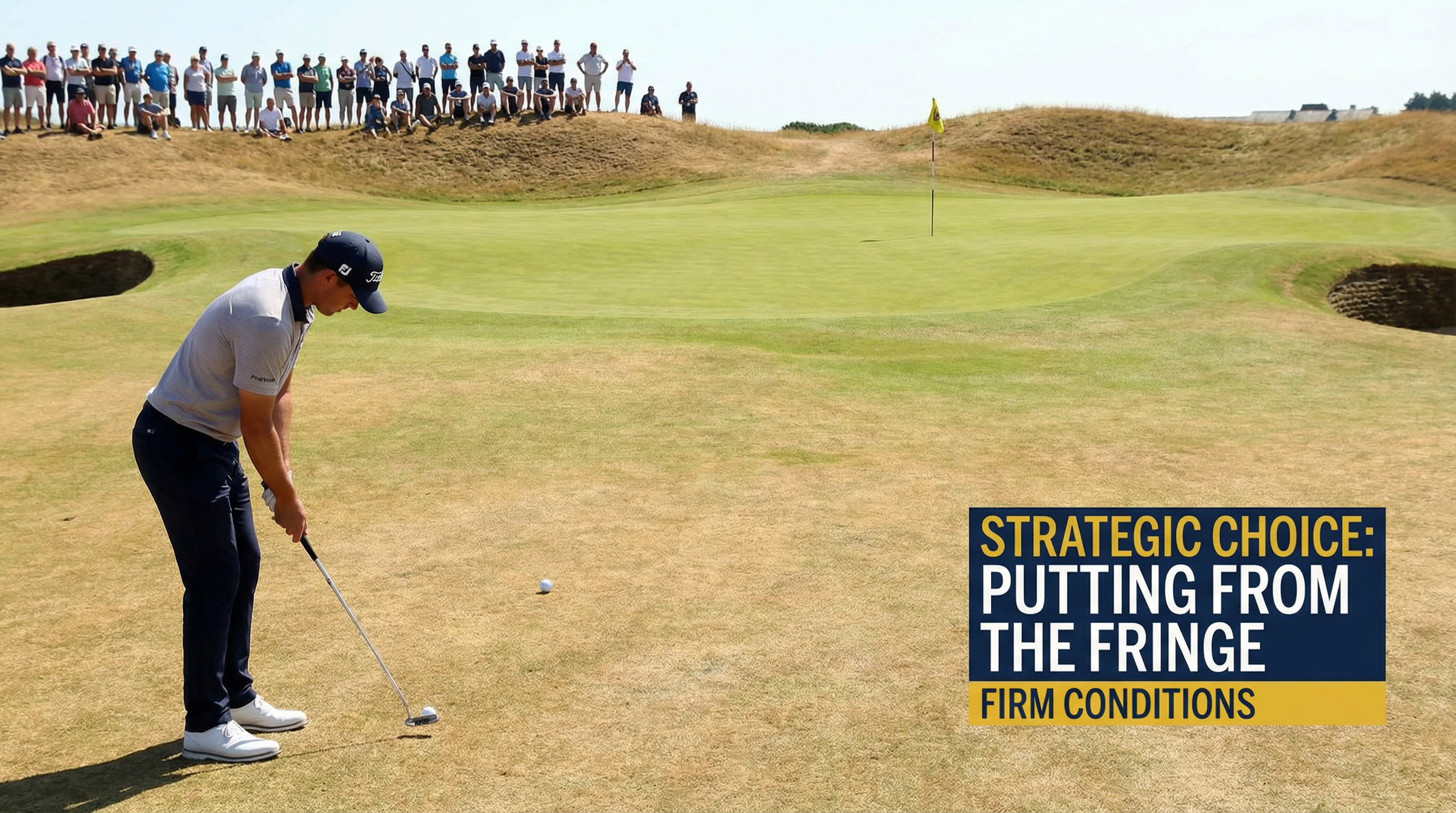
If you can putt it, putt it. From the fairway, from the fringe, from anywhere the grass is cut short—the putter is your most reliable choice. It eliminates the risk of a bladed or chunked chip and guarantees the ball will get rolling on the ground.
2. The Bump-and-Run Revisited
This isn’t just for approach shots. Using an 8-iron or a pitching wedge like a putter is an incredibly effective way to get the ball rolling on the ground quickly and predictably. There are many great tutorials on this technique, like this one from renowned instructor Rick Shiels, that can help you master this essential shot .
3. Use the Bounce on a Fast Firm Course
When you do need to pitch the ball, understanding the bounce on your wedges is critical. On firm ground, a wedge with less bounce is generally preferable as it will be less likely to skip off the turf and into the belly of the ball. Practice with different wedges to see how they interact with firm turf.
The Mental Game: Patience and Acceptance
Perhaps the biggest adjustment to playing on a fast firm course is mental. You must accept that good shots will not always be rewarded with a close look at birdie. You might hit a perfect drive that takes an unlucky bounce into the rough, or a great approach shot that rolls just a little too far.
The key is to stay patient and manage your expectations. A two-putt par is a great score. Avoiding big numbers is more important than making birdies. The player who can stay patient and embrace the strategic challenge will always have the advantage.
By learning to control your trajectory, use the ground as your ally, and think your way around the course, you’ll not only conquer fast and firm conditions but become a more complete and resilient golfer.
What’s the biggest challenge you face when playing on a firm golf course? Share your thoughts in the comments below!
Golf Drills / Practice
How to Master What Makes Augusta So Difficult
Master what makes Augusta National a timeless masterpiece with expert insights from Robert Greenfield. Learn the proven techniques the world’s best players use to navigate its treacherous greens, avoid its strategic pitfalls, and transform your game with actionable tips to apply to your home course.
In the early days of golf course architecture, a prevailing philosophy was to penalize the poor shot. But when Bobby Jones and Dr. Alister MacKenzie envisioned Augusta National in the early 1930s, they championed a more enlightened approach: to reward the well-played shot. This fundamental distinction is the key to understanding what makes Augusta National both a timeless masterpiece and one of the most formidable challenges in golf. It is a course that invites you to play, but it demands that you think.
Today, we’re diving deep into the architectural genius and strategic nuances that make Augusta National so difficult, and I’m excited to share proven techniques and historical insights that will not only deepen your appreciation for the Masters but also help transform your own game. The lessons of Augusta are universal, and understanding them can unlock a new level of strategic thinking on any course you play.
The Soul of the Challenge: Understanding Augusta’s Core Principles
When it comes to what makes Augusta National a perennial puzzle for the world’s best, the answer lies not in brute force, but in its strategic soul. The course was designed to be a mental examination as much as a physical one. Too many golfers, both amateur and professional, overcomplicate their approach by focusing on singular swing thoughts, when the truth is that success at Augusta is about understanding the core principles that make everything click.
The Illusion of Space
The first thing you notice about Augusta is its apparent openness. The fairways are wide, there is no traditional rough, and the landscape is manicured to perfection. This creates an illusion of space, a sense of comfort that can lull a player into a false sense of security. But as Geoff Ogilvy, a major champion and astute student of course architecture, once noted, “Nearly every time you hit it to the wrong side of the green or the wrong side of the fairway you have no chance, but you are given a lot of space to find out for yourself.”
This is the essence of MacKenzie’s strategic design. The course gives you room to play, but it relentlessly punishes the poorly positioned shot. A drive that finds the fairway but ends up on the wrong side can leave an impossible angle to a tucked pin, turning a birdie opportunity into a fight for par. This is the first lesson Augusta teaches us: where you are is more important than how far you are.
The Treacherous Greens: A Masterclass in Contouring
The true defense of Augusta National lies in its greens. They are, without exaggeration, some of the most complex and severely contoured putting surfaces in the world. Originally designed to be played at much slower speeds, the evolution of agronomy has turned them into lightning-fast, multi-tiered marvels that can make even the best putters in the world look foolish.
| Feature | Description | Impact on Play |
|---|---|---|
| Severe Undulations | Greens are composed of multiple tiers, ridges, and bowls. | A shot landing on the wrong tier can roll 50 feet away. |
| Extreme Speed | Often running at 13-15 on the Stimpmeter during the Masters. | Downhill putts are incredibly difficult to control; some are nearly impossible. |
| Firmness | Greens are firm and fast, making it difficult to hold approach shots. | Players must land the ball with precision on the correct spot to get it close. |
| Subtle Breaks | Many breaks are invisible to the naked eye, influenced by Rae’s Creek. | Local knowledge is paramount; even caddies can be fooled. |
These greens demand absolute precision. A shot that is just a few feet off its intended target can be the difference between a tap-in birdie and a 60-foot putt with 10 feet of break. This is the second, and perhaps most important, lesson from Augusta: your approach shot is setting up your first putt, not just your next shot.
Key Techniques to Master: Lessons from the Legends
To conquer Augusta, or at least survive it, players must master a set of skills that go beyond simple ball-striking. These are the techniques that separate the champions from the contenders.
1. The Art of the Lag Putt
On greens as fast and undulating as Augusta’s, two-putting from long distance is a victory. The key is not to try and make every long putt, but to ensure your first putt leaves you with a simple tap-in. This requires exceptional speed control and the ability to read the overall contour of the green, not just the line to the hole.
What You Can Learn: On your home course, dedicate practice time to long-distance putting. Instead of aiming for the hole, try to putt to a three-foot circle around it. This shifts your focus from making the putt to controlling your speed, which will dramatically reduce your three-putts.
2. Mastering Uneven Lies
There are very few flat lies at Augusta National. The fairways roll and tumble, meaning players are constantly hitting shots with the ball above or below their feet, or on an uphill or downhill slope. This requires exceptional balance and the ability to adjust your setup and swing on the fly.
What You Can Learn: Don’t just practice on the flat ground of the driving range. Find a sloped area and practice hitting shots from different lies. Learn how an uphill lie will make the ball go higher and shorter, and how a downhill lie will make it go lower and longer. This will prepare you for the variety of shots you’ll face on any course.
3. Strategic Course Management
Augusta is a course that requires a game plan. Players and their caddies spend days mapping out the course, identifying the ideal spots to land their drives and the areas to avoid at all costs. They know which pins to attack and which to play safely away from.
What You Can Learn: Before your next round, take a few minutes to look at the scorecard and the course map. Think about the ideal position to be in on each hole. Identify the trouble spots and make a plan to avoid them. A little bit of strategic thinking can save you several strokes per round.
Common Mistakes to Avoid: The Augusta Trap
For every moment of glory at the Masters, there are a dozen tales of woe. These are the common mistakes that have derailed countless dreams of a green jacket.
1. Chasing the “Sunday Pin”
Augusta’s pin positions are famously difficult, especially on Sunday. Many are tucked behind bunkers or on tiny shelves. The mistake many players make is getting too aggressive and firing directly at these pins, rather than playing to the safe side of the green.
The Lesson: Know your limits. If a pin is tucked, play to the center of the green and give yourself a 20-foot putt. A two-putt par is always better than a double bogey from a greenside bunker.
2. Disrespecting the Par-3 12th, “Golden Bell”
It is only 155 yards, but the 12th hole has been the site of more meltdowns than any other at Augusta. The swirling winds, the shallow green, and the presence of Rae’s Creek make club selection a nightmare. The biggest mistake is misjudging the wind and coming up short.
The Lesson: Trust your instincts, but always take enough club. It is almost always better to be long than short on a hole with water in front. And if you’re unsure, a safe shot to the middle of the green is never a bad play.
3. The Downhill Putt of Death
At Augusta, a downhill putt is often more difficult than a 40-foot uphill one. The greens are so fast that even the slightest touch can send the ball rolling 10 feet past the hole. Players who don’t give these putts the respect they deserve will pay the price.
The Lesson: When facing a slick downhill putt, your goal is to simply get the ball started on the right line and let gravity do the rest. Think of it as a long tap, not a stroke. Focus on dying the ball into the hole.

Putting It All Together: The Augusta Mindset
The journey to improving your golf game is exactly that – a journey. The lessons from Augusta National are not about rebuilding your swing or buying new equipment. They are about adopting a new mindset, one that prioritizes strategy, patience, and intelligence over brute force.
Remember: progress isn’t always linear, but every round is an opportunity to learn and get better. Stay patient, stay focused, and trust the process. The same principles that have crowned champions at the Masters can help you become a better golfer, no matter what course you play.
What lessons have you learned from watching the Masters that you’ve applied to your own game? Share your experiences in the comments below!
-
Gear Intelligence6 years agoThe Perfect Practice Putting Mat Review by Jason Tenzer
-
Field & Culture5 years agoLoophole Rule Offers PGA Tour Pros a Mulligan
-
Performance Lab5 years ago2021 Buyer’s Guide: The Top 10 Value Golf Balls For Distance & Feel
-
Entertainment5 years agoGolf Marriage Counselor
-
Gear Intelligence7 years agoTHE ADJUSTABLE IRONS: WALKING STICKS GOLF CLUBS
-
Entertainment7 years ago9 Biggest Chokes Of The Past Decade
-
Gear Intelligence5 years agoWhat Your Golf Clubs Say About You
-
Field & Culture3 months agoThe latest news in golf