Connect with us

Golf Drills / Practice

How to Build a Practice Routine for Real On-Course Scoring

Learn how to build a professional-grade practice routine that actually lowers your scores. PGA Pro guidance on block vs. random practice, course simulation, and scoring drills.

Avatar photo

Published

on

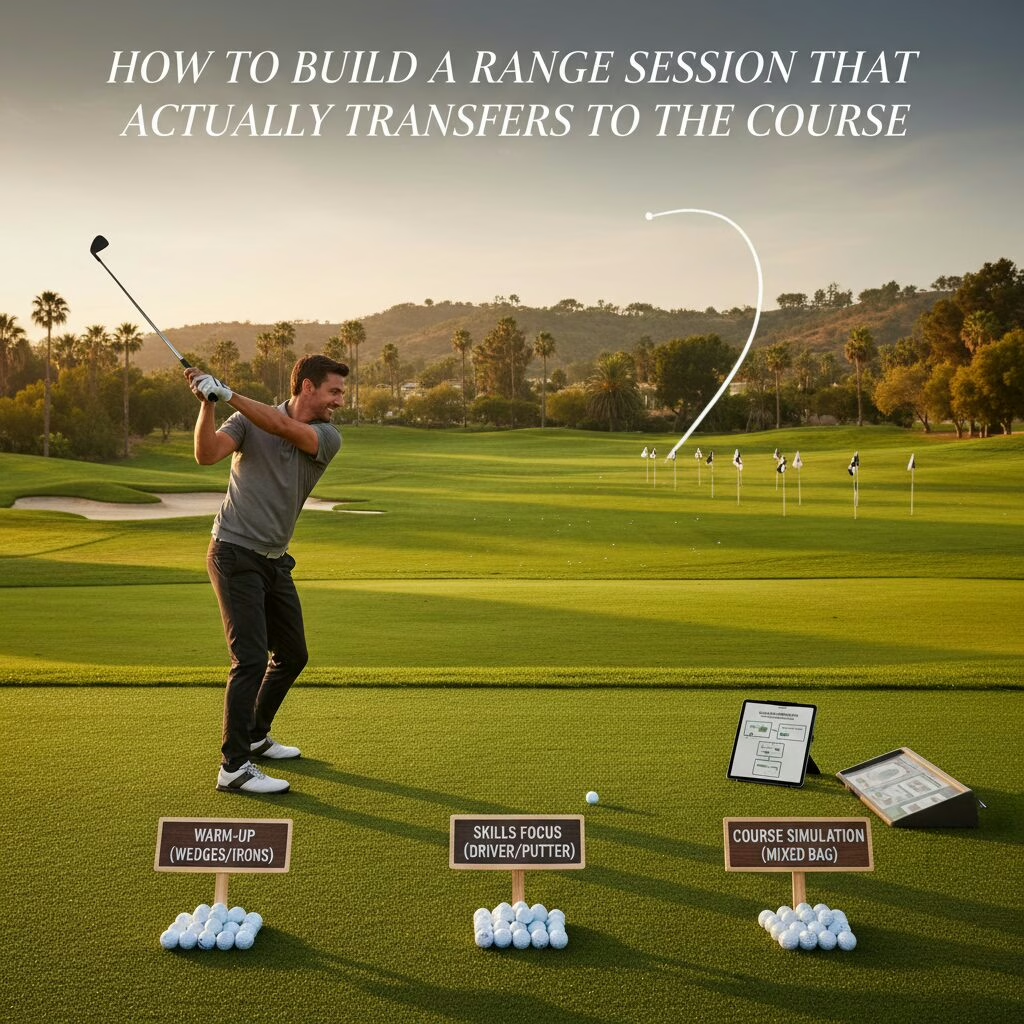
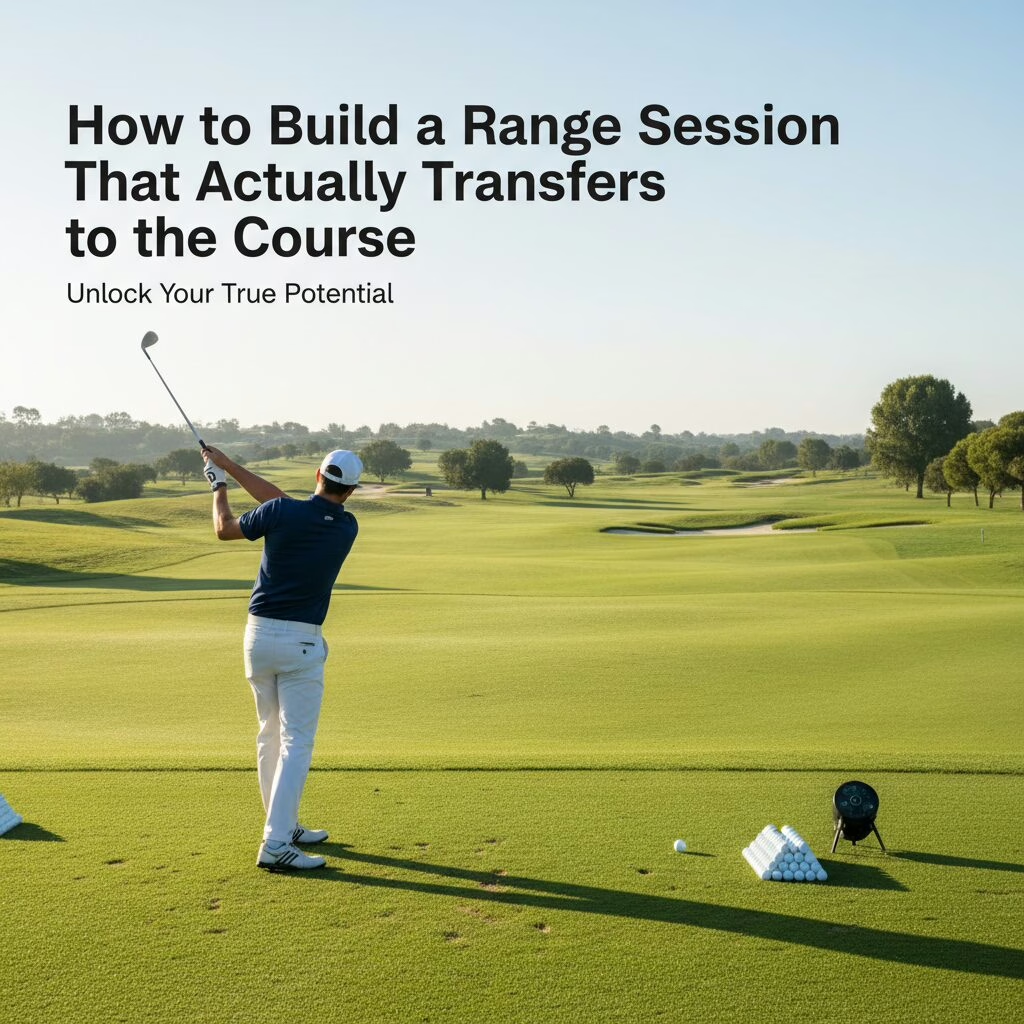
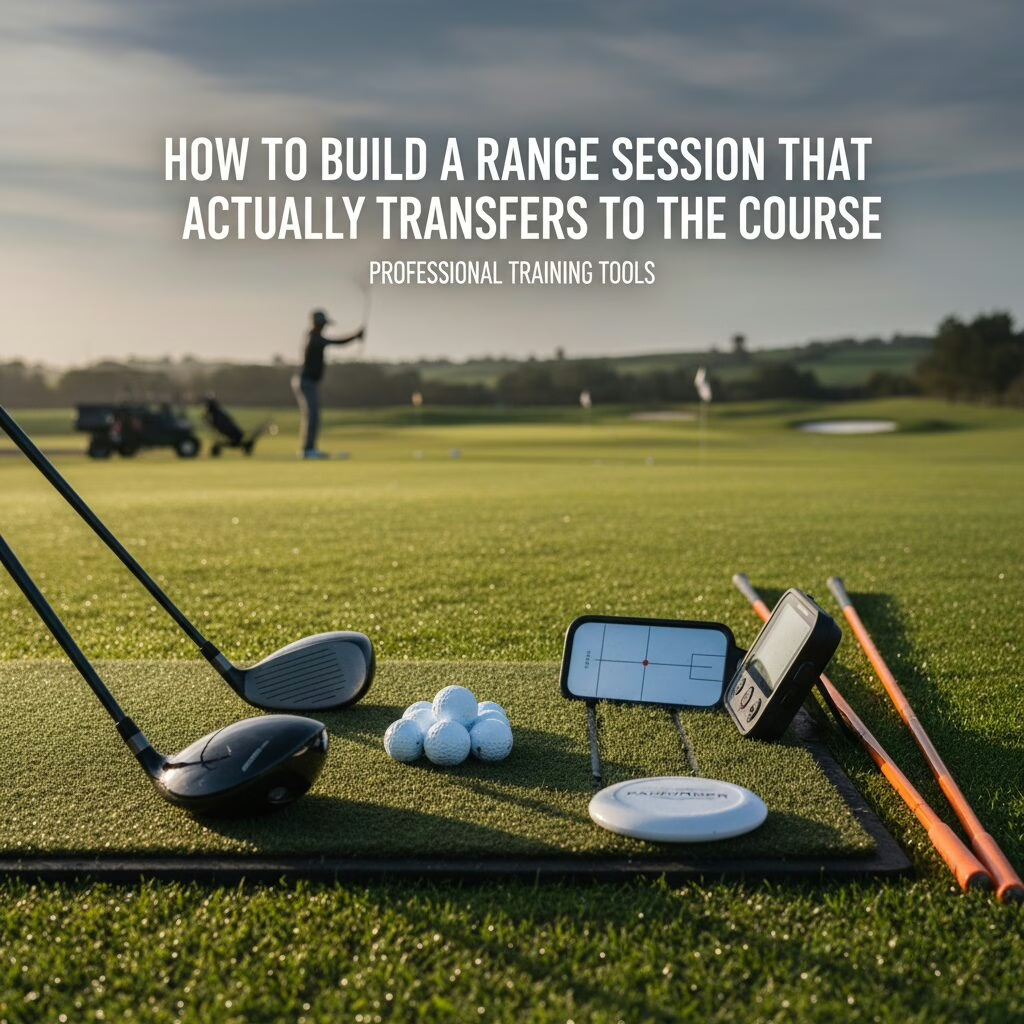
How to Build a Range Session That Actually Transfers to the Course - professional golf photography for How to Build a Range Session for Real On-Course Scoring

We have all been there before. You spend an hour at the practice facility flushing 7-irons into the sunset, feeling like you have finally unlocked the secrets of the swing. Your posture is perfect, your timing is impeccable, and your confidence is soaring. Then, you step onto the first tee the following morning and reality hits. That pure strike vanishes, replaced by a nervous twitch and a ball that refuses to find the fairway. The frustration is palpable because there is a massive disconnect between your practice and your performance. Today, I want to show you how to build a practice routine that actually bridges that gap and translates to lower scores when the pressure is on.

The key is understanding that the driving range is often a controlled environment that bears little resemblance to the game of golf itself. On the range, you have a flat lie, no consequences, and the ability to hit the same club twenty times in a row until you find a rhythm. On the course, you get one shot, a different club every time, and a lie that is rarely level. As your Resident PGA Pro, I can tell you that the secret to improvement isn’t hitting more balls; it’s hitting better balls. Let’s work through this together and transform your range time into a high-performance training session that yields results.

The Architecture of Improvement: How to Build a Purposeful Practice Routine

Most amateurs start their session by pulling the driver out of the bag and swinging for the fences. This is the fastest way to develop bad habits and potentially injure yourself. When we look at how to build a foundation for a good session, we must start with a physical and technical ramp-up. Think of this as the “calibration” phase of your practice. You aren’t trying to fix your swing here; you are trying to find your center and get your body moving in sync with the clubhead.

I always recommend starting with a high-lofted wedge. Don’t even try to hit full shots. Start with small, 30-yard pitches, focusing entirely on the quality of contact and the rhythm of your rotation. This teaches your hands and body to work together without the violent force of a full swing. Gradually increase the length of your swing until you are hitting full wedges, then move through your bag in increments—perhaps a 9-iron, then a 7-iron, then a hybrid. By the time you reach the long clubs, your tempo is established and your muscles are warm.

During this phase, keep your internal dialogue simple. Focus on one fundamental, such as maintaining your spine angle or ensuring a smooth transition at the top. The goal is to build a sense of awareness. If you start your session by spraying balls everywhere with a driver, your brain enters a state of panic. By starting small and successful, you build the neurological confidence needed for the harder work ahead. This is the first step in how to build a session that lasts.

The 15-Ball Calibration Drill

Try this specific exercise during your next warm-up: take 15 balls and divide them into three groups of five. With the first five, hit half-swing wedges focusing on a stable lower body. The next five, hit 7-irons at 75% speed, focusing on hitting the center of the face. Now the final five, hit your preferred “safety” club—the one you trust most on the course—and visualize a wide fairway. This structured start ensures you aren’t just wasting energy but are actually preparing your nervous system for the demands of the game.


Build a practice routine

How to Build Pressure Through Block and Random Practice

To truly understand how to build a transferrable skill set, we have to talk about the difference between block practice and random practice. Block practice is hitting the same shot to the same target repeatedly. It is great for making mechanical changes, but it is terrible for learning how to play golf. Random practice, on the other hand, involves changing your club, your target, and your yardage on every single swing. This forces your brain to “retrieve” the necessary movement pattern each time, which is exactly what happens on the golf course.

In a typical 60-ball bucket, I suggest spending no more than 20 balls on block practice. Use these to work on a specific technical feel your instructor has given you. Once those 20 balls are gone, the “training” is over and the “playing” begins. For the remaining 40 balls, you should never hit the same club twice in a row. If you hit a 5-iron, your next shot should be a driver or a wedge. This constant shifting prevents you from falling into a mindless groove and forces you to stay mentally engaged with every swing.

The key is to simulate the stakes of a real round. If you hit a poor shot during this random phase, don’t just grab another ball and try to fix it. Walk away, reset your grip, and choose a different club and target. This teaches you how to recover from a mistake, a skill that is far more valuable than being able to hit ten perfect 7-irons in a row. When you learn how to build this variety into your practice, the golf course starts to feel much more familiar and much less intimidating.

The Simulation Phase: Playing the Course During Your Practice Routine

This is my favorite part of any lesson and where the real magic happens. Once you are warm and have done some random practice, it is time to play a “virtual round.” Pick a course you know well—perhaps your home course or a local muni—and play the first few holes right there on the range. Visualize the first tee box. Is there out-of-bounds on the left? Is there a bunker on the right? Pull the club you would actually use and go through your full pre-shot routine.

If you hit a great drive, imagine where you would be in the fairway and pull the appropriate iron for your approach shot. If you miss the green in your mind, grab your wedge and try to hit a specific target on the range that represents the pin. This level of visualization is critical. It bridges the gap between the “range swing” and the “course swing” because it introduces the element of consequence. You aren’t just hitting a ball into an open field; you are trying to navigate a specific corridor of space.

I often see players skip their pre-shot routine on the range because it feels tedious. However, your routine is the anchor that keeps you grounded under pressure. If you have a 30-second routine on the course but a 2-second routine on the range, you are practicing two different games. Part of knowing how to build a professional-grade practice session is realizing that the routine is just as important as the swing itself. Every shot in this simulation phase must include your full process: pick the target, visualize the flight, take your breath, and execute.
Practice Routine
Practice Routine

Incorporating Skill-Based Challenges and Scoring

Golf is a game of scoring, yet we rarely keep score on the range. To make your practice more effective, you need to introduce objective benchmarks. This adds a layer of healthy stress that mimics the feeling of needing to make a par on the 18th hole. I like to use the “Fairway Challenge” and the “Green Challenge.” For the Fairway Challenge, pick two flags on the range about 30 yards apart. You have 10 balls with your driver. If the ball lands between the flags, you get a point. If it misses, you lose two points. Try to finish with a positive score.

These types of golf drills / practice routines are essential because they force you to focus on the result rather than the mechanics. In the middle of a round, you cannot be thinking about your left wrist or your weight shift; you have to think about getting the ball to the target. By gamifying your range sessions, you train your brain to prioritize the target over the technique. This is a hallmark of elite players and something every amateur should strive to emulate.

Another excellent drill is the “Up and Down Challenge” if your range has a short game area. Take one ball and move to different spots around the green. You have to get the ball into a three-foot circle to “save par.” If you fail, you have to start the sequence over. This creates a sense of urgency that is impossible to find when you are just mindlessly chipping a bag of 50 balls to a hole. Learning how to build these competitive elements into your day will sharpen your mental toughness and make you a much more formidable opponent on the weekends.

Build a practice range at home.

Conclusion: Mastering the Art of Practice

Building a range session that transfers to the course requires a shift in mindset from quantity to quality. By starting with a structured warm-up, moving into random practice, and finishing with course simulation and scoring challenges, you ensure that every ball you hit is serving a purpose. Remember, the goal of practice isn’t to feel good on the range; it’s to play better on the course. Focus on the fundamentals, stay disciplined with your routine, and don’t be afraid to make your practice difficult. The harder your practice is, the easier the game becomes.

Now that you know how to build a more effective practice routine, I want to hear from you. Which of these phases do you struggle with the most—the discipline of a slow warm-up or the mental effort of course simulation? Have you tried playing a virtual round on the range before? Let’s discuss your experiences in the comments below and help each other get better. What’s your biggest challenge with taking your range game to the first tee? Tell us below!


Continue Reading
Advertisement
Click to comment

Leave a Reply

Your email address will not be published. Required fields are marked *

Golf Drills / Practice

Stop Doing This: The Most Overrated Swing Tips and Better Drills

Tired of hearing the same old clichés at the driving range? The Golf Hacker breaks down the most overrated golf tips that are actually ruining your scorecard. From the myth of the perfectly still head to the dangers of slowing down your swing, find actionable drills that actually work.

Avatar photo

Published

on

The Most Overrated Golf Tips (And What Actually Works) - professional golf photography for Stop Doing This: The Most Overrated Golf Tips and Better Drills

Look, I’m not going to pretend I’ve never fallen for the latest YouTube swing secret or the advice of the local range rat who hasn’t broken ninety since the Clinton administration. We’ve all been there, standing on the range and trying to juggle five different swing tips because some “expert” told us it was the key to unlocking a scratch game. Here’s the deal: a lot of the advice floating around the practice tee is, quite frankly, the most overrated garbage you’ll ever hear. We spend hours grinding on things that actually make us worse golfers, all while neglecting the simple movements that actually move the needle.

I’ve spent a lot of time (and far too much money) chasing these myths. I’ve tried to keep my head still until my neck cramped, and I’ve tucked my elbow so hard I looked like a T-Rex trying to hit a wedge. It didn’t work. Modern equipment and today’s golfers have evolved, but the clichés we shout at each other on the weekend haven’t. If you want to actually lower your scores this season, we need to separate the timeless fundamentals from the fluff. Let’s break down why some of the most common advice is actually holding you back and look at the golf drills / practice routines that will actually help you find the center of the face.

Why “Keep Your Head Still” Is Among the Most Overrated Swing Tips

If I had a nickel for every time I heard a frustrated playing partner yell “Keep your head down!” after a topped shot, I’d be playing at Augusta every weekend. Let’s be honest: this is probably the most overrated of the swing tips in the history of the game. When you try to keep your head perfectly still or pinned down, you aren’t helping your contact; you’re actually killing your ability to rotate. For most of us average Joes, a “still head” leads to a collapsed follow-through and a massive loss of power. You end up looking like you’re trying to swing inside a phone booth, and the result is usually a thin shot or a nasty slice.

The reality is that almost every great pro allows their head to move slightly off the ball during the backswing and certainly allows it to rotate toward the target after impact. If you force your head to stay down, your shoulders can’t turn, your weight stays on your back foot, and you’ll never find any consistency. Instead of focusing on your head, focus on your sternum. As long as your center stays relatively stable, a little head movement is actually a good thing for a natural, athletic motion. Trust me on this, trying to be a statue is a one-way ticket to a back injury and a 105 on the scorecard.

The “Eyes to the Sky” Drill

To fix the rigidity caused by this overrated tip, try this in your next golf drills / practice session. When you hit half-swing wedges, allow your head to turn with your chest. As you strike the ball, let your eyes follow the flight immediately. Don’t stare at the grass where the ball used to be. By letting your head move naturally with your torso, you’ll find that your weight transfers more easily to your lead side. This leads to that crisp, ball-first contact we’re all chasing. It feels weird at first, but once you stop trying to be a gargoyle, the game gets a lot easier.

The Myth of the “Tucked” Lead Elbow

Another contender for the most overrated piece of swing advice is the idea that you must keep your trailing elbow pinned to your ribs throughout the entire swing. People tell you to put a towel under your armpit and keep it there. While this can help some people feel “connected,” for the average golfer, it usually results in a swing that is way too flat and stuck behind the body. When you get stuck, you have no choice but to flip your hands at the bottom to try and save the shot. Hello, snap hooks!

Today’s golfers need width. If you look at the best players in the current season, their arms have plenty of room to move. They aren’t strangling themselves by pinning their elbows to their sides. You want your arms to feel like they are swinging in front of your chest, not wrapped around it. When you create width, you create a larger arc, which translates to more speed without having to swing “harder.” It’s about efficiency, not restriction. Let those arms breathe a little bit, and you’ll find that your swing tips actually start resulting in longer drives.

The “Wide Arc” Practice Routine

Instead of the towel drill, try the “Push Away” drill. During your takeaway, focus on feeling like your hands are as far away from your right ear as possible. At the top of the swing, check to see if there is daylight between your elbow and your torso. This golf drills / practice technique ensures you aren’t collapsing. A wide swing is a powerful swing. If you’re worried about losing control, just shorten the backswing slightly while maintaining that width. You’ll hit it further with a three-quarter wide swing than a full-depth “stuck” swing every single day of the week.

Why “Slow Down Your Swing” is Often Bad Advice

We’ve all heard it after a bad hole: “You’re just swinging too fast, man. Slow it down.” This is arguably the most overrated way to fix a tempo issue. Here’s the deal: most amateurs don’t actually swing too fast; they swing with bad sequencing. When you try to “slow down,” you usually just end up decelerating through the ball, which is the kiss of death for any golf shot. Deceleration leads to chunks, thins, and a complete lack of confidence. You don’t need to be slower; you need to be smoother.

The problem is usually that the transition from the backswing to the downswing is too jerky. If you try to swing the whole club slowly, you lose the natural athletic rhythm required to hit a golf ball. You’ll see modern equipment is designed to be swung with a certain amount of force to activate the shaft’s kick. By slowing down to a crawl, you’re basically fighting the technology you paid hundreds of dollars for. Stop trying to move in slow motion and start focusing on a consistent rhythm that allows for acceleration through the hitting zone.

The 3-2-1 Tempo Drill

To improve your rhythm without losing speed, incorporate the 3-2-1 drill into your golf drills / practice. As you start your backswing, count “one, two” to yourself. The transition and the strike should happen on “three.” This creates a 2:1 or 3:1 ratio that keeps your move fluid. It’s not about how fast the total time is; it’s about the relationship between the backswing and the downswing. You can have a fast tempo like Nick Price or a slow one like Ernie Els, as long as the rhythm is consistent. This is one of those golf hacks that actually works because it focuses on timing rather than speed restriction.

The Danger of “Keep Your Left Arm Straight”

If you’re looking for the most overrated instruction that causes the most physical pain, it’s the “straight lead arm” rule. Yes, a relatively straight arm helps with consistency, but many amateurs take this to mean “lock your elbow until it turns white.” Locking your lead arm creates immense tension in your shoulders and neck. Tension is the absolute enemy of a good golf swing. When you’re tense, you can’t release the club properly, and your swing speed drops through the floor.

Look at many of the legends of the game; a slight soft bend in the lead arm at the top of the swing is perfectly fine. As long as the arm isn’t collapsing completely, you’re in good shape. The goal is a “long” arm, not a “stiff” arm. By relaxing that lead side just a fraction, you allow your wrists to hinge properly, which is where all your power comes from. If you’re struggling with a slice, check your tension levels. A rigid arm often leads to an over-the-top move because the body has to heave the club forward rather than letting it fall into the slot.

The “Rope Swing” Drill

One of my favorite golf drills / practice methods for curing a stiff arm is the imaginary rope swing. Imagine your golf club is a heavy piece of rope. If you try to manhandle a rope with a stiff, locked arm, it won’t move smoothly. You have to use a fluid, rhythmic motion to get the weight of the rope moving. Practice making swings with this “soft” feeling in your arms. You’ll notice the clubhead actually feels heavier. That’s a good thing! It means you’re finally letting the centrifugal force do the work instead of trying to muscle the ball into the next fairway with your triceps.

Pick up some practice gear for yourself.

Conclusion: Focusing on What Swing Tips Actually Matter

At the end of the day, golf is hard enough without trying to follow the most overrated advice that doesn’t fit your natural body movement. We’ve covered why keeping your head still can ruin your rotation, why pinning your elbow kills your width, why slowing down can lead to deceleration, and why a stiff lead arm is a recipe for tension. The key takeaways are simple: stay fluid, create width, maintain a consistent rhythm, and let your body move athletically. Forget the clichés you hear at the local muni and focus on these golf drills / practice routines that prioritize sequence and impact over “positions.”

I’ve wasted years trying to look like a textbook, only to realize the textbook was written for someone with a lot more flexibility and a lot more free time than I have. Start practicing with intent and stop listening to the “overrated” swing tips that keep you stuck in the triple digits. What are your favorite swing tips that actually worked for you? Or better yet, what’s the worst piece of advice you’ve ever been given on the course? Share your stories in the comments below—I’d love to hear I’m not the only one who’s been led astray by a well-meaning playing partner!

Continue Reading

Trending