Drills
The Mental Game of Golf: Mastering the Psychology Behind Lower Scores


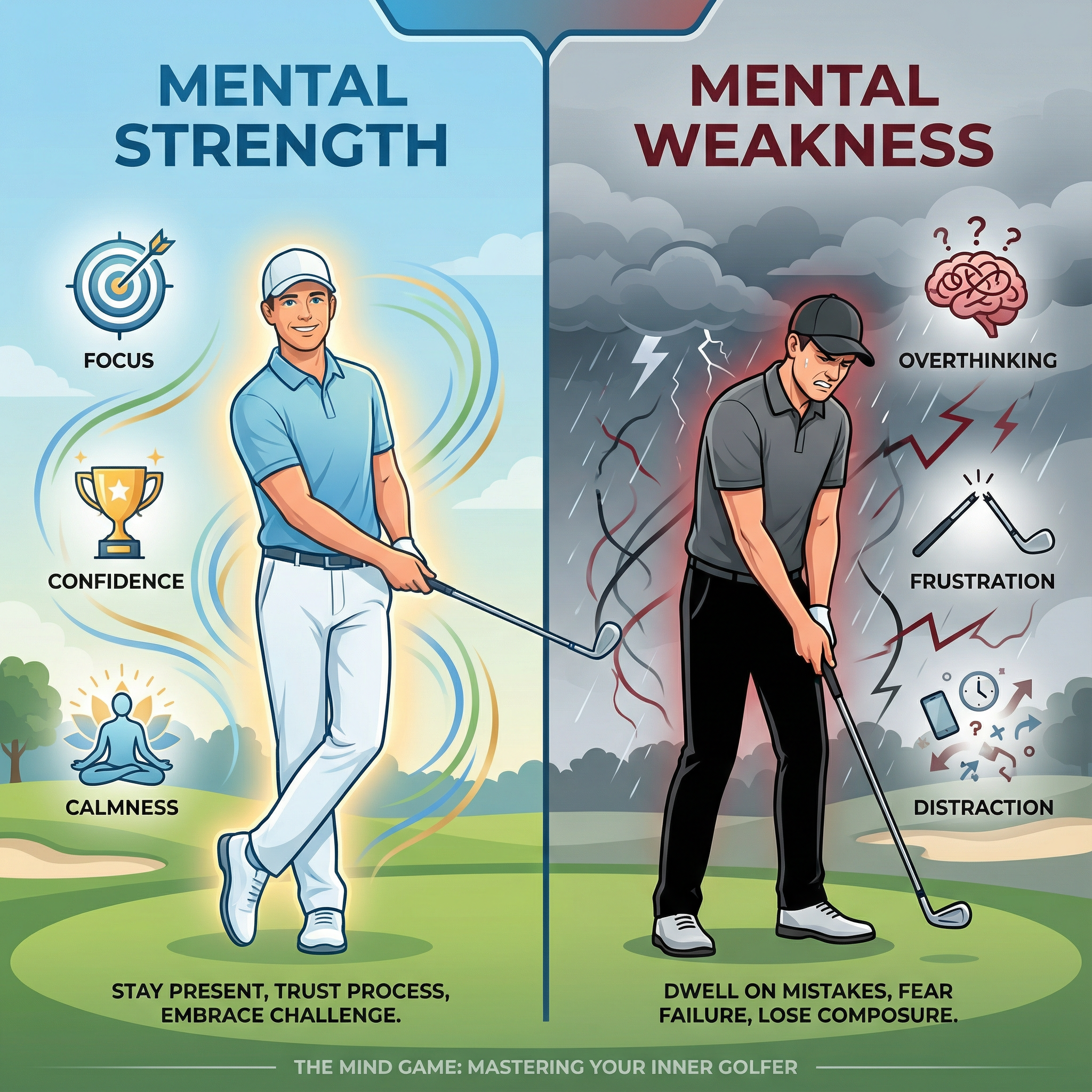
It’s a scenario every golfer knows intimately: you’ve just striped a perfect drive down the middle of the fairway, only to follow it up with a chunked iron shot that barely advances the ball. Frustration mounts, your focus shatters, and the rest of the hole—and perhaps the round—unravels. While we often blame our swing mechanics for these inconsistencies, the true culprit frequently lies between our ears. Research consistently shows that the mental game accounts for a staggering 70-90% of performance in golf . Yet, despite its monumental importance, studies reveal that only about 14% of golfers regularly practice their mental skills .
This article is designed to change that. We will explore the critical role of psychology in golf, break down the most common mental errors that sabotage your scores, and provide you with professional-grade techniques and practical drills to build an unshakeable mental game. By the end, you will have a clear roadmap to not only lower your handicap but also to find more joy and resilience on the course.
Why the Mental Game is Your Most Important Club
In golf, a quiet mind is a powerful asset. Your mental and emotional state directly influences your physical capabilities. When you are calm, focused, and confident, your body is relaxed, and your swing can flow freely and naturally. Conversely, when you are anxious, angry, or distracted, your muscles tighten, your coordination suffers, and your swing mechanics break down. This isn’t just a feeling; it’s a physiological reality. Negative emotions trigger a fight-or-flight response, which is fundamentally at odds with the fine motor control required for a successful golf shot .
A 2025 systematic review on mental fatigue in golf further highlights this connection. The research found that prolonged mental exertion during a round directly leads to a decline in performance, affecting everything from driving distance and iron accuracy to, most significantly, putting . Every decision, every calculation, and every moment of frustration depletes your cognitive resources, making it harder to execute shots as the round progresses. Mastering the mental game is therefore not just about thinking positively; it’s about efficiently managing your mental energy.
The 5 Mental Mistakes Costing You Strokes (and How to Fix Them)
Based on extensive analysis of amateur golfers, sports psychologists have identified several recurring mental errors. Here are five of the most common, along with strategies to overcome them, adapted from the work of mental game coach David MacKenzie .
Mental Mistake Description The Fix 1. Analyzing Your Swing Constantly dissecting your mechanics on the course, trying to “fix” your swing mid-round. Trust the swing you brought. The course is for playing, the range is for practicing. Focus on your target and let your body execute. If you need a swing thought, use a simple rhythm cue like “one-two-three.” 2. Obsessing Over Score Tying your emotional state to your score on every hole, leading to a rollercoaster of feelings. Focus on the process, not the outcome. Your goal for each shot should be to execute your routine flawlessly. The score will take care of itself. 3. Negative Self-Talk Berating yourself after a bad shot, which lowers confidence and increases tension. Become your own best caddy. After a poor shot, offer yourself the same encouragement you would a friend. Develop a post-shot routine that involves acknowledging the feeling, taking a deep breath, and moving on. 4. Vague Targeting Aiming for a general area like “the fairway” or “the green” instead of a specific point. Pick the smallest possible target. Top professionals aim at incredibly precise spots, like a specific tree branch or a single blade of grass. This sharpens focus and improves accuracy. 5. Neglecting Your Routine Lacking a consistent pre-shot and post-shot routine, leading to inconsistent mental preparation and reaction. Make your routine your primary goal. A well-defined routine is your mental armor against pressure. It ensures you are committed to every shot and can handle any outcome.
Building an Unshakeable Mental Game: Pro-Level Techniques
Top professional golfers are masters of the mental game. They employ specific techniques to stay focused, confident, and resilient under immense pressure. Here are a few you can incorporate into your own game.
The Power of a “Pre-Shot Creation”
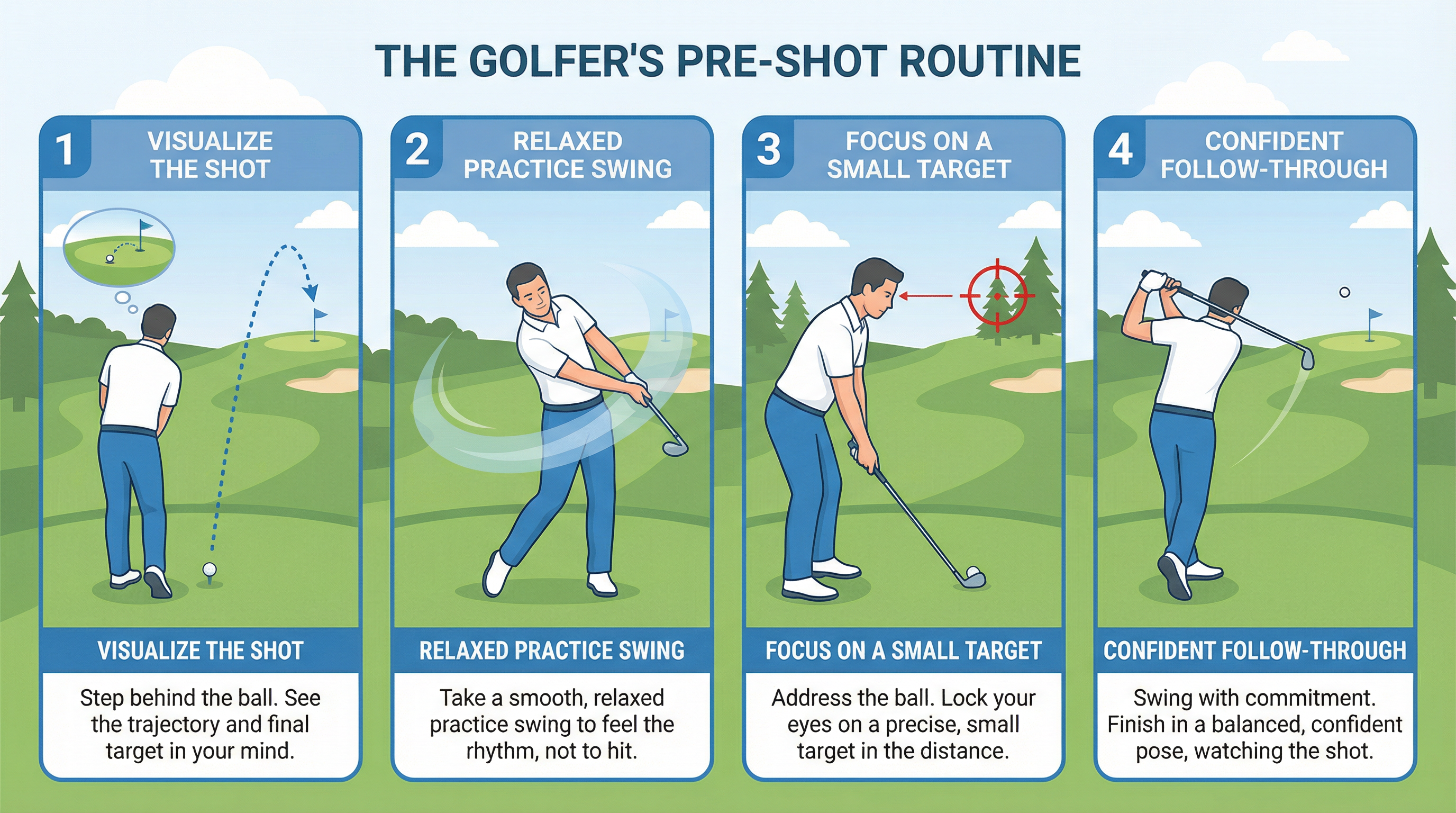
Instead of a rigid, robotic pre-shot routine, think of it as a “pre-shot creation.” This concept, inspired by the approach of players like Tiger Woods, reframes the process as an artistic and imaginative one . Rather than just going through the motions, you should feel the shot, engage your senses, and become genuinely interested in the unique puzzle each shot presents. This fosters a state of deep presence and curiosity, quieting the analytical mind.
Tiger Woods worked extensively with navy psychologist Dr. Jay Brunza early in his career, developing what he called “game training.” Woods emphasized the importance of bringing attention to “THIS SHOT in THIS moment” and described feeling the shot in his fingers rather than relying solely on visualization. At his best, Woods found a way to be immensely interested in each shot, playing from a position of curiosity rather than anxiety .
Mastering Your Mind: Awareness Over Control
One of the biggest paradoxes in golf psychology is that trying to control your thoughts often backfires. Telling yourself “don’t hit it in the water” only makes the water a more prominent feature in your mind . The key is not to suppress negative thoughts but to change your relationship with them through mindfulness and awareness. Acknowledge the thought without judgment, and then gently guide your focus back to your target and your breathing. The best players don’t have fewer negative thoughts; they are simply more skilled at not letting them take over.
Research shows that the average person has approximately 70,000 thoughts per day, with more than two-thirds being negative . The difference between elite golfers and amateurs is not the quantity of negative thoughts but how they respond to them. Elite players have developed the skill of awareness—noticing thoughts without becoming entangled in them—allowing the thoughts to pass like clouds in the sky.
Breathe Like a Champion
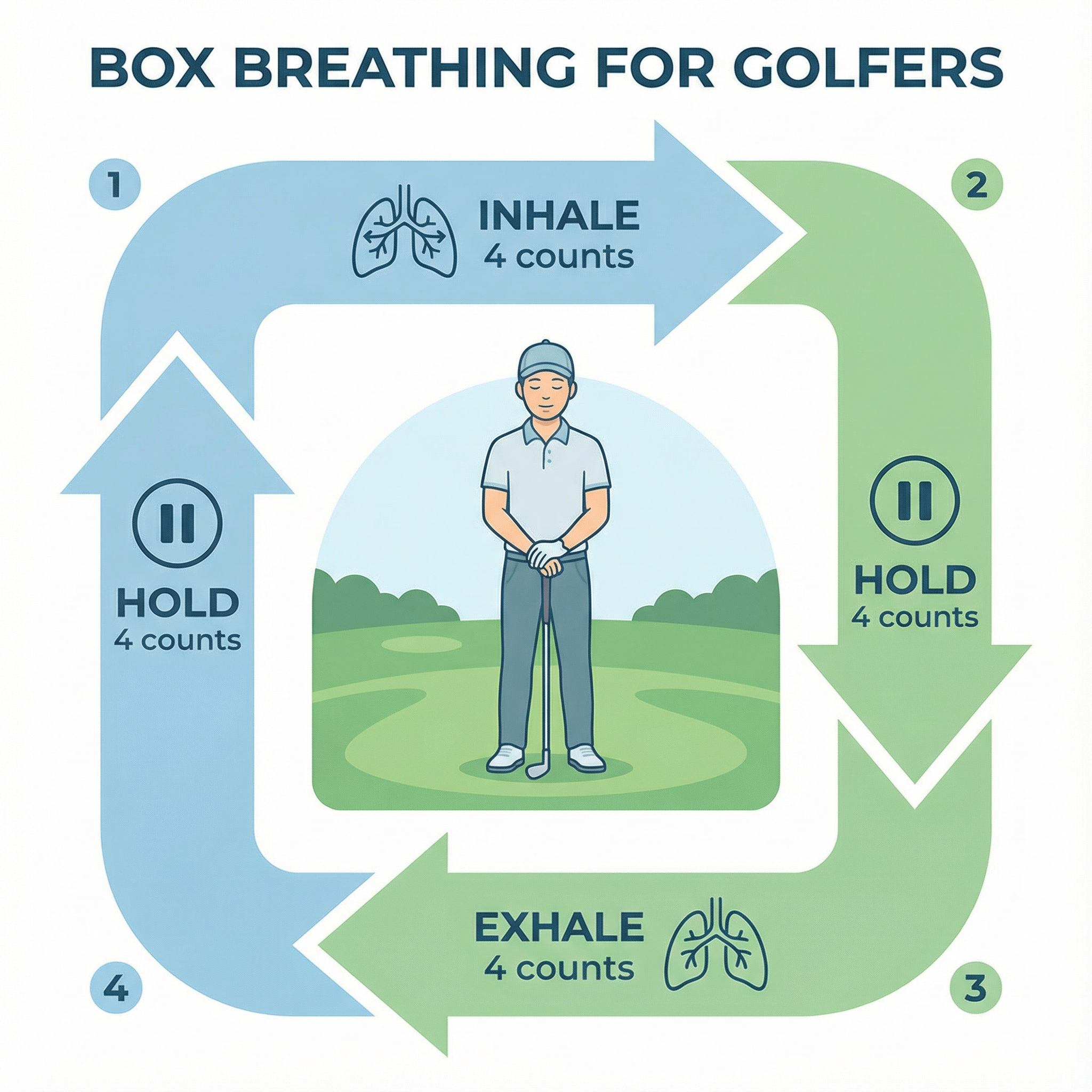
Breathing is one of the most powerful and simple tools for managing your physiological state. When you feel pressure mounting, your breathing becomes shallow and rapid. By consciously slowing it down, you can signal to your nervous system that it’s time to calm down. A popular and effective technique is Box Breathing:
1.Inhale slowly for a count of four.
2.Hold your breath for a count of four.
3.Exhale slowly for a count of four.













4.Hold your breath for a count of four.
Repeating this cycle just a few times can significantly lower your heart rate and reduce muscle tension, allowing you to approach the shot from a state of calm focus .
The Science Behind Mental Training
Recent research validates what professional golfers have known intuitively for decades. A brain training study conducted with UCLA Golf demonstrated remarkable results: participants increased their greens in regulation by 12% and decreased three-putts per round by 9.7%. Perhaps most impressively, these improvements were sustained eight weeks after the training concluded . This demonstrates that mental skills, like physical skills, can be trained and improved with consistent practice.
A 2024 neuroscience study revealed that expert golfers exhibit distinct brain activity patterns during successful putts compared to unsuccessful ones. The research emphasized that mental preparation—not just physical technique—is the key differentiator between making and missing putts . This finding underscores the importance of developing a consistent mental routine before every shot.
Putting It Into Practice: Drills for a Stronger Mind
Improving your mental game requires consistent practice, just like your swing. Here are a few drills you can incorporate into your routine:
Pressure Putting Drill: Place three balls at 3, 6, and 9 feet from the hole. You must make all three in a row to complete the drill. If you miss, you start over. This simulates pressure and forces you to focus on your routine for each putt. As you improve, increase the difficulty by adding more balls or extending the distances.
Mindfulness on the Range: During your practice sessions, take a few moments between shots to simply be present. Feel the grip in your hands, notice the breeze, and listen to the sounds around you. This trains your ability to stay in the present moment, which is essential for peak performance on the course.
Post-Round Journaling: After each round, take five minutes to write down one thing you did well mentally and one mental challenge you faced. This builds self-awareness and helps you identify patterns in your mental game. Over time, you will notice recurring themes that you can address in your practice.
Target Practice with Consequences: On the range, pick a specific target for every shot—not just a general area. If you miss your target, perform a small penalty like five push-ups or hitting the next shot with your opposite hand. This adds consequences to your practice, making it more similar to on-course conditions where every shot matters.
Key Takeaways for Your Next Round
As you prepare for your next round, keep these fundamental principles in mind:
Trust over control. The more you try to consciously control your swing, the more tension you create. Trust the swing you have practiced and let your body execute naturally.
Process over outcome. Make your pre-shot routine your primary goal for every shot. When you focus on executing your process flawlessly, good scores follow naturally.
Awareness over suppression. You cannot eliminate negative thoughts, but you can change your relationship with them. Notice them, acknowledge them, and gently return your focus to the present moment.
Precision over generality. Always pick the smallest possible target. This sharpens your focus and gives your subconscious mind a clear objective.
Compassion over criticism. Treat yourself with the same kindness and encouragement you would offer a playing partner. Negative self-talk only compounds mistakes and drains your confidence.
Conclusion
The journey to mastering the mental game of golf is ongoing, but it is one of the most rewarding pursuits in the sport. By understanding the profound impact of your mind on your performance, recognizing common mental errors, and consistently practicing proven psychological techniques, you can unlock a new level of consistency, resilience, and enjoyment on the golf course. Remember, the next time you step onto the tee, your most powerful tool isn’t in your bag—it’s in your head. The difference between a good round and a great round often comes down to how well you manage the six inches between your ears.
Start small. Pick one technique from this article—perhaps developing a consistent pre-shot routine or practicing Box Breathing before important shots—and commit to it for your next three rounds. Track your progress, notice the changes, and gradually incorporate additional mental skills into your game. The mental game is not a quick fix, but a lifelong practice that will serve you well both on and off the course.
References
[1] NeuroTrackerX. (2023, December 1). Why Golf Performance is 90% Mental.
[2] McCarthy, P. (2025, November 8). The Mental Game of Golf: Pro Secrets You Haven’t Heard Before.
[3] Colorado Senior Golfers’ Association. The Brain Game – Spring Edition.
[4] McCarthy, P. (2025, November 8). The Mental Game of Golf: Pro Secrets You Haven’t Heard Before.
[5] Pan, X., et al. (2025). Mental fatigue in golf: A systematic review. PLOS ONE.
[7] Mind Caddie. (2025, November 9). Tiger Woods’ Mental Strategies.
[9] MyTPI. Mental Game: Brain Training Study With UCLA Golf.
[10] PsyPost. (2024, August 15). Golf: New neuroscience study reveals the secrets of better putting.