Performance Lab
Indoor Putting: The 15-Minute Winter Routine That Protects Your Stroke
Six drills, fifteen minutes, one rug. The indoor putting practice routine that keeps your stroke sharp from November to the first spring round.

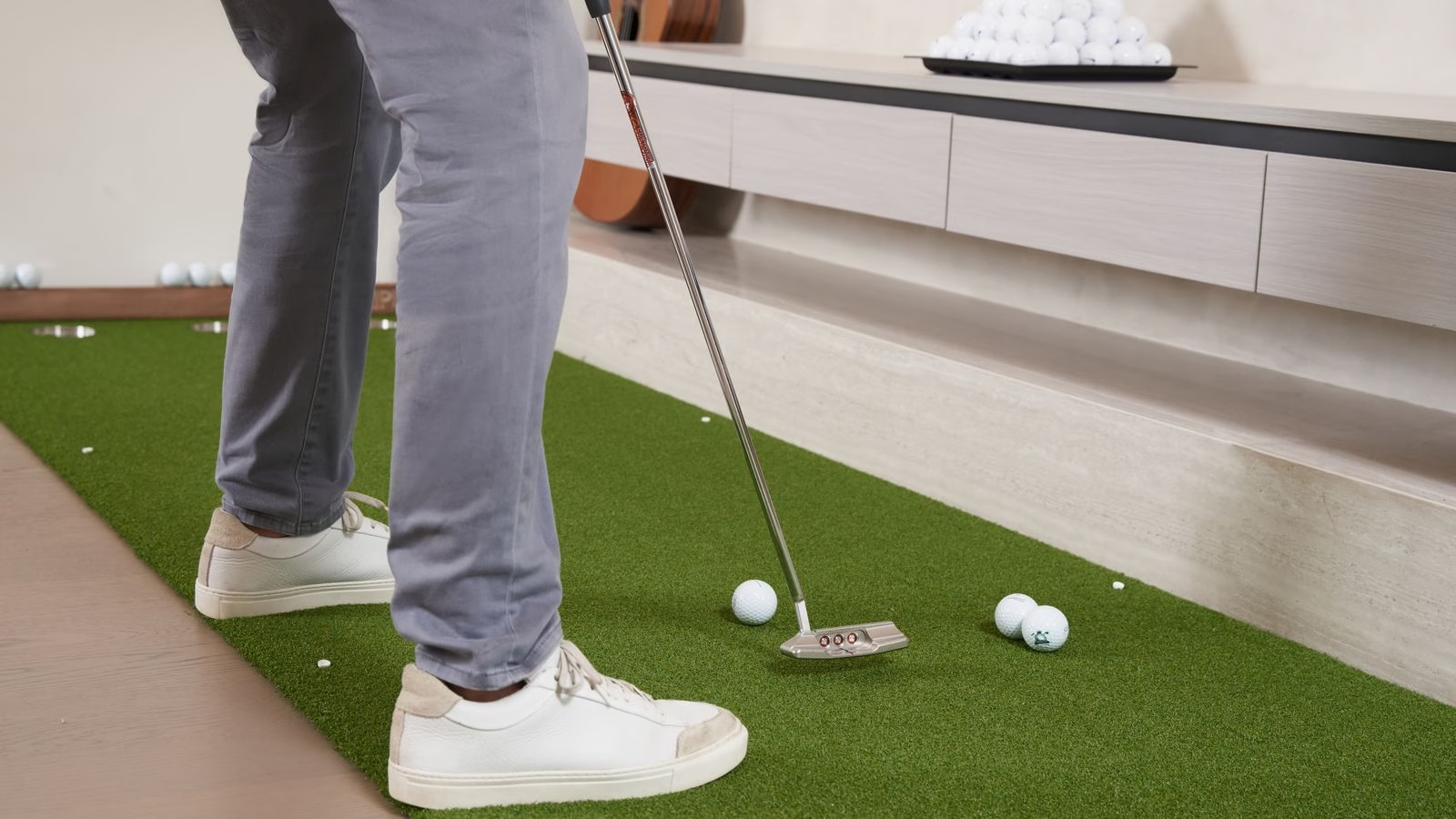
ClickitGolf earns a commission on some purchases made through links on this page, at no extra cost to you. As an Amazon Associate we earn from qualifying purchases.
Your swing will survive the winter. Your putting stroke will not.
Full swing feel comes back after a bucket or two in March. Putting is different. It lives on tiny things, like where the face points at impact and how far a ball rolls for a given stroke, and those fade fast when you stop rolling putts. This indoor putting practice routine takes 15 minutes, needs about eight feet of floor, and protects the parts of your stroke that cost you the most strokes in spring.
Do it three or four times a week. That is the whole commitment.
What an Indoor Putting Practice Routine Can and Cannot Do
Let’s be honest about the limits first. A living room will not teach you to read a double-breaking 40-footer. There is no slope, no grain, and no wind.
What it does do is protect three things: start line, speed control, and nerve on short putts. Those are the skills that slip in the offseason, and they happen to be the ones that turn into three-putts. Every drill below targets one of them.
The 15-Minute Indoor Putting Practice Routine
Six drills, run in this order. The order matters. You start with mechanics, move to speed and feel, and finish under pressure, which is how a good warm-up works on the course too.
Drill Time What It Protects 1. Gate Drill 3 min Start line 2. Coin Drill 2 min Centered contact 3. Speed Ladder 3 min Distance control 4. One-Hand Putts 2 min Feel and face control 5. Eyes-Closed Putts 2 min Trusting your stroke 6. Pressure Finish 3 min Nerve on short putts
Drill 1: The Gate Drill (3 Minutes)
Set two tees, or two pencils on a mat, just wider than your putter head, about six inches in front of the ball. Roll putts through the gate without touching either side. Start from four feet.
What it protects: your start line. If the ball starts on line, a lot of putts take care of themselves. If it clips the gate, your face is open or closed at impact, and the gate tells you which way instantly. A putting mirror with tee slots, like the EyeLine below, builds the gate for you so you are not chasing tees around the carpet.
Drill 2: The Coin Drill (2 Minutes)
Place a coin on the floor and set the ball on it, or just putt the coin itself. Strike it so it rolls end over end without wobbling or skidding sideways.
What it protects: centered contact. Off-center hits lose speed and twist the face, and you rarely feel it on a full-size green. A coin exaggerates every mishit. If it rolls true, your strike is clean.

Drill 3: The Speed Ladder (3 Minutes)
Lay a towel or a book at the end of your space as a backstop. Putt one ball to 3 feet, one to 5, one to 7, then try to stop the next ball between the last one and the backstop. Start over if any ball touches the backstop or comes up short of the one before it.
What it protects: distance control. Most three-putts are a speed problem, not a line problem. Our seven drills for stopping three-putts on real greens pick up where this one leaves off once the course opens.
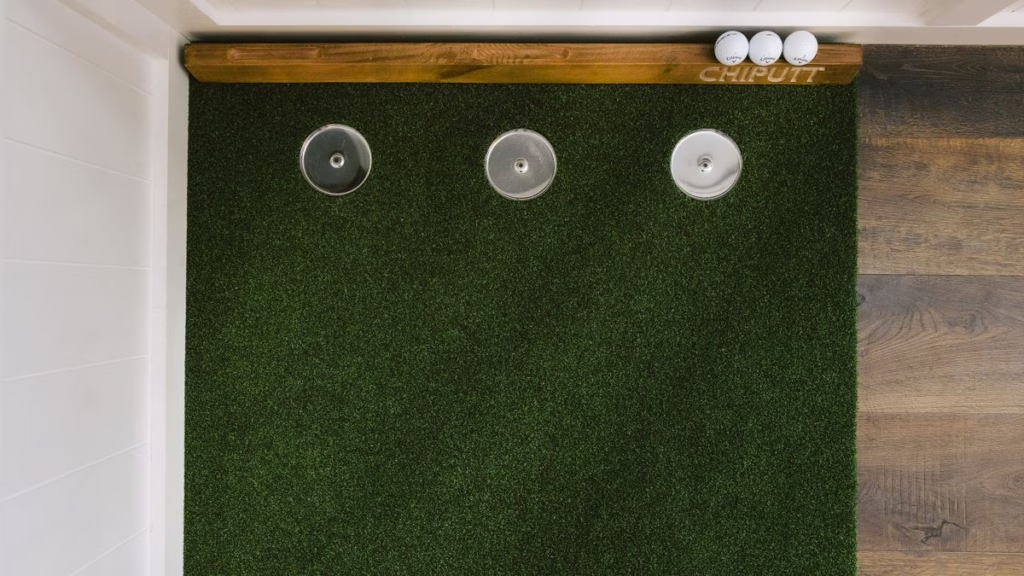
Drill 4: One-Hand Putts (2 Minutes)
Hit five putts from three feet with only your lead hand, then five with only your trail hand. Keep the stroke short and smooth.
What it protects: feel and face control. Your lead hand governs the face, and your trail hand governs pace. Isolating them shows you which one is taking over, and it rebuilds touch that fades fastest when you stop playing.
Drill 5: Eyes-Closed Putts (2 Minutes)
Set up to a four-foot putt. Look at the target, look back at the ball, close your eyes, and stroke. Before you open them, call it: short, long, left, right, or in.
What it protects: trust. With your eyes closed you cannot steer the putter, so you feel the stroke you actually make. Calling the result before you look trains your body to know where the putt went, which is a skill good putters lean on every round.
Drill 6: The Pressure Finish (3 Minutes)
Ten putts from three feet. You must make all ten in a row. Miss one and you start over. If you make all ten before time is up, move back to four feet.
What it protects: nerve. The 10th putt feels different from the 1st, and that feeling is the point. You are rehearsing the three-footer you need on the last hole of a match. A ball return trainer keeps this drill moving because you are not walking to the cup after every putt. Check today’s price on Amazon.
Carpet vs. Mat: Adjusting for Speed
Here is the trap. Every indoor surface rolls at a different speed, and most do not match the greens you play.
Low-pile carpet usually rolls fast and true. Thick or shag carpet is slow and bumpy, and it will teach you to hit putts too hard. A dedicated putting mat gives you a consistent surface, and many manufacturers list a target green speed on the product page. Check the listing before you buy. Green speed is measured with a USGA Stimpmeter, and the number on the box is the closest thing to a fair comparison you will get.
The practical rule: on any indoor surface, trust the drills for start line, strike, and nerve, and treat speed as relative. Your ladder drill teaches you to control distance on that surface. When spring arrives, give yourself one session on a real practice green to recalibrate before your first round.
The Gear That Makes the Routine Easier
You can run this whole routine with a rug, two tees, a coin, and a towel. That is the honest answer. If you want to make it easier to stick with, these three items are worth it, in this order of value:
- A putting mat. The biggest upgrade, because it fixes the speed problem above. Look for at least 9 feet in length and a listed green speed. Check today’s price on Amazon.
- A putting mirror: EyeLine Golf Classic Putting Mirror. Shows eye position and face alignment at address, and its tee slots turn it into a gate for Drill 1. Cheap and genuinely useful. Check today’s price on Amazon.
- A ball return: PuttOUT Premium Pressure Putt Trainer. Returns made putts and rejects ones hit too hard, which keeps the pressure finish moving. Skip the electric versions; they are louder and slower than a simple ramp. Check today’s price on Amazon.
Shopping for a golfer this year? Every item here doubles as a gift. You will find all of them, and plenty more, in the 2026 ClickitGolf Holiday Gift Guide.
Your Four-Week Indoor Putting Progression
Run the same six drills every session. What changes each week is the distance and the standard. Do three or four sessions a week.
Week Gate and Coin Speed Ladder Pressure Finish Week 1 4 feet 3, 5, 7 feet 10 in a row from 3 feet Week 2 5 feet 3, 5, 7, 9 feet 10 in a row from 3 feet, then 4 Week 3 6 feet 4, 6, 8, 10 feet 10 in a row from 4 feet Week 4 6 feet, smaller gate Full length of your space 10 in a row from 4 feet, then 5
After week four, repeat the cycle or hold at week four standards until spring. If you want to see how putting fits into a full offseason plan, our nine-week plan to break 90 shows where these sessions slot in.
Frequently Asked Questions
How long should an indoor putting practice routine be?
Fifteen minutes is enough when the session is structured. Three or four focused sessions a week will do more for your stroke than one long session on the weekend.
Can you really improve your putting indoors?
Yes, for start line, strike, and short-putt nerve. You cannot practise green reading or slope indoors, so plan one session on a real practice green before your first spring round.
Is carpet good for putting practice?
Low-pile carpet works well for start line and strike drills. Thick carpet is too slow and bumpy for speed work. A putting mat with a listed green speed is the better option if you want speed practice to transfer.
How long should an indoor putting mat be?
Aim for at least 9 feet. That leaves room for the speed ladder drill and putts from six feet with space behind the hole.
What is the best indoor putting drill for short putts?
The pressure finish. Make ten three-footers in a row and start over after any miss. It builds the nerve you need for short putts that decide a match.
How often should I practise putting in the winter?
Three or four times a week. Frequency matters more than length, because putting feel fades quickly when you go several days without rolling a ball.
Want more golf every Friday? Join 400,000+ golfers on The 19th Hole. Subscribe here.
Follow ClickitGolf on Instagram and Facebook @clickitgolf, on X @Clickit_Golf, and on TikTok @clickitgolfofficial.