Game Improvement
The Best Golf Balls for 95–105 MPH Swing Speed (2026)
If your swing speed is 95–105 mph, you can compress a tour ball — but which one is right for your game? Our lab-tested rankings of the 9 best golf balls for this swing speed, from the Pro V1 to the best budget pick.

Affiliate Disclosure: Some links in this article are affiliate links. If you buy through these links, ClickitGolf may earn a small commission at no extra cost to you. We only recommend products we genuinely stand behind.
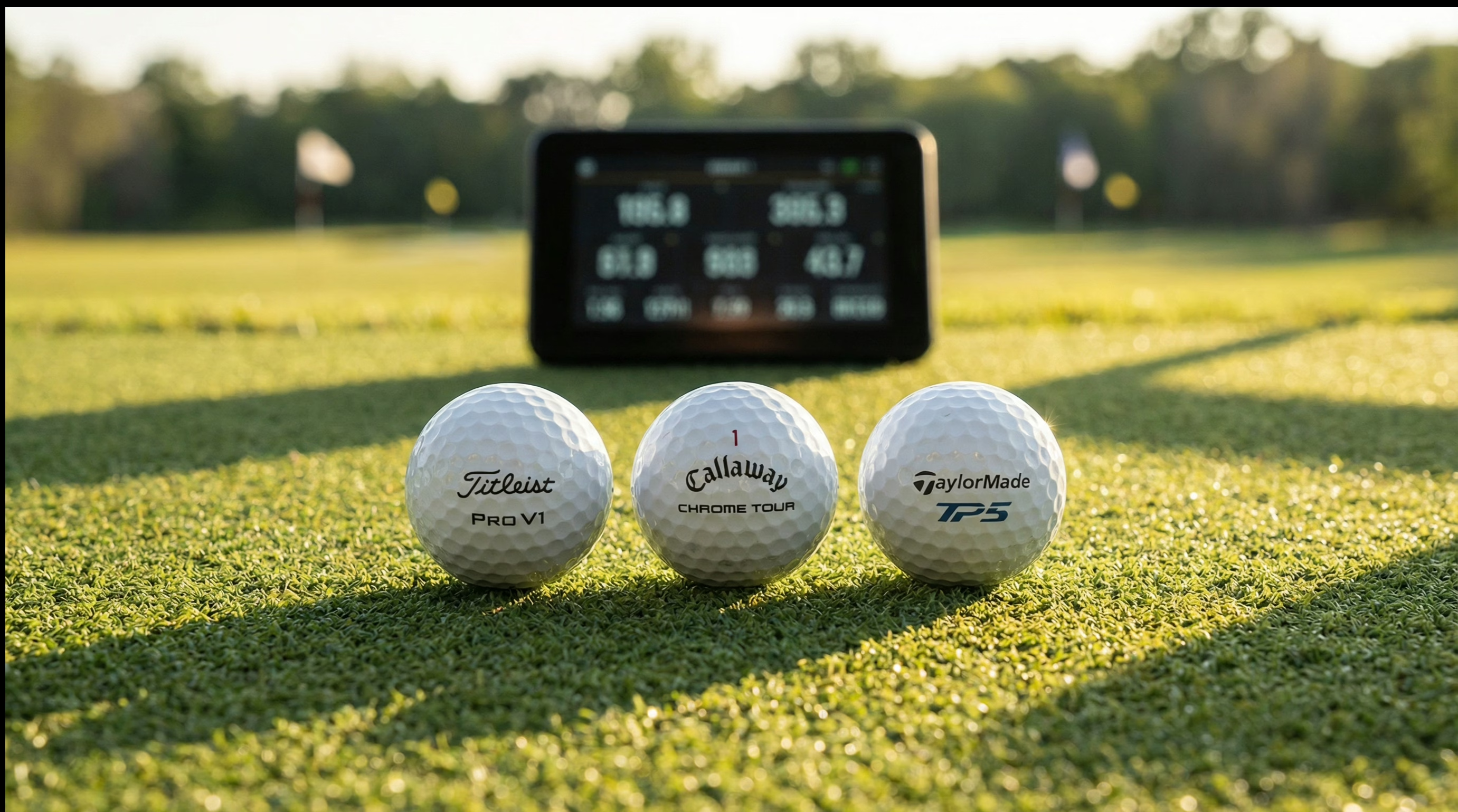
If your driver is sitting somewhere between 95 and 105 mph, you are in a genuinely interesting spot. You have enough speed to properly compress most tour-level golf balls, but you are not quite in the territory where maximum compression is the only variable that matters. The best golf balls for 95 mph swing speed are those that deliver real distance without punishing you on feel, and that give you enough greenside spin to actually score.
The problem is that this swing speed range gets a lot of generic advice. “Play a tour ball” is technically correct but completely unhelpful. There are meaningful differences between the Titleist Pro V1 and the Bridgestone Tour B RX for a player at this speed, and those differences will show up in your scorecard if you pick the wrong one.
This guide cuts through the noise. We looked at compression ratings, cover technology, construction, real-world performance data, and price to give you a clear, honest ranking of the nine best options for 2026.

Not Sure What Your Swing Speed Is?
If you’re unsure whether your driver speed falls in the 95–105 mph range, start with our full guide:
Best Golf Ball by Swing Speed: Practical Fit Guide
Quick Picks
| Ball | Best For | Compression | Price Range | Lab Score |
| Titleist Pro V1 | Overall Performance | 87 | $$$ | 98/100 |
| Callaway Chrome Tour | Soft Feel & Control | 87 | $$$ | 96/100 |
| TaylorMade TP5 | Complete Game Performance | 88 | $$$ | 95/100 |
| Bridgestone Tour B RX | Distance & Forgiveness | 79–83 | $$$ | 94/100 |
| Srixon Z-Star | Greenside Spin | 84 | $$$ | 93/100 |
| Vice Pro | Best Value Tour Ball | 90 | $$ | 92/100 |
| Maxfli Tour | Budget Tour Performance | 85 | $$ | 91/100 |
| Snell Prime 3.0 | Direct-to-Consumer Value | 85–90 | $$ | 90/100 |
| Wilson Staff Model | Underrated Premium Option | ~95 | $$$ | 89/100 |
How We Chose These Products
Selecting the right golf ball for a specific swing speed is not a matter of reading a spec sheet and calling it done. We cross-referenced compression data from independent lab testing, performance reviews from MyGolfSpy’s annual ball test, manufacturer specifications, and real-world feedback from golfers who play in this exact swing speed range.
For the 95–105 mph bracket, the key performance variables we evaluated were driver ball speed and launch conditions, iron spin rates, greenside spin and stopping power, feel off the putter face, and overall consistency. We also factored in price-to-performance ratio, because a ball that performs at 98 percent of a Pro V1 for 60 percent of the cost is a legitimate recommendation.
Every ball on this list has been through independent testing. None of these picks are here because of a marketing budget.

1. Titleist Pro V1 — Best Overall
Summary: The Pro V1 is the benchmark. It has been the most-played ball on tour for over two decades, and the 2026 version continues to justify that dominance. For players in the 95–105 mph range, the Pro V1 hits a near-perfect balance of distance, feel, and greenside control.
Why It Works:
•Compression Sweet Spot: At 87 compression, the Pro V1 is firm enough to generate strong ball speed at 95+ mph but soft enough to provide a responsive, controlled feel on partial shots and putts.
•Penetrating Ball Flight: The aerodynamic design produces a mid-trajectory flight that holds its line in the wind — critical for players who want predictability on approach shots.
•Tour-Grade Greenside Spin: The soft urethane cover engages the grooves of your wedges aggressively, giving you the stopping power to attack pins rather than play for the middle of the green.
Tradeoffs:
•The Pro V1 carries a premium price that adds up quickly if you are prone to losing balls or playing in conditions where you go through several sleeves per round.
•Players at the lower end of this swing speed range (closer to 95 mph) may find the Pro V1x or firmer options generate slightly more ball speed.
Who It’s For: Golfers who want the most complete, proven tour ball available and are willing to pay for it.
Who Should Skip: Budget-conscious players or those who lose more than a sleeve per round.
Lab Score: 98/100
2. Callaway Chrome Tour — Best for Soft Feel and Control
Summary: The 2026 Chrome Tour is Callaway’s most refined tour ball to date. It has quietly become one of the most popular balls on the PGA Tour, and for good reason. The combination of a fast core, precision urethane cover, and consistent flight makes it a legitimate alternative to the Pro V1 for players in this swing speed range.
Why It Works:
•Hyper-Fast Soft Core: Callaway’s core technology is engineered to maximize energy transfer at impact, which translates to competitive ball speeds even at moderate swing speeds.
•Precision Tour Urethane Cover: The cover is designed for high-friction engagement with wedge grooves, delivering excellent spin on approach shots and chips without feeling boardy off the putter.
•Consistent Flight Characteristics: The Chrome Tour produces a reliable, mid-to-high ball flight that works well for players who want to carry the ball into greens rather than running it up.
Tradeoffs:
•The Chrome Tour is not the longest ball on this list. Players who prioritize raw distance over feel and control may find the Chrome Tour X a better fit.
•As a newer model, it has less long-term performance data than the Pro V1 or TP5.
Who It’s For: Players who want a soft-feeling tour ball with excellent short game performance and a slightly higher flight.
Who Should Skip: Distance-first players who are willing to trade feel for extra yards.
Lab Score: 96/100
3. TaylorMade TP5 — Best for Complete Game Performance
Summary: The 2026 TP5 is TaylorMade’s most significant update to the ball in several years. The new, larger tour core reduces contact time at impact for better energy retention, and the updated Microcoating on the cover is designed to improve spin consistency in wet conditions. For players at 95–105 mph, the TP5 is one of the most technically sophisticated options available.
Why It Works:
•5-Layer Construction: Each layer of the TP5 is engineered to optimize a different phase of the shot — from the explosive energy of the core to the soft, high-spin response of the urethane cover. No other ball on this list has this level of engineering depth.
•Tri-Fast Core: The low-compression inner core transitions to progressively firmer outer layers, which helps produce a high launch with low driver spin — a combination that maximizes carry distance for this swing speed.
•Dual-Spin Cover: The combination of a soft urethane outer cover and a firmer inner cover creates a unique spin profile: lower spin off the driver, higher spin on wedge shots.
Tradeoffs:
•The 5-layer construction gives the TP5 a slightly different feel than a traditional 3-piece ball. Some players love it; others find it takes adjustment.
•At the same price point as the Pro V1, the TP5 is competing against a deeply entrenched standard. It earns its place, but the comparison is unavoidable.
Who It’s For: Technically-minded players who want a ball engineered to perform at every stage of the game.
Who Should Skip: Players who prefer a simpler, more traditional ball feel.
Lab Score: 95/100
4. Bridgestone Tour B RX — Best for Distance and Forgiveness
Summary: Bridgestone built the Tour B RX specifically for players with swing speeds under 105 mph, and that intentionality shows in how it performs. The 2026 version introduces the VeloSurge cover technology, which Bridgestone claims delivers best-in-class MOI for improved distance and forgiveness on off-center hits.
Why It Works:
•REACTIV iQ Cover: This is the Tour B RX’s signature technology. The cover is designed to react differently based on the force of impact — firmer on high-speed driver strikes for more distance, softer on lower-speed wedge shots for more spin. It is a genuinely clever piece of engineering.












•Gradational Compression Core: The core transitions from soft in the center to firm on the outside, which helps generate ball speed while keeping spin manageable off the driver.
•Designed for This Swing Speed: Most tour balls are engineered for players swinging 105+ mph. The Tour B RX is one of the few that is explicitly built for the 95–105 mph range, which gives it a meaningful advantage in this category.
Tradeoffs:
•The Tour B RX has a compression rating of approximately 79–83, which is on the softer end of this list. Players at the upper end of this swing speed range (closer to 105 mph) may find they generate slightly more ball speed with a firmer option.
•The greenside spin, while good, is not quite at the level of the Pro V1 or Z-Star.
Who It’s For: Players at 95–100 mph who want maximum distance and forgiveness without sacrificing feel.
Who Should Skip: Players at 103–105 mph who need a firmer ball to maximize energy transfer.
Lab Score: 94/100
5. Srixon Z-Star — Best for Greenside Spin
Summary: The Srixon Z-Star is the choice for players who want to attack pins. It consistently ranks among the highest-spinning balls in independent testing, and its 84 compression makes it very accessible for players in the 95–105 mph range. If your scoring comes from your short game, the Z-Star deserves serious consideration.
Why It Works:
•Spin Skin with SeRM: Srixon’s proprietary urethane coating creates a flexible molecular bond with wedge grooves, generating exceptional spin on partial shots and full wedge approaches. In testing, the Z-Star consistently produces among the highest wedge spin rates of any ball in this category.
•FastLayer Core: The dual-gradient core is soft at the center and gradually firms up toward the outside, providing a great combination of distance off the tee and soft feel on touch shots.
•338 Speed Dimple Pattern: The aerodynamic design reduces drag for a more penetrating flight, which helps the Z-Star hold its own off the tee despite its softer construction.
Tradeoffs:
•The Z-Star is one of the softer balls on this list, which means players at the top of this swing speed range may not generate quite as much ball speed as they would with a firmer option.
•The soft feel that makes the Z-Star great around the greens can feel a bit muted off the driver for players who prefer a more responsive impact sensation.
Who It’s For: Players whose scoring depends on their short game and who want maximum spin and control on approach shots.
Who Should Skip: Players who prioritize distance off the tee above all other performance metrics.
Lab Score: 93/100

6. Vice Pro — Best Value Tour Ball
Summary: The Vice Pro is the answer to a question a lot of golfers are asking: can I get tour-level performance without paying tour-level prices? For players in the 95–105 mph range, the answer is yes. The Vice Pro is a 3-piece urethane ball with a 90 compression rating that competes directly with the Pro V1 in most performance categories at a significantly lower price.
Why It Works:
•Cast Urethane Cover: Vice uses a cast urethane cover rather than the injection-molded covers found on some budget balls, which provides a softer feel and better spin engagement around the greens.
•High-Energy Speed Core (HESC): The core is engineered to generate fast ball speeds, and at 90 compression it is well-suited to players in this swing speed range who want a responsive, lively feel off the driver.
•Competitive Performance Data: In independent testing, the Vice Pro consistently performs within a few percentage points of the Pro V1 in ball speed, spin rates, and distance — at roughly half the price.
Tradeoffs:
•Vice is a direct-to-consumer brand, which means you cannot pick up a sleeve at the pro shop before a round. You need to plan ahead.
•The Vice Pro is a 3-piece ball, which means it does not have the same level of construction complexity as the TP5 or other 4- and 5-piece options.
Who It’s For: Performance-focused players who want tour-quality results without the tour-quality price tag.
Who Should Skip: Players who need to be able to buy balls on the spot at a course pro shop.
Lab Score: 92/100
7. Maxfli Tour — Best Budget Tour Performance
Summary: The Maxfli Tour is one of the most underrated golf balls on the market. Available exclusively at Dick’s Sporting Goods and Golf Galaxy, it offers 4-piece urethane construction and performance data that closely mirrors the Titleist Pro V1 — at a price that makes it one of the best value propositions in golf. For players in the 95–105 mph range who want to play a premium ball without the premium price, the Maxfli Tour is a compelling choice.
Why It Works:
•Center of Gravity Balancing: Maxfli’s manufacturing process ensures the core is perfectly centered within the ball, which produces a more consistent and accurate ball flight. This is a legitimate performance advantage, not just a marketing claim.
•4-Piece Urethane Construction: The 4-layer design provides a level of performance complexity that rivals balls costing significantly more, with a soft urethane cover for greenside spin and a responsive core for driver distance.
•Proven Performance Data: MyGolfSpy’s 2025 ball test showed the Maxfli Tour performing at or near the level of the Pro V1 in multiple categories, making it one of the most credible value recommendations in this guide.
Tradeoffs:
•Availability is limited to Dick’s Sporting Goods and Golf Galaxy, which means you cannot find them at most pro shops or online retailers.
•The Maxfli brand does not carry the same prestige as Titleist or TaylorMade, which matters to some golfers.
Who It’s For: Players who want tour-level performance at a mid-range price and do not mind shopping at Dick’s.
Who Should Skip: Players who need to buy balls at a traditional pro shop or who place significant value on brand prestige.
Lab Score: 91/100
8. Snell Prime 3.0 — Best Direct-to-Consumer Value
Summary: Dean Snell spent decades developing some of the most successful golf balls in history, including the original Titleist Pro V1 and the TaylorMade TP5. When he launched Snell Golf, the premise was simple: build tour-quality balls and sell them directly to consumers at a fair price. The Prime 3.0 delivers on that promise, offering a 3-piece urethane ball with a compression in the 85–90 range that performs well for players in the 95–105 mph window.
Why It Works:
•Pedigree Engineering: The Prime 3.0 is designed by someone who literally invented the balls it competes against. That is not a marketing story — it is a genuine performance credential.
•3-Piece Urethane Construction: The soft urethane cover provides excellent greenside spin, while the low-spin core helps keep driver spin manageable for more distance.
•Competitive Pricing: At roughly $32–35 per dozen, the Prime 3.0 offers tour-quality construction at a price that is meaningfully lower than the Pro V1 or TP5.
Tradeoffs:
•Like Vice, Snell is online-only, which requires planning ahead and eliminates the option of grabbing a sleeve at the course.
•The Prime 3.0 is a 3-piece ball, which means it does not have the same level of construction sophistication as the TP5 or other multi-layer options.
Who It’s For: Players who trust the engineering pedigree, want a tour-quality ball, and are comfortable buying online.
Who Should Skip: Players who want to buy balls at a pro shop or prefer established major-brand options.
Lab Score: 90/100
9. Wilson Staff Model — Best Underrated Premium Option
Summary: The Wilson Staff Model does not get the attention it deserves. It is a 4-piece urethane tour ball with a compression rating of approximately 95, which makes it one of the firmer options on this list and a strong fit for players at the upper end of the 95–105 mph range. Wilson’s V-COR technology and finished urethane cover deliver genuine tour-level performance, and the price is competitive with other premium options.
Why It Works:
•V-COR Advanced Performance Core: Wilson’s proprietary core technology is designed to maximize energy transfer at impact, generating competitive ball speeds for players who can fully compress the ball at 100+ mph.
•4-Piece Construction: The layered design provides a distinct performance profile at each stage of the game, from the explosive energy of the core off the driver to the soft, high-spin response of the urethane cover on wedge shots.
•Finished Urethane Cover: The painted urethane cover provides a clean, classic look and excellent groove engagement for greenside spin.
Tradeoffs:
•At approximately 95 compression, the Staff Model is on the firmer end of this list. Players at 95–98 mph may find it slightly harder to fully compress compared to softer options.
•The Staff Model sits in the shadow of the Staff Model X in Wilson’s own lineup, which can make it harder to find reviews and performance data.
Who It’s For: Players at 100–105 mph who want a firmer, more responsive ball with a classic feel and legitimate tour performance.
Who Should Skip: Players at the lower end of this swing speed range who need a softer compression to maximize energy transfer.
Lab Score: 89/100
Buying Guide: How to Choose the Right Ball for Your Swing Speed

Understanding Compression for 95–105 MPH Players
Compression is one of the most misunderstood concepts in golf ball selection. The old advice — slow swing speed means low compression, fast swing speed means high compression — is an oversimplification that has been largely challenged by modern robotic testing data. Research consistently shows that higher-compression balls often produce faster ball speeds across a range of swing speeds, because firmer balls deform less at impact and transfer energy more efficiently.
For players in the 95–105 mph range, a compression rating between 84 and 95 is generally the sweet spot. This range is firm enough to generate strong ball speed and distance, while still offering the feel and responsiveness that makes a ball enjoyable to play. Balls below 80 compression may feel too soft and lose energy at impact for players at the upper end of this range. Balls above 100 compression are typically better suited to players swinging 105+ mph.
Cover Material: Why Urethane Matters
Every ball on this list uses a urethane cover, and that is not a coincidence. Urethane is the material of choice for tour-level golf balls because it provides a softer, more friction-rich surface that engages wedge grooves more aggressively than the Surlyn covers found on distance and value balls. The result is more spin on approach shots, pitches, and chips — which translates directly to more stopping power and more scoring opportunities.
If you are playing a Surlyn-covered ball at 95–105 mph, you are leaving greenside spin on the table. The upgrade to a urethane cover is one of the most impactful equipment changes a player in this swing speed range can make.
Construction: Layers and What They Mean
The number of layers in a golf ball determines how it performs across different clubs. A 3-piece ball has a core, a mantle layer, and a cover. A 4-piece ball adds an additional mantle layer. A 5-piece ball, like the TaylorMade TP5, adds yet another layer.
More layers generally means more performance differentiation — the ball can behave differently with a driver than it does with a wedge, which is the goal. However, more layers also means more complexity and, typically, a higher price. For most players in the 95–105 mph range, a 3- or 4-piece urethane ball will provide excellent performance. The 5-piece TP5 is worth considering if you want the most technically sophisticated option available.
Price and Value
Premium tour balls — the Pro V1, Chrome Tour, TP5 — typically retail for $50–55 per dozen. Direct-to-consumer options like the Vice Pro, Snell MTB Prime, and Maxfli Tour offer comparable performance for $30–40 per dozen. The performance gap between these tiers has narrowed significantly in recent years, and for most amateur golfers, the direct-to-consumer options represent excellent value.
The most important thing is to find a ball that suits your game and stick with it. Consistency in ball selection allows you to calibrate your distances, develop a feel for spin rates, and make better decisions on the course.
FAQ

What compression golf ball should I use at 95 mph swing speed?
For a 95 mph swing speed, a compression rating between 80 and 90 is generally ideal. The Titleist Pro V1 (87), Callaway Chrome Tour (87), and Srixon Z-Star (84) are all excellent choices in this range. These balls are firm enough to generate good ball speed without requiring you to swing harder to compress them.
What is the difference between the Pro V1 and Pro V1x for a 95–105 mph swing speed?
The Pro V1 has a compression of 87 and produces a mid-trajectory flight with a softer feel. The Pro V1x has a compression of 96 and produces a higher trajectory with more spin. For most players in the 95–105 mph range, the Pro V1 is the better fit — the Pro V1x is better suited to players swinging 105+ mph who can fully compress the firmer ball.
Are direct-to-consumer golf balls like Vice and Snell actually as good as Pro V1?
In independent testing, yes — they are very close. The Vice Pro and Snell MTB Prime consistently perform within a few percentage points of the Pro V1 in ball speed, spin rates, and distance. The primary differences are brand prestige and availability, not performance. For value-focused players, these are legitimate alternatives.
Should I play a lower compression ball if I want more distance at 95 mph?
Not necessarily. Modern testing data shows that higher-compression balls often produce faster ball speeds across a range of swing speeds because they deform less at impact and transfer energy more efficiently. A ball in the 84–90 compression range is likely to give you more distance than a ball in the 60–70 range at 95 mph.
How often should I change my golf ball?
For tour-level urethane balls, most players should consider replacing their ball every 18–36 holes, or whenever they notice visible scuffs or cuts in the cover. A damaged cover affects spin rates and flight consistency. If you are playing a premium ball, protect your investment by inspecting it regularly.
Does the Bridgestone Tour B RX really perform better for under-105 mph swing speeds?
Yes, and this is one of the more credible marketing claims in golf. Bridgestone has invested significantly in fitting technology and player data, and the Tour B RX is genuinely engineered for the 95–105 mph range. The REACTIV iQ cover technology is designed to react differently at different impact speeds, which is a meaningful advantage for players in this bracket.
Is the Maxfli Tour really comparable to the Pro V1?
Based on MyGolfSpy’s 2025 ball test data, the Maxfli Tour performs at or near Pro V1 levels in multiple categories, including ball speed, iron spin, and distance. It is one of the most credible value recommendations in this guide. The primary difference is availability and brand recognition, not performance.
Final Recommendation

For most golfers swinging between 95 and 105 mph, the Titleist Pro V1 remains the most complete option on the market. Its combination of distance, feel, and greenside spin is hard to match, and the 2026 version continues to justify its position at the top of the category.
If you want the best value for your swing speed, the Vice Pro and Maxfli Tour are the two most compelling alternatives. Both offer tour-level performance at a significantly lower price, and both have the independent testing data to back up that claim.
If your game lives and dies by your short game, the Srixon Z-Star deserves a serious look. Its greenside spin numbers are among the best in this category, and it is priced competitively with the other premium options.
Whatever ball you choose, the most important thing is to commit to it. Play the same ball consistently, calibrate your distances, and let the equipment work for you. The best golf balls for 95 mph swing speed are the ones that match your game — not just your swing speed.