Entertainment
Confessions of a Weekend Golfer: The Shots We All Lie About
Every golfer lies to themselves on the course. From “that was my practice swing” to “I usually make that putt,” Ty Webb confesses the universal lies we all tell—and why it’s perfectly okay.


We need to talk. Not about swing mechanics or course management or the latest driver technology. We need to talk about something more fundamental, more universal, more deeply human: the lies we tell ourselves on the golf course. And I’m not talking about the big lies—”I could go pro if I had more time” or “I’m definitely a ten handicap.” I’m talking about the small, everyday lies. The ones we tell ourselves on every single round. The ones that make golf bearable, and occasionally, magical.
I’m guilty of all of them. You are too. Your buddy who claims he shoots in the seventies? He’s lying about at least three things per round, minimum. And that’s okay. Because golf is hard, and life is short, and sometimes a little self-deception is what keeps us coming back. So consider this my confession. A truth-telling about all the lies. A public admission of the creative accounting, selective memory, and optimistic scorekeeping that make this beautiful, frustrating game possible.
Let’s get into it.
The Lie: “That Was My Practice Swing”
You know the one. You step up to the ball, full of confidence. You take a swing. The ball dribbles fifteen yards into the rough. There’s a brief moment of silence. Then, without missing a beat, you say, “That was my practice swing.” You tee up another ball and hit it two hundred yards down the middle.
We’ve all done it. And here’s the thing: nobody believes you. Your playing partners know it wasn’t a practice swing. You know it wasn’t a practice swing. The golf gods know it wasn’t a practice swing. But we all go along with it, because tomorrow, it might be us. Golf karma is real, and we’re all in this together.
The best version of this lie is when you don’t even say it out loud. You just shake your head, tee up another ball, and hit it like nothing happened. The silent practice swing. A masterclass in denial.
The Lie: “I Never Play That Well on the Range”
This is the lie we tell after a terrible round. You shot a hundred and three. You lost six balls. You four-putted twice. And as you’re walking off the eighteenth green, someone asks how it went, and you say, “Eh, I was hitting it great on the range this morning. Just couldn’t figure it out on the course.”
The truth? You were hitting it exactly the same on the range. Maybe worse. But admitting that would mean admitting that your range session was pointless, and we can’t have that. So we create this alternate reality where we were striping it on the range, and something mysterious happened between the range and the first tee that caused everything to fall apart.
It’s a comforting lie. It suggests that your real game—the good one—is still in there somewhere, just waiting to come out. And who knows? Maybe it is.

The Lie: “The Wind Really Got That One”
Ah yes, the wind. Golf’s most convenient scapegoat. You pull your drive forty yards into the trees, and before anyone can say anything, you’re shaking your head and muttering, “Wind really got that one.”
Never mind that it’s a calm day. Never mind that the flag on the green isn’t moving. Never mind that your ball started left and stayed left. The wind got it. End of story.
The beauty of the wind lie is that it’s impossible to disprove. Sure, it doesn’t feel windy right now, but maybe there was a gust. Maybe it was a micro-burst. Maybe it was a localized weather phenomenon that only affected your ball. Who’s to say? Not your playing partners, that’s for sure. They’re too busy preparing their own wind-related excuses.
The Lie: “I’m Just Playing for Fun Today”
This is the lie we tell on the first tee when we’re trying to manage expectations. “I’m just out here for fun today. Not worried about my score.” Translation: I’m about to play terribly, and I’m getting ahead of it.
The problem with this lie is that nobody who says it actually means it. You say you’re playing for fun, but by the third hole, you’re grinding over a five-footer like it’s for the Masters. You say you don’t care about your score, but you’re definitely counting every stroke and doing the math in your head after every hole.
Golf has a way of making liars out of all of us. We tell ourselves we’re playing for fun, and then we spend four hours being deeply, personally offended by a small white ball.
The Lie: “I Usually Make That Putt”
You’re standing over a six-footer. It’s a straight putt, slightly uphill. You hit it. It misses. And immediately, without thinking, you say, “I usually make that.”
Do you, though? Do you really? Because if you usually made six-footers, you’d be a scratch golfer. The stats say that even tour pros only make about sixty-five percent of putts from six feet. So unless you’re secretly Scottie Scheffler, you probably don’t “usually” make that putt.













But we say it anyway. Because in our minds, we’re better putters than we actually are. We remember the putts we make and forget the ones we miss. It’s selective memory, and it’s what keeps us believing that we’re one good putting day away from shooting our best round ever.

The Lie: “I Didn’t See Where It Went”
You hit your ball into the woods. Deep into the woods. You know exactly where it went. You watched it the whole way. But when your playing partner asks, “Did you see where it went?” you say, “Nope. Lost it.”
Why? Because if you admit you saw it, you have to go look for it. And nobody wants to spend ten minutes searching through poison ivy and thorns for a ball that cost you three dollars. So you take the stroke-and-distance penalty, drop a new ball, and move on with your life.
The “I didn’t see where it went” lie is an act of self-preservation. It’s not about cheating—it’s about maintaining your sanity and keeping pace of play. The golf gods understand.
The Lie: “That’s Good”
This is the lie we tell our playing partners, and they tell us. You’re three feet from the hole. Your buddy says, “That’s good.” You pick up your ball without putting it. Everyone’s happy.
Except here’s the thing: that putt wasn’t good. Not really. You might have made it. You also might have missed it. We’ll never know, because we didn’t putt it out. But we all agree to pretend it was a gimme, because nobody wants to watch you line up a three-footer for five minutes.
The “that’s good” lie is the social contract that makes recreational golf possible. Without it, rounds would take six hours, and we’d all hate each other. So we give each other putts, we accept them graciously, and we pretend we would have made them anyway.
The Lie: “I’m Going to Play More This Year”
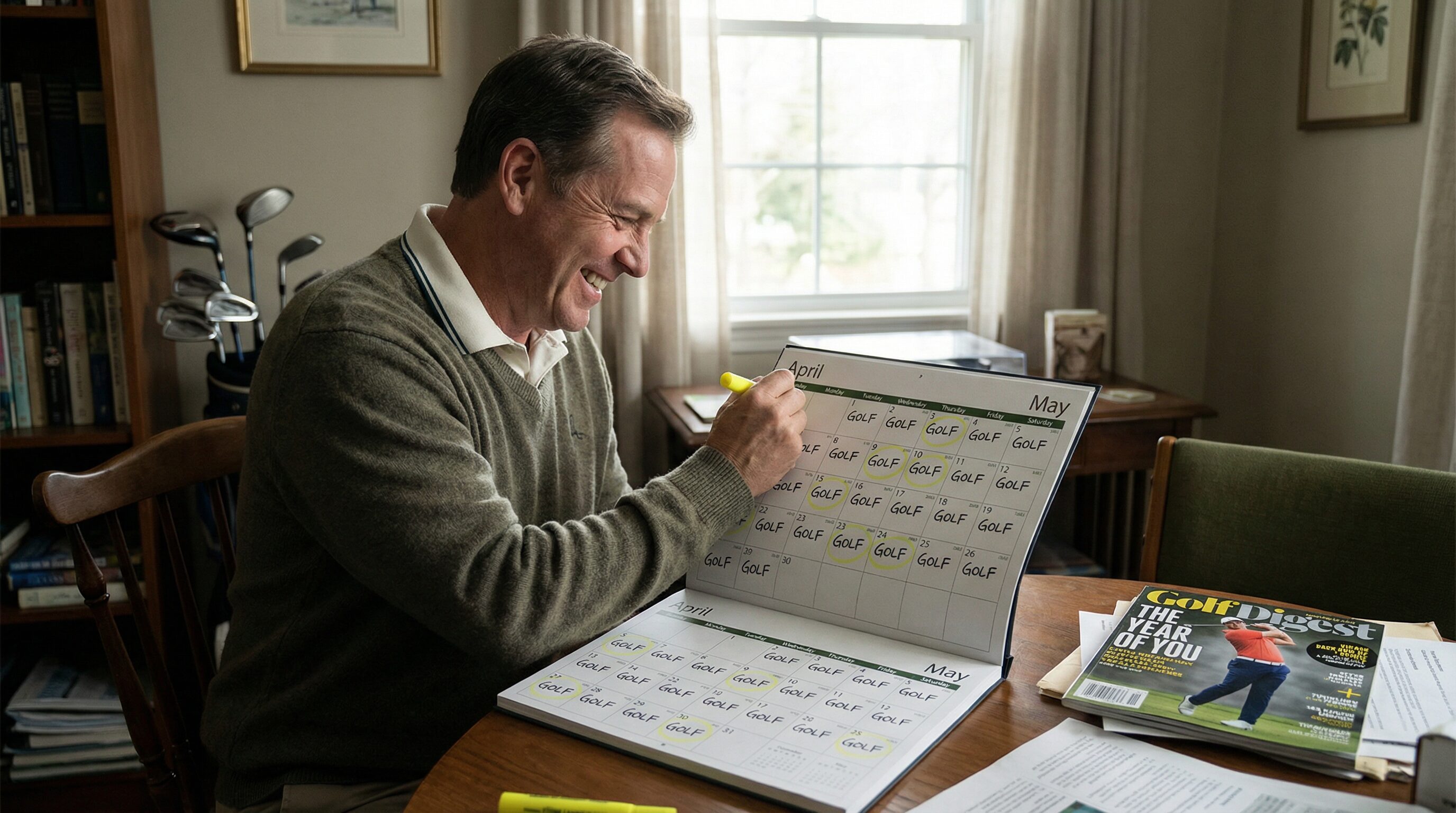
This is the lie we tell ourselves in January. “This is the year. I’m going to play twice a week. I’m going to practice. I’m going to get my handicap down to single digits.”
And then life happens. Work gets busy. The weather doesn’t cooperate. Your back starts hurting. By June, you’ve played six times, and you’re already revising your goals. “Okay, maybe not twice a week. But definitely once a week.” By September, you’re down to once a month, and you’re telling yourself, “Next year. Next year I’ll play more.”
We all do this. We all have grand plans for our golf game that reality refuses to accommodate. And yet, every January, we make the same promise. Because hope springs eternal, and golf is nothing if not a game of hope.
The Lie: “I Just Need to Figure Out One Thing”
This is the lie that keeps golf instructors in business. “I’m so close. I just need to figure out one thing, and it’s all going to click.” Maybe it’s your grip. Maybe it’s your takeaway. Maybe it’s your weight shift. Whatever it is, you’re convinced that once you figure it out, you’ll unlock your true potential.
The truth? There is no “one thing.” Golf is a thousand things, all working together in a complex, fragile system that falls apart the moment you think about it too hard. But we can’t accept that, because it’s too overwhelming. So we tell ourselves it’s just one thing. One fix away. One lesson away. One range session away.
And you know what? Sometimes it works. Not because there really was one thing, but because believing there was one thing gave us the confidence to play better. Golf is weird like that.
The Lie: “I’m Going to Lay Up”
You’re two hundred and twenty yards from the green. There’s water in front. Trees on the right. Bunkers on the left. Your playing partner says, “What are you hitting?” You say, “I’m going to lay up. Play it safe.”
And then you pull out your three-wood.
We all know how this ends. You go for it. You don’t make it. The ball finds the water, or the trees, or the bunkers. And as you’re walking up to take your drop, you’re already explaining to yourself why going for it was actually the smart play. “I hit it pretty good. Just came up a little short.” Or, “I had the distance. Just pulled it a bit.”
The “I’m going to lay up” lie is aspirational. It’s the golfer we want to be—smart, strategic, disciplined. But it’s not the golfer we are. We’re the golfer who goes for it, because going for it is fun, and golf is supposed to be fun. Even when it’s not.
The Lie: “I Don’t Care About My Handicap”
Sure you don’t. That’s why you update it after every round. That’s why you get excited when it goes down and defensive when it goes up. That’s why you’re constantly checking the GHIN app to see where you stand.
Look, it’s okay to care about your handicap. It’s a measure of progress. It’s a way to compete with your friends. It’s a number that represents all the hours you’ve spent working on your game. Caring about it doesn’t make you shallow or obsessed. It makes you human.
But we pretend we don’t care, because caring too much feels vulnerable. What if we try really hard and don’t improve? What if we’re stuck at this level forever? So we act casual. “Oh, my handicap? I don’t really pay attention to that.” Meanwhile, we’re checking it three times a day.

Why We Do It
So why do we lie to ourselves? Why do we engage in this elaborate theater of self-deception every time we step onto a golf course?
Because golf is hard. Really hard. And if we were completely honest with ourselves about how hard it is, and how little control we have, and how much luck is involved, we’d probably quit. So we lie. We tell ourselves we’re better than we are. We blame external factors. We give ourselves the benefit of the doubt. We create a version of our golf game that’s just slightly better than reality.
And here’s the thing: it works. Those little lies keep us motivated. They keep us hopeful. They keep us coming back. Because if we truly accepted that we’re a twenty handicap who’s going to stay a twenty handicap no matter how much we practice, what would be the point? But if we believe we’re one swing thought away from being a fifteen, or one lesson away from being a ten, then we have a reason to keep playing.
The lies aren’t about cheating. They’re about hope. They’re about maintaining the belief that improvement is possible, that the next round will be better, that we’re capable of more than we’ve shown. And in a game as humbling as golf, hope is everything.
Why It’s Okay
Here’s what I’ve learned after years of lying to myself on the golf course: it’s not just okay to do this. It’s necessary. Golf is a game that will break you if you let it. It will expose every flaw, every weakness, every limitation. It will make you question your intelligence, your coordination, and your life choices. If you approach it with complete, brutal honesty, you’ll be miserable.
So we lie. We soften the edges. We give ourselves grace. We remember the good shots and forget the bad ones. We tell stories that make us sound better than we are. And in doing so, we make golf bearable. We make it fun. We make it something we want to keep doing.
The best golfers I know aren’t the ones who are hardest on themselves. They’re the ones who can laugh at their mistakes, shrug off bad shots, and find joy in the process. They’re the ones who understand that golf is supposed to be fun, and sometimes fun requires a little creative interpretation of reality.
So if you need to call that a practice swing, go ahead. If you need to blame the wind, be my guest. If you need to believe you usually make that putt, I’m not going to argue with you. We’re all just trying to enjoy this ridiculous game, and if a few harmless lies help us do that, then who’s really getting hurt?
The Truth About the Lies
I’ll leave you with this: the lies we tell ourselves on the golf course aren’t really about golf. They’re about life. They’re about how we cope with failure, how we maintain hope, how we keep trying even when the odds are against us. Golf just happens to be the arena where these lies play out most obviously.
In life, we tell ourselves we’re going to start eating better, exercising more, being more patient with our kids. We tell ourselves we’re going to finish that project, learn that skill, make that change. And most of the time, we don’t. But we keep telling ourselves we will, because the alternative—accepting that we’re not going to change—is too depressing to consider.
Golf is the same. We tell ourselves we’re going to practice more, play smarter, stay calm. We tell ourselves we’re better than our last round, that we’re improving, that we’re capable of greatness. And sometimes we are. But most of the time, we’re just out there, doing our best, lying to ourselves just enough to keep it interesting.
And you know what? That’s beautiful. That’s human. That’s why I love this game.
So the next time you’re on the course, and you hit a terrible shot, and you hear yourself saying, “That was my practice swing,” or “The wind got it,” or “I usually make that,” just smile. Because you’re part of a long tradition of golfers who’ve been lying to themselves since the game was invented. You’re in good company. And you’re doing exactly what you need to do to keep loving this maddening, magnificent game.
Now if you’ll excuse me, I have a tee time. And I’m definitely going to break eighty this time. I can feel it.