Competitive Edge
How to Pick Golf Prediction Markets on Kalshi, Polymarket, and Fanatics
Kalshi, Polymarket, Fanatics Markets — each platform works differently. Kelly Hodgeson’s playbook shows you exactly how to pick golf markets like a sharp.

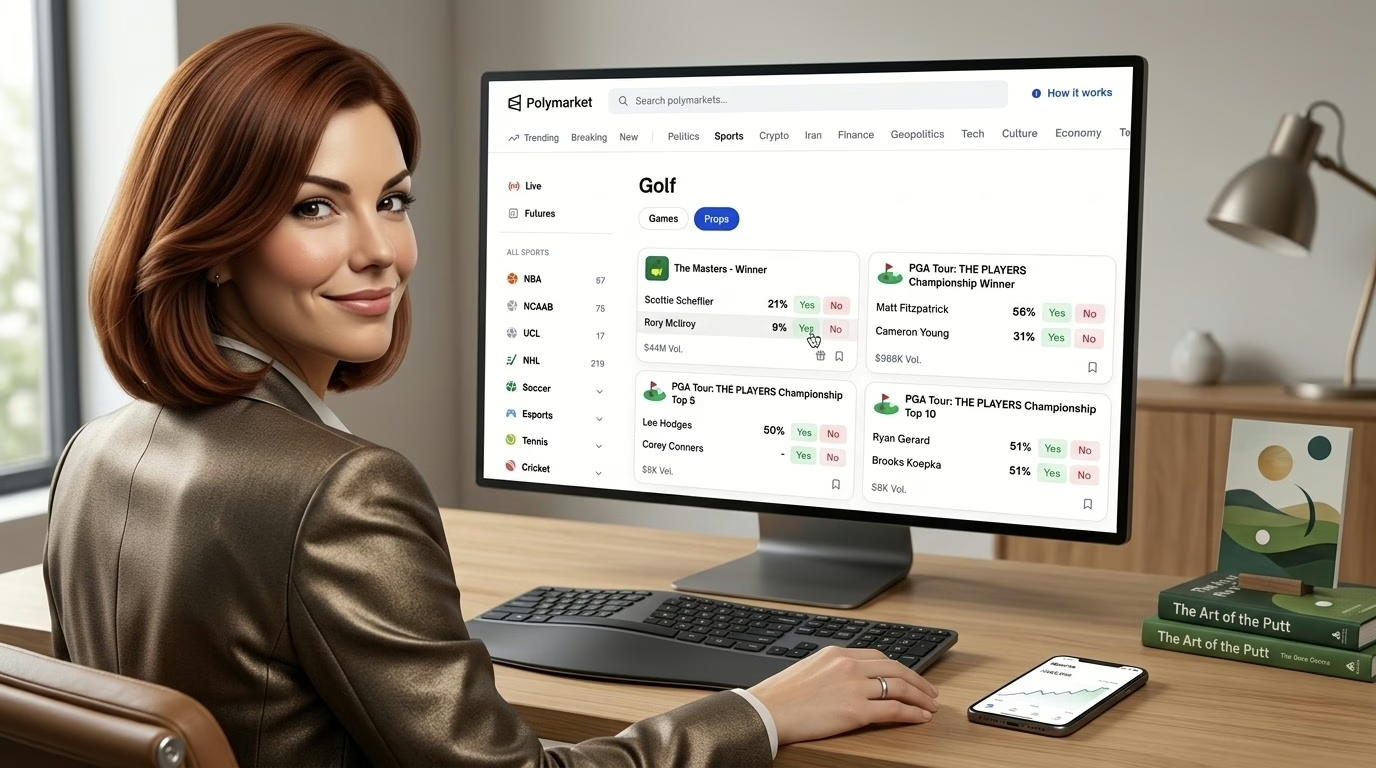
I made my first Kalshi trade on a Masters outright last spring. Bought a contract at 8 cents on a player I liked for Augusta’s setup. By Friday evening he was -7 through 36 holes, sitting two off the lead, and my contract was trading at 22 cents. I sold. That’s a 175% gain in 36 hours — and the player never won the tournament. He faded on the weekend and finished T12. If I’d been on a sportsbook, I’d have lost my stake. That’s the difference between betting and trading, and it’s why golf prediction markets have become my favorite edge in this sport.
This isn’t a beginner’s guide to golf betting. If you need odds and format basics, start with my Golf Betting 101 piece at clickitgolf.com/golf-betting-101-how-to-bet-on-golf. This playbook is for people who understand betting and want to apply prediction market strategy specifically to golf — finding mispriced probabilities, trading positions live during a four-day tournament, and building a repeatable process. I wrote a broader comparison of how prediction markets stack up against sportsbooks at clickitgolf.com/prediction-markets-vs-sportsbooks-golf-betting-guide. This piece goes deeper on the golf-specific plays.
The Mental Shift: From Betting to Trading
On a sportsbook, you place a bet and hold a ticket until the tournament ends. Win or lose. That’s it. There’s no exit button, no partial profit, no way to manage risk once you’re in. You’re a spectator with a receipt.
On a prediction market — Kalshi, Polymarket, Fanatics Markets — your position has a live price that moves in real time based on what’s happening on the course. Think of it like a stock. You bought shares at $0.10. After round one, your player is on the leaderboard and the market reprices those shares at $0.25. You can sell right now for a 150% gain. Or you can hold for the $1.00 payout if they actually win on Sunday. That choice — hold or sell — is the core skill in prediction market golf trading.
This is a fundamentally different game. You’re not trying to predict who wins the tournament. You’re trying to find contracts that are priced lower than they should be, buying them, and selling them when the market corrects. Sometimes you hold to settlement. Most of the time, you don’t.
KELLY’S RULE OF THUMB: If a player’s implied probability has moved past your “fair value” estimate, sell. Don’t be greedy. A 150% gain you lock in beats a 900% gain you give back because you held through a Sunday collapse. I’ve learned this the hard way.
Where to Find Golf Prediction Markets on Each Platform
Kalshi
Navigate to kalshi.com → Sports → Golf → Futures. The direct URL is kalshi.com/category/sports/golf/all/futures. Current markets include Masters winner, US Open winner, Ryder Cup 2027 (Europe ~50% / USA ~45%), and Solheim Cup (USA ~52% / Europe ~42%). Tournament-week markets — outright winner and make/miss cut — appear weekly during the PGA Tour season. Click the “All” tab to see everything. Kalshi is CFTC-regulated, contracts are priced $0.01–$0.99, each settles at $1.00 if correct and $0.00 if not. They now display American odds (+/-) alongside contract prices, which makes comparison shopping with sportsbooks much faster. Trading fees are charged as a percentage of expected earnings and are typically under 3–4% of maximum profit per contract, with no settlement or processing fees.
Polymarket
Search “golf” in the markets tab. Polymarket’s golf coverage is less consistent than Kalshi — you’ll reliably find markets for majors and marquee events, but not every weekly tour stop. The interface uses probability percentages, not odds. Polymarket runs on USDC and uses a probability‑percentage interface, with trading routed through a CFTC‑regulated exchange structure for U.S. users following its late‑2025 approval. It is in the process of re‑launching to U.S. customers via a waitlist and may not yet be available in every state, so you should check current access and state‑level restrictions before trading.
Fanatics Markets
Find golf under the sports menu. Fanatics uses a familiar sportsbook-style interface but with contract-based mechanics under the hood. Fee structure is around 2% on trades, based on current public information, and may change; always check the in‑app fee disclosure before trading. This is the best on-ramp for traditional bettors transitioning to prediction markets — it feels like what you’re used to, but with the ability to exit positions early.
Platform Golf Market Types Odds Format Early Exit? Fees Best For Kalshi Outrights, futures, cut markets, Ryder/Solheim Cup Contract price ($0.01–$0.99) + American odds Yes — sell anytime at market price ~1% on expected earnings US-based traders who want regulation + deepest golf liquidity Polymarket Majors, high-profile events (inconsistent weekly) Probability % (e.g., 12%) Yes — peer-to-peer order book Variable (spread-based) Global users comfortable with crypto; arbitrage hunters Fanatics Markets Outrights, select props Sportsbook-style (American odds) Yes — contract cash-out ~2% Traditional bettors transitioning to prediction markets
Kelly’s 4-Step Golf Prediction Market Process
Step 1 — Find the market and note the implied probability
Convert the contract price to American odds (or use Kalshi’s built-in display). A 10-cent contract = 10% implied probability = +900 American odds. A 25-cent contract = 25% = +300. Then compare to the best available sportsbook price using OddsJam or Action Network’s odds comparison tool. If Kalshi’s implied probability is LOWER than the sportsbook’s implied probability for the same player — buy on Kalshi. If Kalshi’s is higher — use the sportsbook. Always take the best number.
Step 2 — Identify your entry point
For outright winner markets, enter BEFORE the tournament starts — Monday or Tuesday after the field is confirmed. This is when pricing is least efficient because casual money hasn’t arrived yet. For live trading during the event, wait for round 1 results. If a player you like is -4 or better after Thursday and their contract price hasn’t fully caught up to the new reality, that’s often the best entry window of the whole week.
Step 3 — Set a target exit price, not a target outcome
This is the most important mindset shift in the entire playbook. Don’t think “I need Rory to win.” Think “I bought Rory at 14 cents. My target is 28 cents — a double. If he’s leading or co-leading after 36 holes, I’ll be near that price. I’ll sell.” This removes emotional attachment to the final result. You’re not rooting for a player. You’re managing a position.














Step 4 — Manage your position size
Because you can exit early, you can take slightly larger positions than on a sportsbook where you’re locked in. But discipline still matters. Never risk more than 3–5% of your total bankroll on any single tournament market. Golf is the highest-variance sport to bet on — fields of 156 players, four rounds of weather and momentum swings. Size accordingly.
WORKED EXAMPLE: The Live Trade Monday: The field for the Players Championship drops. I like Collin Morikawa’s course history and current form. His Kalshi contract is at 8 cents (8% implied, equivalent to +1150). I buy 100 shares at $0.08 = $8.00 total risk. Thursday evening: Morikawa shoots -6, sits T2 after round 1. His contract jumps to 18 cents. Friday evening: He adds another -3, now -9 total, co-leading at the halfway mark. Contract price: 24 cents. Decision point: I bought at 8, it’s now 24. That’s a 200% gain. My original target was 20 cents (a 150% gain). The market has exceeded my target. I sell 100 shares at $0.24 = $24.00. Profit: $16.00 on an $8.00 investment (200% return). What happened Sunday: Morikawa shot +2 in the final round and finished T8. If I’d held, my contracts would have settled at $0.00. Instead, I locked in $16 profit. That’s trading, not betting.
The Live Trading Playbook — Round by Round
Round 1 — Thursday: Hunt for Pricing Lag
Watch for inefficiencies in the first six hours after round 1 finishes. If a 20/1 longshot shoots -6, their Kalshi price may still be lagging the sportsbook because the prediction market audience is smaller and slower to react. Move fast. This is where the biggest single-day gains happen. I keep both Kalshi and DraftKings open side-by-side on Thursdays.
Round 2 — Friday: Cut Markets Settle, Leaders Emerge
Cut markets settle Friday evening — that’s free information flowing into the outright market. Buy contracts on players at the top of the 36-hole leaderboard if their outright price hasn’t fully adjusted yet. I especially like players known to be “closers” — guys with strong weekend scoring averages (Scheffler, Schauffele, Morikawa). The Friday-to-Saturday overnight window is underrated for value.
Round 3 — Saturday: The Sell Window
Prices get efficient by Saturday. The casual money has arrived, the leaderboard is set, and the market knows what it’s pricing. This is when you consider selling positions that have doubled or better. Saturday is my heaviest selling day. I’m almost never entering new positions on Saturday unless something weird happens — a weather delay, a surprise withdrawal — that creates a temporary mispricing.
Round 4 — Sunday: The Decision Point
Final-round prices move dramatically hole by hole. If your player is -2 with 4 holes to play and holding the lead, their contract is probably at 65–75 cents. Decide: sell and take the 5x–8x return, or hold for the $1.00 payout. My default is to sell when a contract hits 60+ cents unless I have very strong conviction. The difference between 70 cents and $1.00 is not worth the risk of a back-nine collapse — and if you’ve watched enough golf, you know how fast leads disappear on Sunday.
The Arbitrage Play — Free Money When Markets Disagree
Arbitrage in prediction markets means the same thing as in any financial market: two platforms are pricing the same outcome at different probabilities, and you can exploit the gap.
How to spot it: use OddsJam (free tier works). It shows real-time price comparisons across sportsbooks and prediction markets for the same event. When Kalshi and DraftKings disagree on a player’s probability, that’s your signal.
ARBITRAGE EXAMPLE: DraftKings has Viktor Hovland at +2200 to win the Memorial (implied probability: 4.3%). Kalshi has the same outcome priced at 6 cents (implied probability: 6.0%). DraftKings is offering better value — you’re getting 4.3% implied for a player the prediction market thinks has a 6% chance. Bet on DraftKings. If the situation were reversed — Kalshi at 3 cents (3%) and DraftKings at +2200 (4.3%) — buy on Kalshi.
True arbitrage — betting both sides for a guaranteed profit regardless of outcome — rarely happens in golf outrights because the fields are too large (you’d need to cover 156 players). But it CAN happen in cut markets or head-to-head matchup props where there are only two outcomes.
My honest take: Pure arb opportunities are rare and small in golf. The real, repeatable edge is in consistently finding which platform offers the better price on a player you already like, and always taking the best number. Over 50 tournaments a year, that discipline compounds.
Golf-Specific Strategies That Work on Prediction Markets
| STRATEGY 1: The Pre-Tournament Futures Play on Majors Buy Masters and US Open winner contracts 4–6 weeks before the event. Pricing is less efficient that far out because casual money hasn’t arrived and the field isn’t finalized. As the tournament approaches, the field firms up, media attention builds, and public money compresses prices toward the favorites. Even if your player doesn’t win, you can often sell at 2x if they’re playing well in the weeks leading up. I bought a Xander Schauffele Masters contract at 11 cents six weeks out. Two weeks before Augusta, after he won a tune-up event, it was trading at 19 cents. I sold half. Free roll on the rest. |
| STRATEGY 2: The Round 1 Momentum Trade Buy contracts on 3–4 players known for fast tournament starts at 6–8 cents each ($6–$8 investment per player). Total outlay: $24–$32. Wait for the round 1 leaderboard. Anyone at -5 or better will typically see their contract jump to 15–20 cents by Friday morning. Sell the ones that moved. Let the rest expire at $0. Even if only 1 of 4 hits, you’re selling at 15–20 cents on an 8-cent investment. That covers the other three. When 2 hit, it’s a very good week. Best candidates: players with high birdie rates and aggressive early-round scoring tendencies. Check DataGolf’s strokes-gained-early-round stats. |
| STRATEGY 3: The “Sharp Fade” on Overpriced Favorites If Scottie Scheffler is priced at 28 cents on Kalshi (28% implied) for a tournament but his historical win rate at similar course types is under 20%, buy the NO side. You’re buying a 72-cent “No” contract that settles at $1.00 if Scheffler doesn’t win — which happens roughly 80% of the time even for the world’s best player. This is one of my favorite plays. The public overprices dominant favorites in golf because golf fields are enormous. Nobody wins more than 25% of the time. The math is on your side. The edge is smaller per contract (you’re risking 72 cents to make 28 cents), but the win rate is high. Consistency > magnitude. |
| STRATEGY 4: The Cut Market Play “Will [player] make the cut?” is often available on Kalshi for weekly PGA Tour events. This is an underrated market with consistent edges. For players ranked 80–120 in the world on a tough course (Bethpage, Oakmont, etc.), the YES price is often priced at 60–65 cents when historical cut rates for this caliber of player suggest 70–75%. Small edge per contract. But over 30–40 weeks of PGA Tour events, buying cut YES contracts at 60–65 cents on players with 70%+ historical cut rates is a grinder play that compounds. Track results in a spreadsheet. After 100 contracts, you’ll see whether the edge is real. Mine has been: 68% hit rate on contracts bought at an average of 62 cents = long-term profit. |
What Golf Markets to Avoid (My Honest Take)
| SKIP THESE (or size them as entertainment, not strategy): |
- Hole-in-one props: The probability is genuinely low (~0.5% per player per par-3), and fees eat your edge on extreme low-probability contracts. You’re paying more in friction than you’re gaining in EV. Pass.
- First-round leader: Fun, but essentially chaotic. One hot putting round decides it, and the contract moves so fast you can’t trade it intelligently. I’ll throw $5 on a first-round leader as a flier, but it’s not part of my core process.
- Parlay/combo markets: Kalshi now offers some combo contracts. Skip these until you completely understand single-market mechanics. Combos multiply your edge — but they also multiply the house edge. Learn to walk before you run.
- Any market with under $5,000 in volume: Thin liquidity means bad prices on entry AND hard exits. If you can’t sell when you want to at a fair price, the entire trading advantage disappears. Always check volume before entering a position.
Frequently Asked Questions
Q: Can I bet on golf on Kalshi right now?
A: Yes — Kalshi currently offers golf futures including Masters, US Open, Ryder Cup 2027, and Solheim Cup, with more weekly markets appearing during each PGA Tour event. Visit kalshi.com/category/sports/golf to see current offerings. Tournament-specific outright and cut markets typically go live Monday or Tuesday of tournament week.
Q: How much money do I need to start trading golf on Kalshi?
A: You can start with as little as $10. Contracts trade in fractions, so a 10-cent contract on 100 shares costs $10. Most players I know start with $100–$500 to have meaningful position sizes while staying within sensible bankroll limits (3–5% per tournament). You don’t need a large bankroll to learn the mechanics.
Q: Is Kalshi safe to deposit money into?
A: Yes. Kalshi is CFTC-regulated (Commodity Futures Trading Commission) and holds user funds in segregated accounts at regulated financial institutions. It’s regulated as a designated contract market — the same category as the CME — not as a sportsbook. This is a meaningfully higher standard of financial regulation than any offshore book.
Q: What’s better for golf — Kalshi or Polymarket?
A: Kalshi for US-based bettors who want regulation, easy dollar deposits, and the deepest golf market liquidity. Polymarket for users in the U.S. access via a CFTC‑regulated structure and still subject to state‑level restrictions, who want to shop for potentially better prices. Ideally, use both and always compare prices before entering. The platform with the better price wins — loyalty to a platform costs money.
Q: Can I use prediction markets if sports betting isn’t legal in my state?
A: In most cases, yes. Most prediction platforms are regulated by the CFTC, not state gaming commissions, which means it’s available in many states where traditional sports betting isn’t legal. However, availability varies — some states have additional restrictions. Check each website for your specific state’s current eligibility. This is one of prediction markets’ biggest advantages for golf bettors in restricted states.
The Bottom Line
The edge in golf prediction markets isn’t about knowing who’s going to win tournaments. Nobody does — not the oddsmakers, not the sharps, and definitely not the guy in the group chat who’s “certain” about Rory this week. The edge is in reading the market, finding mispriced probabilities, and trading positions rather than holding tickets. Golf is nearly perfect for this because tournaments run four days (plenty of time for prices to move), the field is enormous (pricing inefficiencies everywhere), and the prediction market audience is still smaller and less sophisticated than traditional sportsbook sharps.
Build your process. Start small — $50–$100 across a few contracts. Track every trade. Set exit targets before you enter. And treat every position like a business decision, not a bet you’re emotionally attached to. The money follows the discipline.
New to golf betting entirely? Start with my Golf Betting 101 guide first
More from Kelly Hodgeson on ClickItGolf → Golf Betting 101: How to Read Odds and Pick Winners → Prediction Markets vs. Sportsbooks: A Golf Betting Guide → DFS Golf Strategy: How to Build Winning Lineups