Competitive Edge
Deciding Between Sportsbooks vs. Prediction Markets? What You Need to Know in 2026
Sportsbooks and prediction markets are not the same. Kelly Hodgeson explains the key differences and which one is smarter for golf bettors in 2026.

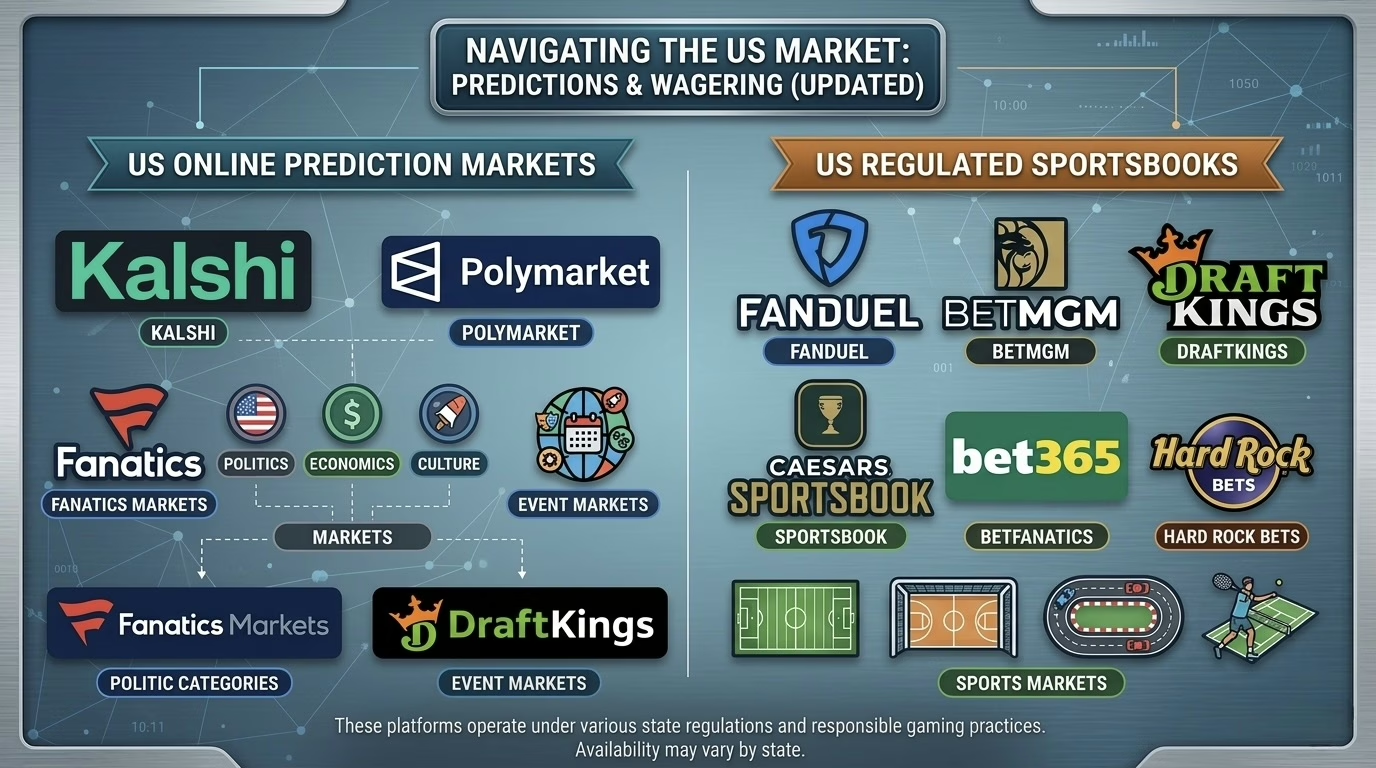
One billion dollars. That’s how much Kalshi processed in trading volume during Super Bowl 2026 which was a 27x increase from the previous year. Let that number sink in for a second. A prediction market and not DraftKings, not FanDuel, not Caesars, handled more action on a single event than most state-regulated sportsbooks see in a month. Let’s dive into the differences between sportsbooks vs. prediction markets.
The prediction market revolution isn’t coming. It’s here. And if you’re a golf bettor who hasn’t explored how these platforms work — or why understanding the differences between prediction markets vs sportsbooks matters for your bankroll — you’re already behind.
I’ve spent the last year testing Kalshi, Polymarket, Fanatics Markets, and the new prediction market products from DraftKings and FanDuel alongside my traditional sportsbook accounts. This is the guide I wish existed when I started. I’m going to explain what these platforms actually are, how they price golf differently, and whether you should switch — or just add another weapon to your arsenal.
What Is a Traditional Sportsbook vs. Prediction Market? (Quick Refresher)
If you’ve ever placed a bet on DraftKings, FanDuel, BetMGM, Caesars, or bet365, you know the model. You bet against the house. The sportsbook sets the odds, takes your action, and pays you out if you win. Simple enough.
But here’s the part most casual bettors don’t think about: those odds aren’t fair. They’re not designed to be. The house builds in a margin — called the vig or juice — on every single market. When you see both sides of a bet priced at -110, that means you’re risking $110 to win $100. If the sportsbook gets equal action on both sides, they collect $220 and pay out $210. That 4.5% they keep? That’s the business model.
And then there’s the dirty secret of traditional sportsbooks: they limit winners. If you’re consistently sharp — meaning you beat the closing line and make money over time — most major sportsbooks will restrict your account. Reduced maximum bet sizes. Banned from certain markets. In some cases, outright account closure. You read that right: the reward for being good at sports betting is being told you can’t bet anymore.
Traditional sportsbooks are currently legal in approximately 38 states plus Washington, D.C. Each state regulates its own market, which means availability, tax rates, and platform offerings vary.
| KEY TAKEAWAY Sportsbooks make money from your losses and from vig. Their incentive is for you to lose. If you win too much, they will limit or ban you. This is the structural conflict at the heart of traditional sports betting. |
What Is a Prediction Market?
A prediction market is not a sportsbook. I need you to internalize that before we go any further, because the mental model matters.
A prediction market is a federally regulated exchange — more like the New York Stock Exchange than a casino. Instead of buying shares of Apple, you buy contracts on real-world outcomes. Those contracts are priced between $0.01 and $0.99, and each one settles at $1.00 if the outcome occurs or $0.00 if it doesn’t.
The price of a contract represents the market’s consensus probability. If a contract is trading at $0.35, the collective wisdom of all participants says there’s a 35% chance that outcome will happen. If you think the real probability is higher, you buy. If you think it’s lower, you sell (or buy NO contracts).
Here’s the critical structural difference: prediction markets are peer-to-peer. When you buy YES contracts, another participant is selling them to you. The platform isn’t on the other side of your bet. The platform makes its money through small transaction fees — typically 1–2% — not from your losses. This means they have zero incentive to limit winning bettors. None. A sharp bettor who trades $100,000 a month generates more fee revenue than a casual bettor who trades $500. Prediction markets want you to win because winners trade more.
Golf example: “Will Rory McIlroy win the 2026 Masters?” The contract is trading at $0.18. The market says there’s an 18% chance he wins. You think it’s closer to 25%. So you buy at $0.18. If Rory wins, each contract pays $1.00 — you profit $0.82 per contract. If he doesn’t, you lose $0.18 per contract. No vig. No juice. Just your assessment of probability versus the market’s.
| WORKED EXAMPLE: $100 Trade on Kalshi You believe Scottie Scheffler has a better-than-25% chance to win the Players Championship. The Kalshi contract for “Scheffler to win” is priced at $0.25 (25% implied probability). Your trade: • You invest: $100 • Price per contract: $0.25 • Number of contracts: 400 ($100 ÷ $0.25) • Platform fee: ~$2.00 (1–2%) If Scheffler wins: • Each contract settles at $1.00 • Your payout: 400 × $1.00 = $400 • Your profit: $400 − $100 − $2 fee = $298 • That’s equivalent to +298 in American odds If Scheffler doesn’t win: • Each contract settles at $0.00 • Your loss: $100 + $2 fee = $102 |
Kalshi now also displays American-style odds (+300, -150, etc.) alongside contract prices, which makes it much easier if you’re transitioning from a traditional sportsbook and thinking in those terms.
The Big Comparison Table
Here’s the side-by-side breakdown of how traditional sportsbooks stack up against the two main prediction market platforms:
| Feature | Traditional Sportsbook | Kalshi | Polymarket |
| Who sets the price? | Oddsmakers at the sportsbook | The market (peer-to-peer supply/demand) | The market (peer-to-peer, blockchain-based) |
| Who takes the other side of your bet? | The sportsbook (the house) | Another market participant | Another market participant |
| How does the platform make money? | Vig/juice + your losses | Transaction fees (~1–2%) | Transaction fees (~1–2%) |
| Can they limit winning bettors? | Yes — and they will | No — structurally cannot | No — structurally cannot |
| Available in all US states? | ~38 states + DC (state-regulated) | ~48 states (CFTC-regulated; blocked in MA, uncertain in NV) | CFTC-regulated DCM since July 2025; US app in phased rollout via waitlist (polymarket.com/usa) |
| Can you exit a bet early? | Cash-out feature (limited, unfavorable pricing) | Yes — sell contracts at current market price anytime | Yes — sell contracts at market price anytime |
| American odds displayed? | Yes — standard format | Yes — shown alongside contract price | No — probability pricing only |
| Golf markets available? | Extensive: futures, props, matchups, live, hole-by-hole | Futures + outright winner (growing) | Futures + outright winner (limited) |
| Regulated by? | State gaming commissions | CFTC (federal) | CFTC (federal) — Designated Contract Market since July 2025 |
| Best for? | Variety of bet types, promos, familiar UX | Sharp bettors, tournament trading, live exits | Odds shopping, arbitrage, global access |
The Key Platforms — Who’s Who in 2026
Kalshi
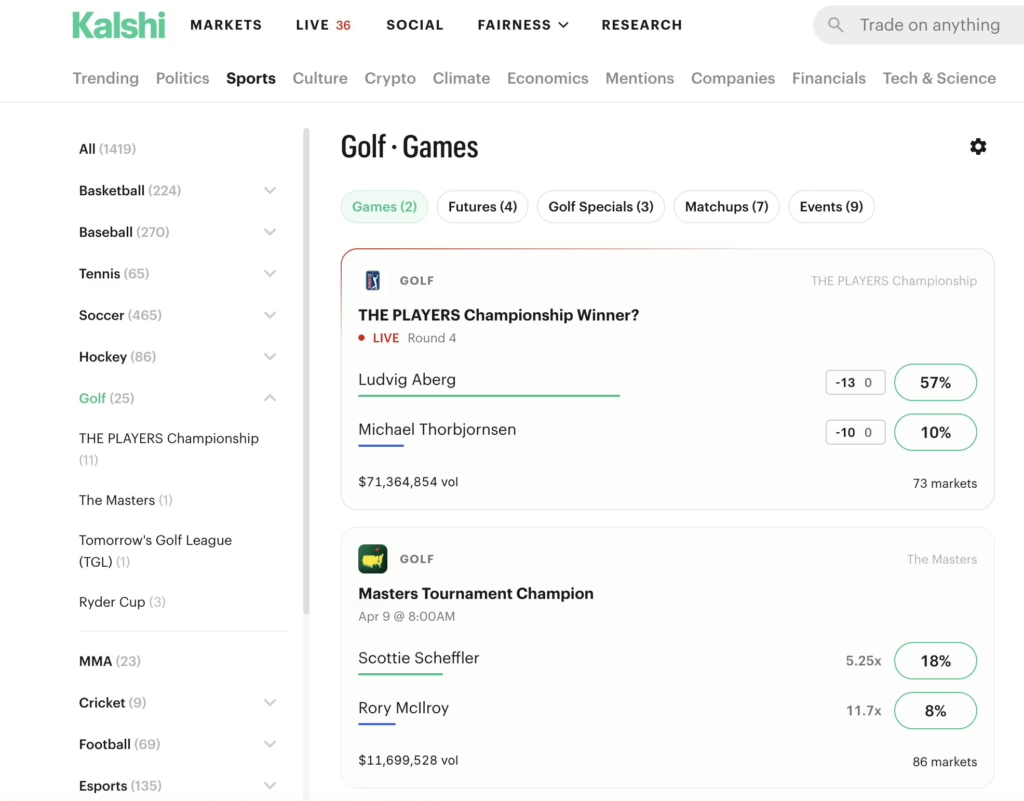
Kalshi is the platform that changed everything. Regulated by the CFTC as a designated contract market, it won a landmark legal battle against the commission in 2024 to offer event contracts on sports outcomes. Since then, it’s exploded. The $1 billion+ Super Bowl 2026 volume wasn’t a fluke — it was validation. Kalshi now displays American-style odds alongside contract prices, has a clean mobile app, and offers markets on major golf tournaments including all four majors. The state-level legal battles in Massachusetts and Nevada are real headwinds, but Kalshi remains available in approximately 48 states. If you’re a US-based golf bettor, this is the prediction market to learn first.
Polymarket
Polymarket has come a long way from its unregulated roots. In July 2025, the CFTC officially designated QCX LLC — operating as Polymarket US — as a federally regulated Designated Contract Market (DCM), the same regulatory classification as Kalshi. Polymarket acquired the CFTC-licensed exchange QCEX for $112 million to make that happen, and a November 2025 amended order expanded the designation to allow US brokerages and retail customers to trade directly through regulated financial channels. The US app launched in early 2026 and is currently rolling out via waitlist at polymarket.com/usa. It’s still built on blockchain and uses the USDC stablecoin for settlement, which means the mechanics feel different from a traditional sportsbook — but “unregulated gray area” is no longer accurate. Polymarket is a federally regulated US exchange. It draws from a larger global participant pool than Kalshi, which often means better pricing on certain golf markets, making it worth having in your toolkit for price comparison once you have access.
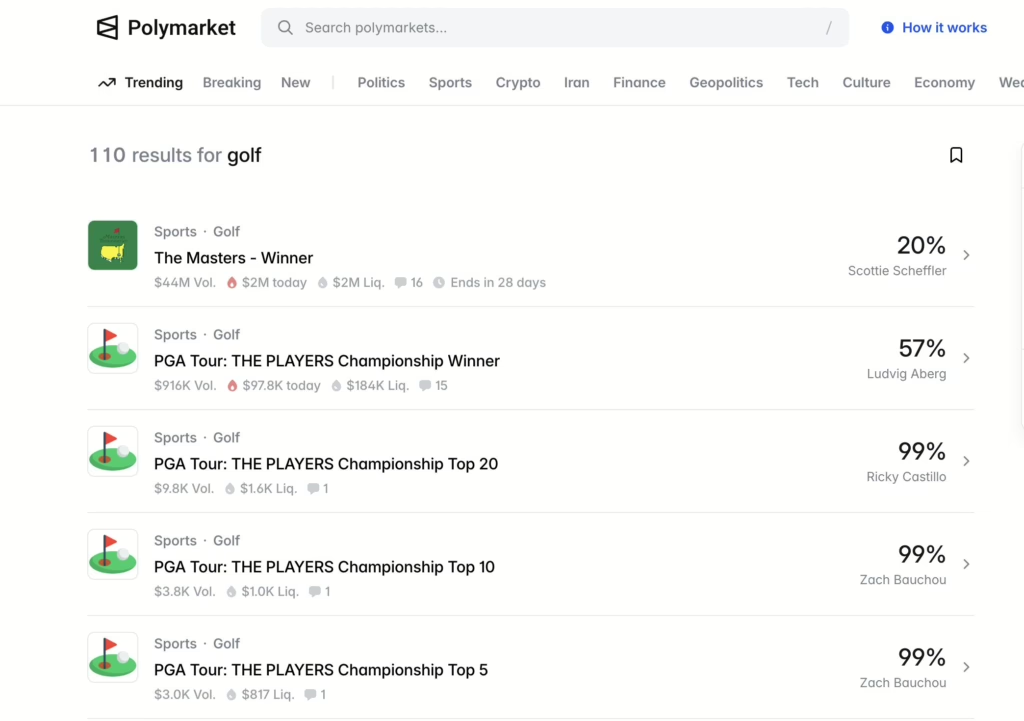
Check out some markets on PolyMarket
Fanatics Markets
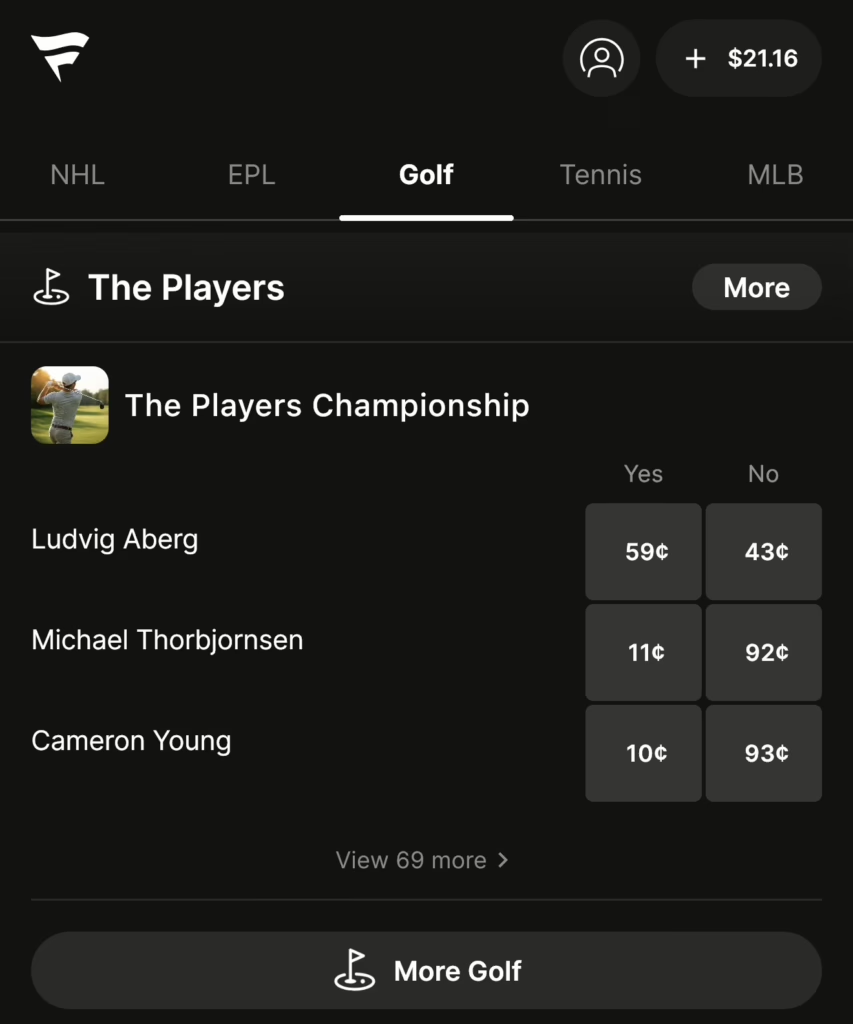
Fanatics entered the prediction market space with the advantage most platforms would kill for: brand trust and an existing user base of millions. Their prediction market product uses a familiar sportsbook-style interface but runs on contract-based mechanics underneath. It’s the best bridge product for traditional bettors who want to dip their toes into prediction markets without learning a new platform from scratch. Golf coverage is growing, and I expect Fanatics to be aggressive in this space throughout 2026.
DraftKings & FanDuel Prediction Markets
Both giants have launched their own prediction market products, offered separately from their traditional sportsbooks in states where regulations allow it. These are early-stage products — the market depth isn’t as strong as Kalshi’s yet, and the feature set is more limited. But the user base advantage is massive. If you already have DraftKings or FanDuel accounts, check whether prediction market products are available in your state. The convenience of having everything in one ecosystem is real.
Robinhood
Robinhood now offers prediction markets powered by Kalshi contracts. If you already invest through Robinhood and want one app for stocks, options, and event contracts, this is the cleanest path. The golf market selection mirrors Kalshi’s, and the interface will feel immediately familiar to anyone who’s traded stocks or options. The downside is that it’s a wrapper around Kalshi — you’re not getting anything you can’t get directly — but the convenience factor is significant for some users.
How Prediction Markets Price Golf Differently
This is where things get genuinely interesting for golf bettors — and it’s the reason I started taking prediction markets seriously.
On a traditional sportsbook, golf odds are set by oddsmakers. These are smart people, but they’re also working with limited resources. The major books have large NFL and NBA teams. Golf? Smaller desks. Less sophisticated modeling. And because golf fields are 120–156 players deep, the vig on outright winner markets is often astronomical — I’ve seen effective juice of 20–40% on some sportsbook golf futures. That’s brutal.
On Kalshi, the price is set by the crowd. Every buy and sell order contributes to price discovery. And because prediction markets are newer and attract a different bettor profile — more finance-minded, fewer traditional sharp bettors — the pricing inefficiencies in golf markets are often significant. I’ve found Kalshi prices that imply 3–5% different probabilities than the equivalent sportsbook odds on the same golfer. That’s an edge you can exploit.
But here’s the real game-changer: you can trade in and out of positions during a tournament. This is the single biggest structural advantage prediction markets have over sportsbooks for golf betting.
| LIVE TRADING EXAMPLE Before the Masters, you buy Rory McIlroy contracts at $0.12 (12% implied probability). After Round 1, Rory shoots 65 and is tied for the lead. His contract price jumps to $0.35 (35% implied probability). You have two choices: 1. Hold — and collect $1.00 per contract if he wins Sunday 2. Sell now at $0.35 — lock in a profit of $0.23 per contract regardless of what happens On a $100 investment (833 contracts at $0.12), selling at $0.35 nets you $291 in profit — with zero Sunday stress. No sportsbook on earth lets you do this. Their cash-out features are limited, poorly priced, and not available on most golf markets. |
Think of it this way: on a sportsbook, a golf futures bet is a lottery ticket. You hold it and hope. On a prediction market, a golf futures bet is a position. You manage it actively. You can trim, add, or exit based on what actually happens on the course. That’s a fundamentally different — and better — way to bet on golf.
The Legal Situation in 2026 (What You Need to Know)
The legal landscape for prediction markets is evolving fast, so let me give you the current picture as of early 2026.
Kalshi is regulated by the CFTC — the Commodity Futures Trading Commission — at the federal level. This is the same agency that regulates commodities futures, options markets, and derivatives exchanges. Prediction market contracts are classified as event contracts or binary options, not as gambling. This federal classification is what allows Kalshi to operate in states that don’t have legal sports betting, because they’re not technically offering sports betting under state law.
However, not everyone agrees with that classification. In January 2026, Massachusetts issued a preliminary injunction blocking Kalshi from offering sports-related event contracts in the state. The argument: these contracts look and function like sports bets, and Massachusetts wants them regulated under state gambling law. Meanwhile, Nevada — the original sports betting state — has sued Kalshi to block operations within its borders, likely motivated by protecting its established sportsbook industry.
As of now, Kalshi’s sports contracts remain available in approximately 48 states, with Massachusetts blocked and Nevada’s situation in litigation. Other states may follow with their own challenges. This is genuinely uncertain legal territory, and I expect at least 2–3 more states to file challenges in 2026.
| BOTTOM LINE ON LEGALITY Kalshi = safest, most legitimate option for US-based bettors. Federally regulated, available in most states. Polymarket = CFTC-regulated DCM since July 2025. US app rolling out via waitlist. Blockchain-based, USDC settlement. Federal regulatory status same as Kalshi. DraftKings / FanDuel / Fanatics prediction markets = regulated where offered, but state availability varies. Always check Kalshi’s website for current state availability before depositing funds. |
Should You Switch From Sportsbooks to Prediction Markets?
Here’s my honest take after a year of using both: don’t switch. Add.
Prediction markets aren’t a replacement for your sportsbook accounts. They’re a complement. The smart play is to have both and use each one where it’s strongest.
Use sportsbooks for:
- Familiar, established markets with deep liquidity
- Same-game parlays and exotic bet types (round matchups, top-10 finishes, hole-by-hole props)
- Sign-up bonuses, promotions, and odds boosts — free money is free money
- Live, in-tournament betting with extensive market variety
Use prediction markets for:
- Outright winner futures where you want to trade in and out during the tournament
- States where sports betting isn’t legal but CFTC-regulated prediction markets are accessible
- Markets where sportsbook prices are worse than prediction market prices (compare before betting)
- When you’ve been limited or banned by a sportsbook — prediction markets will never limit you
The arbitrage opportunity is real. Compare Kalshi contract prices to DraftKings or FanDuel odds on the same golfer. Convert both to implied probabilities. When the difference is 3% or more, there’s an exploitable edge.
| ARBITRAGE EXAMPLE DraftKings has Xander Schauffele to win the US Open at +800. Implied probability: 1 ÷ (800/100 + 1) = 11.1% Kalshi has the same outcome priced at $0.14 (14% implied). The sportsbook is giving you a better price — 11.1% vs. 14%. Take the DraftKings line. If Kalshi had priced it at $0.08 (8%) and DraftKings at +800 (11.1%), Kalshi would be the better value. Always compare. |
The bettors who will have the biggest edge in 2026 are the ones who can move fluidly between platforms, compare prices in real time, and use each tool for what it does best. That’s the skillset to build.
Frequently Asked Questions About Sportsbooks Vs. Prediction Markets
Q: Are prediction markets legal in my state?
A: Kalshi is available in most US states as a CFTC-regulated exchange. As of early 2026, Massachusetts has a court injunction blocking sports contracts, and Nevada has filed suit. Approximately 48 states currently have access. Always check Kalshi’s website for your state’s current status before signing up. Polymarket received CFTC designation as a Designated Contract Market in July 2025 and is now a federally regulated US exchange. Its US app is currently rolling out via waitlist at polymarket.com/usa.
Q: Can I really exit a prediction market bet early?
A: Yes — and this is one of the biggest advantages over traditional sportsbooks. Your contracts trade on an open market, just like stocks. If you bought Rory McIlroy at $0.12 before a major and he’s leading after two rounds, your contracts might be worth $0.40. You can sell at that price and lock in profit without waiting for the tournament to end. Sportsbooks offer “cash out” features, but they’re typically limited, unavailable on many golf markets, and priced unfavorably compared to true market exits.
Q: Do prediction markets have the same golf markets as sportsbooks?
A: Not yet. Kalshi excels at outright winner futures for major tournaments and significant PGA Tour events. Sportsbooks still dominate in market variety — they offer round matchups, top-5 and top-10 finishes, hole-by-hole props, same-game parlays, and live in-tournament betting with far more granularity. The best approach right now is to use prediction markets for futures trading and sportsbooks for everything else. I expect prediction market golf coverage to expand significantly throughout 2026.
Q: How is Polymarket different from Kalshi?
A: Kalshi is US-regulated by the CFTC, uses US dollars, has a familiar web and mobile interface, and is the safest option for American bettors. Polymarket is decentralized, built on blockchain, uses cryptocurrency (USDC stablecoin) for transactions, operates globally, and is now a CFTC-regulated Designated Contract Market since July 2025. Polymarket often has better prices and liquidity on certain markets because it draws from a global participant pool. But it requires crypto knowledge, has no regulatory protections, and doesn’t display American-style odds. Kalshi for safety and accessibility. Polymarket for price advantage and global markets.
Q: Won’t sportsbooks just copy prediction markets?
A: They’re already trying. DraftKings, FanDuel, and Fanatics have all launched prediction market products. But their versions currently don’t replicate the full structural advantages of platforms like Kalshi. Most importantly, true peer-to-peer markets with real-time exit capability and no bettor limits are fundamentally different from a sportsbook adding a “contract” wrapper on top of its existing model. The sportsbook’s core business still depends on vig and bettor losses. Until that changes, pure prediction markets will retain structural advantages for sharp bettors.
The Bottom Line
The prediction market revolution is real, and golf is one of the sports where it makes the most sense. Multi-day tournaments are tailor-made for contract trading. The ability to buy a golfer before the tournament, watch the price move after round one, and decide whether to hold or sell — that’s a level of control that sportsbooks have never offered and probably never will.
My advice: don’t abandon your DraftKings or FanDuel accounts. But open a Kalshi account this week and fund it with $50–$100. Start watching how golf contract prices move during a tournament. Learn the mechanics. Compare the pricing to what your sportsbook is offering. Within a few weeks, you’ll start seeing the edges.
The bettors who understand both worlds — traditional sportsbooks and prediction markets — are the ones building real, sustainable edges in 2026. Be one of them.
Next up: My specific strategy for trading golf markets on Kalshi, Polymarket, and Fanatics Markets — including the exact process I use to compare prices, time my entries, and manage live positions during tournaments. Stay tuned. Also read more of my articles here.