Field & Culture
The 25 Best Public Golf Courses in the US
The 25 best public golf courses in the US, ranked for 2026. From bucket-list layouts to hidden gems, Lord Eagleman III breaks down where you need to play.


The best public golf courses in the US represent something the game’s founding fathers could scarcely have imagined: world-class architecture, championship conditioning, and breathtaking settings available to any golfer willing to book a tee time and make the journey. We are living through an era of unprecedented public golf excellence. The courses on this list are not consolation prizes for those without a private club membership. They are, in many cases, superior to the most storied private enclaves in the land — and they welcome you.
I have played them all, or near enough. I have stood on the first tee at Pebble Beach as the Pacific fog burned off the cliffs. I have walked the fescue-cloaked dunes at Bandon in a sideways gale, laughing at the absurdity of it all. I have stood in the center of Bethpage Black’s first fairway and read the famous warning sign with the reverence it deserves. What follows is not a list assembled from a spreadsheet. It is a reckoning — a considered, opinionated, and deeply felt accounting of where American public golf stands in 2026.
How We Ranked the Best Public Golf Courses in the US
To rank the best public golf courses in the US with any intellectual honesty, you must first establish what you are actually measuring. This is not a popularity contest, and it is not a comfort survey. The criteria that governed this list are the same ones that have governed serious golf course evaluation for a century.
Architectural merit is the foundation. A great course poses compelling strategic questions on every hole. It rewards the thoughtful player, punishes the careless one, and offers multiple routes to the hole that make every playing group’s experience slightly different. The routing must feel inevitable — as if the course could not have been built any other way on that particular piece of land.
Sense of place is equally vital. Golf is a game of landscape, and the best courses are inseparable from their terrain. Pebble Beach without the Pacific cliffs is a decent municipal track. Bethpage Black without the gnarled, muscular terrain of Long Island is just a long golf course. The land and the design must speak to each other.
Conditioning and playability matter, though they are weighted below architecture. A course that is brilliantly designed but poorly maintained loses points. A course that is immaculate but architecturally pedestrian never makes this list in the first place.
Finally, accessibility and value are considered. A course that charges $1,000 and delivers a transcendent experience earns its place. A course that charges $75 and delivers something comparable earns it even more emphatically.
The rankings below synthesize decades of personal play, the consensus of the most respected course-ranking panels in the game — including Golf Digest’s biennial survey of America’s 100 Greatest Public Courses — and an honest accounting of what makes golf worth playing in the first place.
Best Public Golf Courses in the US: The Top 10
1. Pebble Beach Golf Links — Pebble Beach, California
Green Fees: $675 (walking) | Difficulty: 9/10 | Best Hole: No. 18
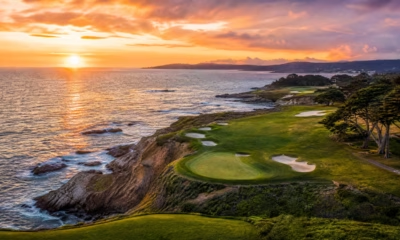
There is no more important piece of ground in American public golf. Jack Neville and Douglas Grant’s 1919 routing along the Monterey Peninsula cliffs is the standard against which all other public courses are measured, and it has never been surpassed. The stretch from the 4th hole through the 10th — where the course clings to the edge of the Pacific — is the most dramatic sequence in the game. Every hole presents a different relationship with the ocean: sometimes it is a backdrop, sometimes a hazard, always a presence.
The 18th is the defining finishing hole in golf. A par-5 that plays entirely along the water, with a massive cypress tree guarding the approach and the entire left side open to the sea, it demands a final act of courage from every player who has ever walked it. The green fees are steep and climbing annually, but there is no public golf experience in the world that justifies a premium more convincingly.
Detail Info Location Pebble Beach, CA Green Fees ~$675 Designer Jack Neville & Douglas Grant (1919) Difficulty 9/10 Best Hole No. 18 (par-5, ocean left)
2. Pacific Dunes — Bandon, Oregon
Green Fees: $110–$450 (seasonal) | Difficulty: 8.5/10 | Best Hole: No. 13
Tom Doak’s 2001 masterpiece is the finest pure links design on American soil. It emerges from shore pines and fescue onto a series of dramatic clifftop holes that offer views of the Pacific and playing conditions that change by the hour. Doak worked with the land rather than against it, finding holes that feel as if they were always there, waiting to be discovered. The greens are complex, the fairways firm, and the wind is the most reliable playing partner you will ever have.
The par-4 13th, playing along the cliff edge with the ocean roaring below, is among the finest holes in the world. Pacific Dunes consistently ranks as the second-best public course in America on Golf Digest’s panel, and the argument for placing it first is not entirely without merit. It is a course that demands you think, feel, and improvise — the three highest virtues in the game.
3. Pinehurst No. 2 — Pinehurst, North Carolina
Green Fees: Resort package required | Difficulty: 9.5/10 (around the greens) | Best Hole: No. 5
Donald Ross built his masterpiece on a sandy, longleaf pine-covered plateau in the North Carolina Sandhills, and it has served as the site of more major championships than any other course in America. The genius of No. 2 is its deceptive simplicity. There is no water. The fairways are wide. The pines frame each hole with stately elegance. And yet, the inverted-saucer greens — crowned, sloped, and perfectly positioned to repel anything less than a precise approach — make it one of the most demanding tests in the game.
Kyle Franz’s 2011 restoration, which removed the collar of rough around the greens and replaced it with sandy waste areas, returned the course to something close to Ross’s original vision. The result is a course where the short game is everything. You can drive it 320 yards and still make bogey on every hole if your wedge game is not precise. That is the mark of a truly great design.
4. Whistling Straits (Straits Course) — Kohler, Wisconsin
Green Fees: ~$600 | Difficulty: 10/10 | Best Hole: No. 17 (“Pinched Nerve”)
Pete Dye took a flat, featureless stretch of land along Lake Michigan and, with a staggering amount of earthwork, created something that looks and plays like a rugged Irish links. The result is simultaneously artificial and utterly convincing. The 1,000-plus bunkers are not a gimmick; they are the course’s primary defense, lurking in the rough, guarding the fairways, and framing the greens with menace. The wind off the lake ensures that no two rounds ever play the same way.
The 2021 Ryder Cup confirmed what golf architecture enthusiasts had long known: Whistling Straits is one of the most demanding and visually spectacular venues in the world. The par-3 17th, a terrifying drop-shot over sand and scrub to a green perched at the lake’s edge, is the hole that separates the brave from the prudent.
5. Kiawah Island Golf Resort (The Ocean Course) — Kiawah Island, South Carolina
Green Fees: ~$600 | Difficulty: 10/10 | Best Hole: No. 17














Pete Dye designed The Ocean Course for the 1991 Ryder Cup — the “War by the Shore” — and it has never stopped delivering drama. With more oceanside holes than any course in the Northern Hemisphere, it is a relentless, wind-battered examination of every aspect of the game. The fairways are generous enough, but the wind turns routine shots into agonizing decisions. Club selection is a constant negotiation with the elements.
The course’s difficulty rating is the highest on this list, and that is not an accident. The Ocean Course does not flatter anyone. It is a serious test for serious players, and the setting — salt air, sawgrass, and the Atlantic horizon — makes every difficult moment feel earned.
6. Bethpage State Park (Black Course) — Farmingdale, New York
Green Fees: $75 (NY Resident) / $150 (Non-Resident) | Difficulty: 10/10 | Best Hole: No. 4
The Black Course is the great democratic institution of American golf. A.W. Tillinghast’s 1936 design is a bruising, muscular, uncompromising test that has hosted two U.S. Opens and a PGA Championship. The famous sign on the first tee — warning that the course is recommended only for highly skilled golfers — is not hyperbole. The rough is thick, the fairways are narrow, and the greens are fast and complex. It is a course that demands respect.
What makes Bethpage Black extraordinary beyond its architecture is its accessibility. At $150 for non-residents, it is among the greatest green-fee values in the world. Golfers camp overnight in the parking lot to secure morning tee times on weekends. That devotion is the highest compliment a course can receive.
7. Shadow Creek — North Las Vegas, Nevada
Green Fees: $1,250 (MGM Resorts stay required) | Difficulty: 8/10 | Best Hole: No. 17
Tom Fazio carved a lush, rolling, Carolina-style landscape out of the flat Nevada desert at a reported cost of $47 million. The result is a surreal, immaculate experience that feels entirely disconnected from its surroundings — which is, of course, the point. Shadow Creek is the golf equivalent of a five-star hotel: every detail is considered, every surface is perfect, and the whole experience exists in a kind of beautiful isolation from the real world.
The green fee is the highest on this list, and it requires a stay at an MGM property. But for those who seek the absolute pinnacle of conditioning and service in American public golf, Shadow Creek is without peer.
8. TPC Sawgrass (Stadium Course) — Ponte Vedra Beach, Florida
Green Fees: $600–$900 (seasonal) | Difficulty: 9/10 | Best Hole: No. 17
Pete Dye’s permanent home of The Players Championship is the most famous golf course in Florida and one of the most recognizable layouts in the world. The Stadium Course tests every club in the bag, demands precise shot-making from tee to green, and builds to a finish that is as nerve-wracking as any in the sport. The 17th island green has swallowed more balls — and more dreams — than any other hole in professional golf.
Playing TPC Sawgrass is a pilgrimage for any serious student of the game. The experience of standing on the 17th tee, knowing exactly what is required, and executing the shot anyway is a test of character that no amount of practice can fully prepare you for.
9. Bandon Dunes — Bandon, Oregon
Green Fees: $110–$450 (seasonal) | Difficulty: 7.5/10 | Best Hole: No. 16
The course that started the destination golf revolution. When David McLay Kidd’s original Bandon Dunes routing opened in 1999, it proved that American golfers would travel to the middle of nowhere for a world-class links experience. The routing is more forgiving than Pacific Dunes, with wider fairways and a more celebratory character, but it is no less beautiful. The clifftop holes offer some of the most spectacular scenery in golf.
Bandon Dunes the resort now encompasses six courses, a short course, and a putting course, making it the most complete golf destination in the United States. The original course remains the emotional heart of the property.
10. Erin Hills — Erin, Wisconsin
Green Fees: $395–$495 | Difficulty: 9/10 | Best Hole: No. 12
Carved from the glacier-sculpted drumlins of southeastern Wisconsin, Erin Hills is a grand, sprawling, fescue-covered examination of every shot in the bag. Hurdzan, Fry, and Whitten’s design uses the natural topography brilliantly, routing holes through valleys, over ridges, and around massive fescue-covered mounds that serve as both visual framing and strategic hazard. The 2017 U.S. Open confirmed its championship credentials.
The scale of the place is remarkable. At over 7,800 yards from the tips, it is one of the longest courses in the country, but the routing never feels manufactured. It feels found.
Best Public Golf Courses in the US: #11–25
The depth of quality in American public golf is staggering. These fifteen venues round out the top 25, each delivering a world-class experience in its own right.
Rank Course Location Approx. Green Fee Designer 11 Bandon Trails Bandon, OR $110–$450 Coore & Crenshaw 12 The Lido at Sand Valley Nekoosa, WI $100–$350 Gil Hanse (restoration) 13 Spyglass Hill Pebble Beach, CA ~$400 Robert Trent Jones Sr. 14 Old Macdonald Bandon, OR $110–$450 Doak & Urbina 15 Pasatiempo Golf Club Santa Cruz, CA ~$295 Alister MacKenzie 16 Arcadia Bluffs (Bluffs) Arcadia, MI $135–$195 Rick Smith & Warren Henderson 17 Landmand Golf Club Homer, NE ~$175 King & Collins 18 Streamsong Red Bowling Green, FL ~$460 Coore & Crenshaw 19 Chambers Bay University Place, WA $149–$425 Robert Trent Jones II 20 Kapalua Plantation Course Kapalua, HI ~$350 Coore & Crenshaw 21 Forest Dunes Roscommon, MI $95–$185 Tom Weiskopf 22 Cabot Citrus Farms (Karoo) Citrus County, FL ~$250 Kyle Franz 23 Torrey Pines South La Jolla, CA $258–$322 Rees Jones 24 Gamble Sands Brewster, WA ~$175 David McLay Kidd 25 Pine Needles Southern Pines, NC ~$250 Donald Ross
Bandon Trails is the hidden gem of the Bandon resort — a routing through dunes, meadows, and forest that offers a completely different character from its oceanside siblings. Coore and Crenshaw’s design is more introspective, more varied, and in some respects more interesting than the clifftop courses that get all the attention.
Landmand Golf Club in the Nebraska Loess Hills deserves special mention as the most exciting arrival in American public golf over the past three years. King and Collins built something bold, massive in scale, and deeply fun — a course with 33,000 square feet of putting surface on a single hole and elevation changes that would make a mountain goat nervous. It sold out its 2025 tee times within an hour of release. That is not a coincidence.
Cabot Citrus Farms’ Karoo course is the most significant new public golf development in Florida in decades. Kyle Franz’s design embraces the sandy, scrubby, minimalist aesthetic that has defined the best new courses of the past decade, and it does so in a state not known for that kind of golf. It is a revelation.
Best Public Golf Courses in the US by Region
Northeast
The Northeast is the cradle of American golf, but public access to its finest historic designs is frustratingly limited. Bethpage Black stands alone as the undisputed king of public golf in the region — a genuine championship venue available to anyone with the patience to book a tee time and the game to survive it. Yale Golf Course in New Haven, Connecticut, a Charles Blair Macdonald and Seth Raynor design, is a remarkable architectural artifact available to the public. Taconic Golf Club in Williamstown, Massachusetts, offers brilliant classic architecture in a stunning Berkshires setting.
Southeast
The Southeast is the richest region for public golf architecture in America. The North Carolina Sandhills alone — home to Pinehurst No. 2, Pine Needles, Mid Pines, and the newly renovated Southern Pines Golf Club — constitute a pilgrimage destination of the first order. South Carolina’s Kiawah Island and Harbour Town Golf Links anchor the coastal end of the spectrum. Florida has been transformed by the arrival of Streamsong and Cabot Citrus Farms, moving the state’s public golf identity away from flat, water-laden resort tracks toward something far more architecturally serious.
Midwest
The Midwest has become the undisputed epicenter of the modern American golf resort. Wisconsin leads the charge with an extraordinary concentration of elite public golf: Sand Valley (home to The Lido, Sand Valley, Mammoth Dunes, and Sedge Valley), Whistling Straits, Erin Hills, and the classic Lawsonia Links. Michigan contributes Arcadia Bluffs and Forest Dunes. Nebraska, improbably, has entered the conversation with Landmand and the legendary Sand Hills Golf Club. The Midwest’s wide, open landscapes and sandy soils have proven to be ideal canvases for the firm-and-fast, links-inspired golf that defines the best modern design.
Southwest
The Southwest offers a completely different palette. Desert golf, when done well, is a spectacular experience — emerald fairways carved against red rock, saguaro cactus standing sentinel at the edges of the rough, and mountain backdrops that dwarf the entire enterprise. Shadow Creek in Nevada is the region’s most famous public course, though its price point places it in a category of its own. Arizona’s Quintero Golf Club and New Mexico’s Paa-Ko Ridge offer dramatic, elevation-rich experiences at more accessible price points. Texas’s PGA Frisco complex has added a new dimension to the region’s public golf landscape.
West Coast
The West Coast is, quite simply, the most spectacular region for public golf in the world. The Monterey Peninsula alone — Pebble Beach, Spyglass Hill, Pasatiempo — would constitute a world-class destination. The Oregon coast, anchored by the Bandon Dunes resort, has become the most celebrated golf destination in America. Washington State punches above its weight with Chambers Bay and Gamble Sands. California’s Torrey Pines offers a rare combination of municipal accessibility and championship pedigree. The West Coast is where the American public golf story reaches its most dramatic chapter.
Best Public Golf Courses Under $100 (Hidden Gems)
Not all great golf requires a second mortgage. Some of the best public golf courses in the US are municipal tracks, university courses, and rural hidden gems that offer genuine architectural excellence for under a hundred dollars. These are the courses that reward the curious golfer willing to venture off the beaten path.
Lawsonia Links — Green Lake, Wisconsin (~$65–$90): William Langford and Theodore Moreau’s 1930 design is one of the most underrated courses in America. Built on a glacially sculpted site, it features wild elevation changes, steep-faced bunkers, and a routing that demands every shot in the bag. It consistently appears on Golf Digest’s list of America’s 100 Greatest Public Courses and rarely costs more than $90.
Wild Horse Golf Club — Gothenburg, Nebraska (~$70): Built by the same shapers who worked on the legendary Sand Hills Golf Club, Wild Horse is a minimalist prairie masterpiece. The fairways are wide, the greens are complex, and the sandy waste areas are both beautiful and penal. It is a course that could charge twice as much and still represent good value.
George Wright Golf Course — Boston, Massachusetts (~$55): A Donald Ross municipal design in Hyde Park that has been lovingly restored in recent years. The routing is brilliant, the greens are complex, and the history is palpable. It is the kind of course that reminds you why public golf matters.
Northwood Golf Club — Monte Rio, California (~$30): Alister MacKenzie’s nine-hole design routed through towering coastal Redwoods is a spiritual experience. The greens are among the most complex MacKenzie ever built, and the setting is unlike anything else in golf. At $30, it is the greatest value in American public golf.
Cog Hill No. 4 (Dubsdread) — Lemont, Illinois (~$80–$100): Dick Wilson and Joe Lee’s design, long the home of the Western Open, is a demanding, tree-lined test that has challenged the best players in the world. It is available to the public at a fraction of what comparable courses charge.
Tips for Playing the Best Public Golf Courses in the US
Playing the best public golf courses in the US requires more than a good swing. These venues demand preparation, the right equipment, and the right mindset.
Embrace the ground game. The finest courses on this list — Bandon Dunes, Sand Valley, Chambers Bay, Lawsonia — are designed to be played on the ground as much as through the air. The bump-and-run is not a concession; it is a weapon. Learn to use the contours of the fairway and the slopes around the greens to your advantage. Courses that play firm and fast reward creativity and punish the golfer who insists on hitting high, spinning wedges into every green.
Walk whenever possible. Golf was designed as a walking game, and the best public courses in America are best experienced on foot. The rhythm of walking, the physical engagement with the terrain, and the unobstructed view of the routing are all diminished from a cart. Hire a caddie if the course offers them; the local knowledge alone is worth the investment. If you are planning a walking trip, make sure your bag is up to the task — our guide to the best golf bags 2026 covers the top carry and cart options for every budget.
Book early and plan around the weather. The most sought-after tee times at courses like Bethpage Black, Pebble Beach, and the Bandon resort can be booked months in advance. Do not wait. For coastal and prairie courses, check the wind forecast and embrace whatever conditions you find. A round at Pacific Dunes in a 30-mph gale is not a misfortune; it is the point.
Respect the etiquette. These are hallowed grounds, and the golfers who play them take the game seriously. Replace your divots, fix your pitch marks, keep up the pace, and leave the course in better condition than you found it. A thorough review of golf etiquette 101 will ensure you are a welcome guest at any of these venues.
Prepare your game and your gear. If you are planning a spring or early-season trip to one of these bucket-list venues, use our spring golf checklist to ensure your equipment is ready for the test. The best courses in America deserve your best game.
The best public golf courses in the US are not just places to play golf. They are places to understand what the game can be at its highest level — architectural, spiritual, and deeply human. Every round on this list is a conversation with the land, the history, and the game itself. Book the tee time. Make the journey. The course is waiting.
Lord Eagleman III has walked the fairways of more great courses than most people have heard of. He prefers persimmon off the tee, believes that a round over four hours is a crime against the game, and considers a well-struck 2-iron the most satisfying shot in golf. Follow his dispatches at /author/eagle3/.