Blog
You’re On The Green, Now What?
Half of your golf score comes from putting!
Mastering Golf Putting Grips: Claw, Two Thumbs, Left-Hand Low & More
In the intricate world of golf, where every stroke counts, how a golfer grips their putter can significantly impact their performance on the green. From the traditional to the unconventional, let’s delve into some popular putting grips—the Claw, the Two Thumbs, the Left-Hand Low, the Arm Lock, the Long Putter Claw, and the Alternative Reverse Overlap—to understand their mechanics and benefits.
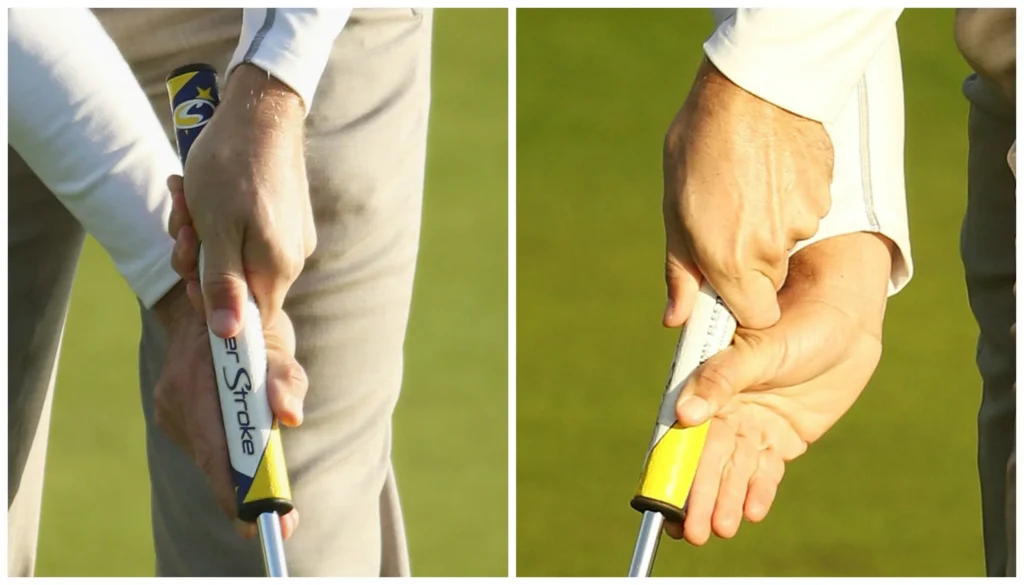
The Claw Grip
The Claw grip has gained popularity among professional and amateur golfers alike due to its ability to promote a more stable putting stroke. In this grip:
- The dominant hand (typically the right hand for right-handed golfers) holds the putter with the fingers forming a “claw” shape.
- The non-dominant hand remains in a conventional grip position on the upper part of the handle.
This method minimizes the influence of the dominant hand, reducing the chances of flipping or excessive wrist movement during the stroke. The result is a smoother and more consistent putting motion. Golfers who struggle with the yips or overly active wrists often find relief using the Claw grip.
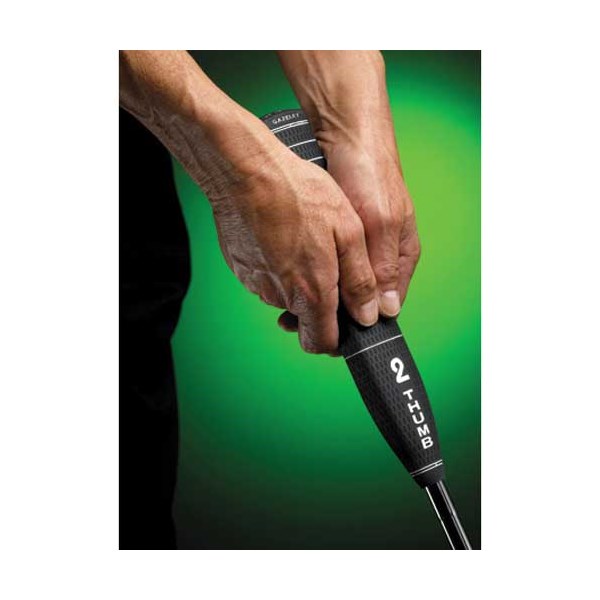
The Two Thumbs Grip
True to its name, the Two Thumbs grip involves positioning both thumbs on the top of the putter grip. Here’s how it works:
- Both hands are placed symmetrically on the handle, with the thumbs running parallel to each other on the flat surface of the grip.
This grip encourages a balanced and unified hand action, which promotes a pendulum-like stroke. Golfers who prefer simplicity and symmetry often gravitate towards the Two Thumbs grip, as it eliminates unnecessary wrist action and helps maintain a straight putter path.

The Left-Hand Low Grip
The Left-Hand Low grip, also known as the Cross-Handed grip, is a popular option for golfers seeking improved control and alignment. In this grip:
- The left hand (for right-handed golfers) is placed below the right hand on the putter handle.
This configuration helps keep the shoulders level and reduces wrist breakdown during the stroke. Many players find that this grip enhances their ability to keep the putter face square to the target line.
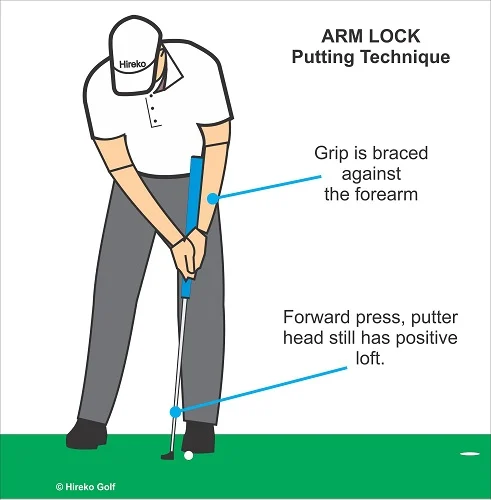
The Arm Lock Grip
The Arm Lock grip is a modern innovation designed to provide maximum stability. Here’s how it works:
- The grip is extended up the leading arm (usually the left arm for right-handed golfers), creating a locked position.
- Both hands conventionally hold the putter, but the handle’s connection to the arm reduces wrist action.
This grip offers exceptional control and consistency, making it a favorite among golfers looking to eliminate variability in their putting stroke.

The Long Putter Claw Grip
The Long Putter Claw grip combines the advantages of a long putter with the stability of the Claw technique. In this grip:
- The non-dominant hand holds the top of the long putter shaft for support and alignment.
- The dominant hand adopts the Claw grip further down the shaft.
This method reduces wrist involvement and provides a pendulum-like motion, ideal for players who prefer the anchoring feel of a long putter without violating current regulations.
The Alternative Reverse Overlap Grip
The Reverse Overlap grip is a traditional favorite, but its alternative variation adds a unique twist:
- The non-dominant hand assumes the primary role, gripping the handle near the top.
- The dominant hand overlaps the non-dominant hand’s index finger, creating a firm connection between both hands.
This grip fosters excellent control and stability, ensuring that your hands work in unison during the stroke. By focusing on the non-dominant hand, golfers can achieve a smoother and more deliberate putting stroke, reducing the influence of jerky movements from the dominant hand.
Choosing the Right Grip
Selecting the ideal putting grip often depends on personal preference, hand size, and the challenges a golfer faces on the green. Experimentation is key—what works for one player might not suit another. The ultimate goal is to find a grip that provides comfort, control, and consistency.
Final Thoughts
The journey to mastering putting is as much about technique as feeling and confidence. Whether you opt for the Claw, the Two Thumbs, the Left-Hand Low, the Arm Lock, the Long Putter Claw, or the Alternative Reverse Overlap, understanding the mechanics and benefits of each grip can help you make an informed decision. Practice diligently, and remember that the right grip can transform your game—one putt at a time.
Blog
Mastering the Art of Overcoming Choking under Pressure: Strategies for Peak Performance
Learn the skills needed to stay calm under pressure.
Imagine this: you’ve spent countless hours honing your skills, preparing for that big presentation, important meeting, or decisive sports match. But, when the big moment arrives, instead of performing at your best, your mind goes blank, your hands shake, and you flub it. The dreaded phenomenon of ‘choking under pressure’ can strike anyone, from the seasoned professional to the eager amateur. So, how do you overcome this common mental roadblock? In this article, we’ll explore effective strategies to help you conquer the fear of choking and elevate your performance under pressure.
Understanding Choking under Pressure
Before you can overcome choking, it’s crucial to understand what it is. Psychologists define choking as performing below your ability under pressure. This can be due to heightened anxiety, overthinking, or fear of failure. The irony is, the more you care about performing well, the more likely you are to choke.
Why Do We Choke?
Several factors contribute to choking under pressure. Here are a few:
-
- Fear of Negative Evaluation: The fear of being judged negatively by others can cause significant anxiety, leading to poor performance.
- High Stakes: When the stakes are high, and the outcome is important, the pressure can cause you to underperform.
- Overthinking: The tendency to scrutinize every detail in high-pressure situations can divert your focus from the task at hand.
Strategies to Overcome Choking
Now that we understand why we choke, let’s delve into strategies to prevent it:
- Practice Under Pressure: Simulate high-pressure situations during practice to acclimate yourself to the stress.
- Focus on the Process, Not the Outcome: Concentrating on the process helps keep your mind focused and prevents overthinking.
- Use Positive Affirmations: Positive self-talk can boost your confidence and reduce anxiety.
Case Studies: Athletes Overcoming Choking
Many successful athletes have overcome choking to deliver exceptional performances. Take Michael Jordan, for example. He often missed crucial shots early in his career but used these failures to fuel his determination and eventually became renowned for his clutch performances. Similarly, Serena Williams has bounced back from choking in several matches to claim victory, demonstrating her mental toughness.
Choking under pressure is a common phenomenon, but with the right strategies, it can be overcome. By understanding the causes of choking and implementing techniques like practicing under pressure, focusing on the process, and using positive affirmations, you can learn to perform at your best when it counts the most. Remember, it’s not about never feeling pressure; it’s about learning how to thrive within it.
As Michael Jordan said, “I’ve missed more than 9,000 shots in my career. I’ve lost almost 300 games. 26 times, I’ve been trusted to take the game-winning shot and missed. I’ve failed over and over and over again in my life. And that is why I succeed.” So, next time you face a high-pressure situation, think of it as an opportunity to grow, not a threat to be feared.
If you’ve enjoyed this article and want to learn more about mastering your mental game, subscribe to our newsletter for more tips and strategies. Or, if you’re ready to take your mental toughness to the next level, check out our other articles designed to help you conquer pressure and perform at your peak.
Blog
Golf Course Aesthetics: Exploring the Artistry of Manicured Landscapes
Imagine standing at the tee of a beautifully manicured golf course, gazing out across a landscape of rolling greens, sculpted bunkers, and artfully placed bodies of water.
The Intersection of Golf and Art: Viewing Golf Courses as Living Masterpieces
Imagine standing at the tee of a beautifully manicured golf course, gazing out across a landscape of rolling greens, sculpted bunkers, and artfully placed bodies of water. The course stretches out before you like a canvas, a living masterpiece of design and nature. This is where golf and art intersect, where the game becomes more than just a sport and the course becomes more than just a playing field. It is a crossroads where the beauty of nature and the aesthetics of design come together to create a truly unique experience.
Understanding Golf Courses as Works of Art
Golf courses are meticulously designed and maintained, with every element placed with purpose and intention. They are the result of careful planning, creative vision, and a deep understanding of both the game of golf and the principles of landscape design. In this way, they can be viewed as works of art, with the designer acting as the artist and the landscape serving as the canvas.
The Aesthetics of Golf Course Design
Golf course design is a subtle blend of art and science. Designers must consider a range of factors, including the natural features of the landscape, the skills and abilities of the players, and the overall aesthetic of the course.
Key elements of golf course design include:
- Landscape: The natural features of the landscape, including trees, water bodies, and elevation changes, are integral to the design of a golf course.
- Layout: The layout of a golf course is carefully planned to provide a balance of challenge and enjoyment for players.
- Hazards: Hazards, such as bunkers and water bodies, are strategically placed to add challenge and visual interest to the course.
- Green Complexes: These are the areas surrounding the putting surfaces. They include elements such as bunkers, mounds, and grassy hollows, all of which contribute to the aesthetic appeal and challenge of the course.
The Artistic Influence on Golf Courses
Many renowned golf course designers approach their work with an artist’s eye. They view the landscape as a blank canvas, using the natural features of the land and the principles of design to create an aesthetically pleasing and challenging course.
One of the most influential golf course designers, Alister MacKenzie, was actually a trained surgeon before he turned his hand to course design. His medical background gave him a unique perspective on the relationship between the human body and the landscape, and he used this knowledge to create courses that were both beautiful and challenging to play.
In his book, “The Spirit of St. Andrews,” MacKenzie wrote, “A golf course should be a beautiful place, so arranged that it pleases the eye and stimulates the mind, while the game itself brings the muscles into play.” This philosophy is evident in his designs, which are renowned for their natural beauty and strategic complexity.
Golf Course Design and Environmental Art
In recent years, there has been a growing recognition of golf course design as a form of environmental art. This is due to the increasing focus on sustainability and environmental conservation in the design and maintenance of golf courses.
An excellent example of this is the work of Bill Coore and Ben Crenshaw, who are known for their minimalist approach to course design. Their courses are designed to fit seamlessly into the natural landscape, with minimal alteration of the land. They use the existing topography and vegetation to create a course that is both challenging and visually stunning.
The Future of Golf Course Design
As we look to the future, the intersection of golf and art is set to become even more pronounced. With advances in technology, designers have increasingly sophisticated tools at their disposal, allowing for even greater creativity and innovation in course design.
At the same time, there is a growing emphasis on sustainability and environmental stewardship, with designers striving to create courses that are not only beautiful and challenging to play, but also in harmony with the natural environment.
In conclusion, golf courses are far more than just playing fields for a game. They are living canvases, where the artistry of design meets the beauty of nature. Whether you’re a golfer or not, the next time you step foot on a golf course, take a moment to appreciate the artistry and design that has gone into creating that space. It’s a testament to the incredible intersection of golf and art, and a reminder that sometimes, the crossroads of different worlds can create something truly beautiful.
Blog
When Golf Meets Supercars: The World Series of Golf Takes Over Skip Barber’s Mexico Resort
World Series of Golf partners with Skip Barber Racing for a two-year luxury sports series at Gran Reserva, Mexico – where championship golf meets supercars starting April 2026.
Picture this. You’re standing on the 18th green at Gran Reserva, Mexico, finishing a round of championship golf with the World Series of Golf’s signature betting format still buzzing in your veins. The sun’s dropping low. Your heart’s still racing from that final putt.
And tomorrow? You’re driving a McLaren on Skip Barber’s brand-new racetrack.
Two Sports, One Unforgettable Weekend
The World Series of Golf just announced something we’ve never seen before. A two-year partnership with Skip Barber Racing School that transforms their new Mexican resort into the ultimate luxury sports destination. It’s not just golf. It’s not just racing. It’s both, wrapped into an experience that redefines what a sporting weekend can be.
Starting in April 2026, Gran Reserva becomes ground zero for a completely new kind of event.
Year One: The Foundation
The first year lays the groundwork. You’ll compete in the World Series of Golf championship using their patented tournament format – the one that adds poker-style betting mechanics to traditional stroke play and turns every hole into a strategic showdown. High stakes. Real tension. Golf the way it was meant to be played.
But here’s where it gets interesting. While you’re playing, Skip Barber’s building their racetrack right there on the property. You’ll see construction crews working on what will become one of North America’s most anticipated racing circuits. State-of-the-art simulators give you a taste of what’s coming, letting you experience the thrill of motorsports between rounds.
VIP receptions. Celebrity appearances. Curated culinary showcases that match the caliber of the competition. It’s an invitation-only event designed for people who expect excellence and aren’t willing to settle for anything less.
Year Two: The Payoff
Then 2027 hits. The track is finished. And suddenly you’re not just imagining what it’s like to drive a supercar at speed – you’re actually doing it.
McLaren. Ferrari. Mercedes. Lamborghini. Take your pick and put it through its paces on a circuit designed by people who’ve spent over 50 years teaching professional racers how to extract every ounce of performance from a machine. Skip Barber doesn’t mess around when it comes to motorsports education, and this track reflects that pedigree.

You’ll stay in exclusive luxury accommodations at Gran Reserva, network with athletes and industry leaders, and experience both golf and racing at the highest possible level. All in one place. All in one unforgettable weekend.
Why This Matters
Michael Berg, CFO of Skip Barber Racing School, called it perfectly: “Guests will see the racetrack under construction during our first event and then drive world-class vehicles on it the following year.”
That’s the hook. You’re not just attending an event. You’re watching it evolve. You’re part of the story from day one, and by year two, you’re living the payoff.
Robert Davidman, CEO of the World Series of Golf, added this: “This partnership unites golf and motorsports in an elevated format that caters to international fans seeking competition, luxury, and adventure.”
Competition. Luxury. Adventure. Three words that sum up what makes this special.
Why Sponsors Are Paying Attention
Here’s what makes this different from every other golf tournament trying to get your marketing dollars.
The World Series of Golf’s patent-protected format keeps spectators glued to every shot. Shot-by-shot wagering. Antes that double every three holes. Strategic decisions that matter as much as swing mechanics. It’s golf designed for television, and television designed to keep people watching.
Add Skip Barber Racing to the mix and you’ve got something networks actually want to cover. Over 40 hours of TV coverage. More than 15 million media impressions. Five million-plus social media reach. This isn’t a local tournament hoping for some local news pickup. This is a broadcast-ready event with an audience that’s already paying attention.
The demographics tell the rest of the story. You’re reaching affluent golf enthusiasts who also appreciate high-performance automobiles. International travelers who think nothing of flying to Mexico for a weekend of luxury sports. Decision-makers and industry leaders who network at VIP receptions and actually have the authority to sign deals on the spot.
Title sponsorship gets you naming rights, eight playing positions, and premium TV exposure throughout the broadcast. But even smaller packages deliver value. Hole sponsors get exclusive on-course branding and social media mentions for ten grand. Golf cart wraps guarantee TV and photo exposure because every shot of the tournament includes your brand.
The opportunities are limited by design. Only 18 hole sponsors. Three presenting sponsors. One title sponsor. Once they’re gone, they’re gone.
Want the details? Check out the full sponsorship packages at wsg.golf/sponsorship.
The Bottom Line
This isn’t your typical golf tournament. It’s not your standard track day either. It’s something entirely new – a two-year luxury sports series that gives you the best of both worlds and raises the bar for what a sporting experience can deliver.
Year one plants the seed. Year two delivers the harvest. And whether you’re attending as a player or partnering as a sponsor, you’ll be there for both.
For player inquiries, contact events@skipbarber.com. For sponsorship opportunities, reach out to sponsorship@wsg.golf. These events are strictly invitation-only, and opportunities won’t last long.
Golf and supercars. Mexico and motorsports. The World Series of Golf and Skip Barber Racing School.
This is going to be something special.
-
Product Review6 years agoThe Perfect Practice Putting Mat Review by Jason Tenzer
-
Blog4 years agoLoophole Rule Offers PGA Tour Pros a Mulligan
-
Blog4 years ago2021 Buyer’s Guide: The Top 10 Value Golf Balls For Distance & Feel
-
Blog4 years agoGolf Marriage Counselor
-
Product Review6 years agoTHE ADJUSTABLE IRONS: WALKING STICKS GOLF CLUBS
-
Blog6 years ago9 Biggest Chokes Of The Past Decade
-
Blog4 years agoWhat Your Golf Clubs Say About You
-
Equipment6 years agoOHK Sports Interview by Jason Tenzer