Blog
Golf Introduces New “Bryson” Rule to Limit Driver Length

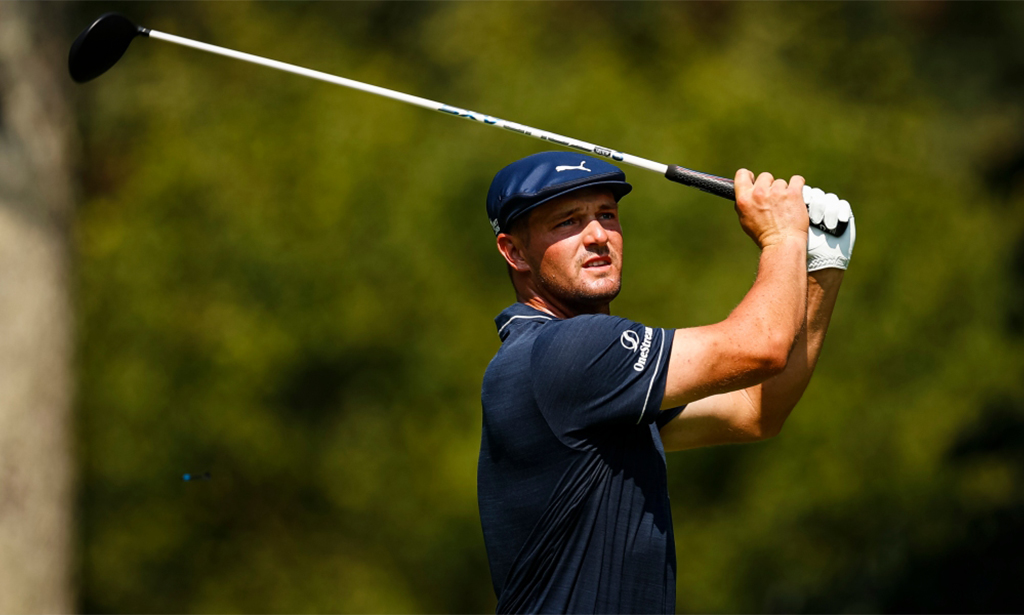
Around this time last year, the world was different. We were amidst a global pandemic, parents were thrust into the job of teachers as schools were, for the most part still solely online learning, and oh yeah…48-inch drivers were one of the hottest topics in the golf equipment world. That was mostly thanks to Bryson DeChambeau’s announcement that he’d be testing longer drivers following his 2020 U.S. Open win.
Mind you, DeChambeau had just lapped the field at Winged Foot, quite literally one of the most difficult U.S. Open venues statistically. Then he does what? He starts talking about his plan to test out even longer drivers to push his distance limits. This clearly got the golf worlds attention. Fast forward 12 months…
You could almost hear the thoughts swirling in the heads of his competitors heads: If Bryson gets even longer, I’m gonna be forced to keep up. Shoot, I can’t keep up now. I must be better! Others were likely more skeptical of longer drivers and wanted nothing to do with it.
All that said, either way, DeChambeau did bring up a viable point. Why not experiment with longer driver builds to see if there’s significantly more distance to be had?
In the wake of DeChambeau’s declaration, some tour players ordered 47- and 48-inch drivers from their PGA Tour equipment reps to try out. “If he is gonna do it, why cant I? Afterall, he is the mad scientist of golf” As onlookers, and experimenters ourselves, we speculated: Will 48-inch drivers REALLY become the new norm? Will so many players switch into longer drivers that 8,000 yard golf courses will become the new norm?
I suppose, if you really wanted to, you could argue that distance was already an issue on the PGA Tour. Hell, even without longer drivers being thrown into the equation. The USGA has certainly been researching the distance debate for itself.
In the last year, though, 48-inch drivers haven’t quite taken over professional golf like some thought they might. Sure, Viktor Hovland has experimented with the concept. And yeah, Phil Mickelson won the 2021 PGA Championship with a driver measuring 47.9 inches (Bet you didn’t know that gem).
But as the PGA Tour discovered in its recent research on the matter of driver length, it really only impacts a very small segment of tour golfers. The numbers you ask, well I am glad you did. A mere 3 percent of professional players use clubs longer than 46 inches. That’s not exactly the takeover that us equipment insiders were anticipating. Surely golf wouldn’t make a rule that affects 3 out of 100 golfers and makes the game less fun? Right?

Regardless, on Tuesday, the USGA and R&A announced a new local rule option to limit driver length to 46 inches. That’s right, its an option. So, week in and week out the rules governing this will change based on who is hosting the event. 1 week it’s OK, but the next may be… “nah, sorry man – it’s a hard no for us”. It’s kind of like reservation gambling at the native American casinos. Its illegal over here, 1 mile away, BUT over here, 1 mile east, you are playing blackjack and penny slots to your hearts content and it’s all good. Something seems off to me on this one…
“Admittedly, this is not the ‘answer’ to the overall distance debate/issue, but rather a simple option for competitive events,” Mike Whan, the USGA’s chief executive officer, said in a statement. “It’s important to note that is not a ‘Rule of Golf,’ and as such, it is not mandated for the average, recreational golfer. Rather, this is an available tool for those running competitive events.”
In a statement, the PGA Tour then announced that it would implement the local rule for its competitions starting on Jan.1, 2022.
“After understanding the feedback received from the golf manufacturing community, we also undertook a survey of usage of clubs in use across the PGA Tour, PGA Tour Champions and the Korn Ferry Tour and found that a very small number of players either have used or are currently using clubs greater than 46 inches,” the statement read. “The PGA Tour Player Advisory Council recently reviewed the subject and we have concluded that the PGA Tour will implement the Local Rule on Jan. 1, 2022.”
We already know Mickelson’s stance on the subject, as you can watch in the embedded Tweets below. Spoiler alert, He don’t like it!
That got us thinking…What do other PGA Tour players think about the ban of drivers longer than 46 inches? Here’s what a collection of PGA Tour pros had to say at the 2021 CJ Cup following the news.
Justin Thomas
“Yeah, I don’t really agree with it,” Thomas told the press on Tuesday at the 2021 CJ Cup. “I think it’s — I don’t know. I feel like there’s a lot of other things, you know, like the arm-bar putter, that they should be approaching as opposed to the length of driver. I think the fact that you see only a few people using a long driver speaks for itself, that it’s not really that big of an advantage. It’s a lot harder to hit it straight.
“In terms of do I think it makes the game of golf and growing the game better? No, I don’t at all, but they seem to have their kind of mind around that for a while now, so it seems to be the issue because if there’s an amateur golfer or players at home that want to hit it a little bit farther, so be it. Or if there’s guys out here that want to have a chance to put it in play with a 47-, 48-inch driver, then power to them. I had that opportunity; I just chose not to. I don’t necessarily agree with it, but it is what it is.”
Kevin Kisner
“I don’t know what they’re trying to accomplish other than to keep people from hitting it far,” Kisner told GOLF.com. “I mean, the game’s moving in that direction. I think they’re just trying to figure out a way to keep it in some sort of a realm. But anything that makes the game harder I’m against. So, if it makes it harder, I don’t wanna do it. The game’s hard enough, man.
Dustin Johnson
“My opinion is more, I don’t think it matters what length someone uses, because the longer the driver gets the harder it is to hit straight,” Johnson told GOLF.com. “So, if you could hit a 48-inch driver and keep it on the planet, then more power to you. I’ve tested with ‘em, and yeah it goes further, but it also goes a lot more crooked. You lose a lot of control, so for me, I don’t think it’s necessary.”
Adam Scott
“My initial reaction is that I don’t think it’ll make any difference,” Scott told GOLF.com. “The only thing I can say is maybe for the future if everyone started using 47- and 48-inch drivers and they all started to go down that route, but for now I don’t see it making any real difference. I don’t know how many guys were using 47-inch drivers.”
Collin Morikawa
“Look, it’s not going to change my driver specs, I’ll tell you that, and I don’t think it’s going to change many other guys’ driver specs,” Morikawa told the press on Tuesday. “Is that the answer to hitting it shorter? No. You know, I think yeah, if you have a long driver and you see what Bryson did, you see what long drive guys do, they have a longer driver, right, and they’re able to hit it farther, but can you maintain that on the golf course? Hasn’t been done yet. Not saying it won’t be done, but you know like if a guy wants a 47-inch driver, I think they should let them, because why not?
“We’ve seen courses that you end up shooting 10-to-15 under, and it’s not because the course is 9,000 yards long. We don’t play that. It’s because it makes you shape shots; it makes you hit different shots and it’s all about course design. So that’s my opinion in it or on it, is that I think course design needs to be structured in a way where we don’t need 8,000-yard courses. Yeah, they’re great sometimes, but there’s a lot of short courses on our tour that don’t provide 25 under par and it’s because of the way the layout is and the conditions. So, I don’t think many guys have over 46 inches, their driver, anyways, so I don’t think it will change much.”
Hudson Swafford
“I mean I can’t hit a 48-inch driver, so, it doesn’t really bother me,” Swafford told GOLF.com. “I hit a 45-inch driver; pretty standard, actually a little shorter. So, it doesn’t really bother me. It is what it is. I don’t really care. But it’s interesting; people are trying it and picking up a lot of speed. I picked up like a 46-inch and picked up speed, but I can’t hit it straight. So, it didn’t do me any good.”
Stewart Cink
“I think it’s going to have zero impact on golf, because I don’t know if I’ve ever known a golfer to use a driver longer than that in competition out here,” Cink told GOLF.com. “I don’t think it’s going to be a huge impact. To me it seems like there’s other areas, if they want to address distance, the length of the shaft is probably not the main thing, it’s probably just to safest one from a legal standpoint.”
This article originally appeared on Golf.com









It’s a scenario every golfer knows intimately: you’ve just striped a perfect drive down the middle of the fairway, only to follow it up with a chunked iron shot that barely advances the ball. Frustration mounts, your focus shatters, and the rest of the hole—and perhaps the round—unravels. While we often blame our swing mechanics for these inconsistencies, the true culprit frequently lies between our ears. Research consistently shows that the mental game accounts for a staggering 70-90% of performance in golf . Yet, despite its monumental importance, studies reveal that only about 14% of golfers regularly practice their mental skills .
This article is designed to change that. We will explore the critical role of psychology in golf, break down the most common mental errors that sabotage your scores, and provide you with professional-grade techniques and practical drills to build an unshakeable mental game. By the end, you will have a clear roadmap to not only lower your handicap but also to find more joy and resilience on the course.
Why the Mental Game is Your Most Important Club
In golf, a quiet mind is a powerful asset. Your mental and emotional state directly influences your physical capabilities. When you are calm, focused, and confident, your body is relaxed, and your swing can flow freely and naturally. Conversely, when you are anxious, angry, or distracted, your muscles tighten, your coordination suffers, and your swing mechanics break down. This isn’t just a feeling; it’s a physiological reality. Negative emotions trigger a fight-or-flight response, which is fundamentally at odds with the fine motor control required for a successful golf shot .
A 2025 systematic review on mental fatigue in golf further highlights this connection. The research found that prolonged mental exertion during a round directly leads to a decline in performance, affecting everything from driving distance and iron accuracy to, most significantly, putting . Every decision, every calculation, and every moment of frustration depletes your cognitive resources, making it harder to execute shots as the round progresses. Mastering the mental game is therefore not just about thinking positively; it’s about efficiently managing your mental energy.
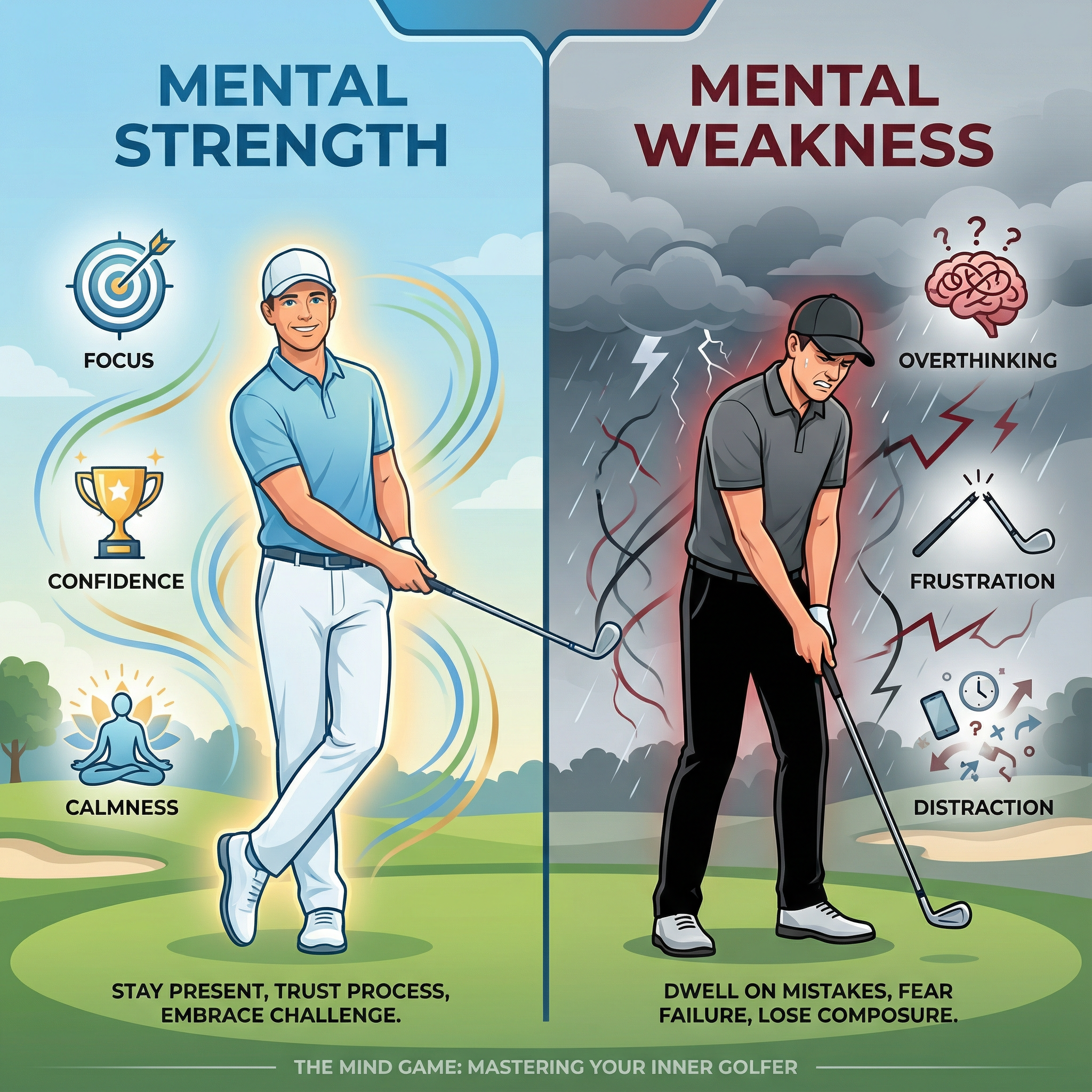
The 5 Mental Mistakes Costing You Strokes (and How to Fix Them)
Based on extensive analysis of amateur golfers, sports psychologists have identified several recurring mental errors. Here are five of the most common, along with strategies to overcome them, adapted from the work of mental game coach David MacKenzie .
Mental Mistake Description The Fix 1. Analyzing Your Swing Constantly dissecting your mechanics on the course, trying to “fix” your swing mid-round. Trust the swing you brought. The course is for playing, the range is for practicing. Focus on your target and let your body execute. If you need a swing thought, use a simple rhythm cue like “one-two-three.” 2. Obsessing Over Score Tying your emotional state to your score on every hole, leading to a rollercoaster of feelings. Focus on the process, not the outcome. Your goal for each shot should be to execute your routine flawlessly. The score will take care of itself. 3. Negative Self-Talk Berating yourself after a bad shot, which lowers confidence and increases tension. Become your own best caddy. After a poor shot, offer yourself the same encouragement you would a friend. Develop a post-shot routine that involves acknowledging the feeling, taking a deep breath, and moving on. 4. Vague Targeting Aiming for a general area like “the fairway” or “the green” instead of a specific point. Pick the smallest possible target. Top professionals aim at incredibly precise spots, like a specific tree branch or a single blade of grass. This sharpens focus and improves accuracy. 5. Neglecting Your Routine Lacking a consistent pre-shot and post-shot routine, leading to inconsistent mental preparation and reaction. Make your routine your primary goal. A well-defined routine is your mental armor against pressure. It ensures you are committed to every shot and can handle any outcome.
Building an Unshakeable Mental Game: Pro-Level Techniques
Top professional golfers are masters of the mental game. They employ specific techniques to stay focused, confident, and resilient under immense pressure. Here are a few you can incorporate into your own game.
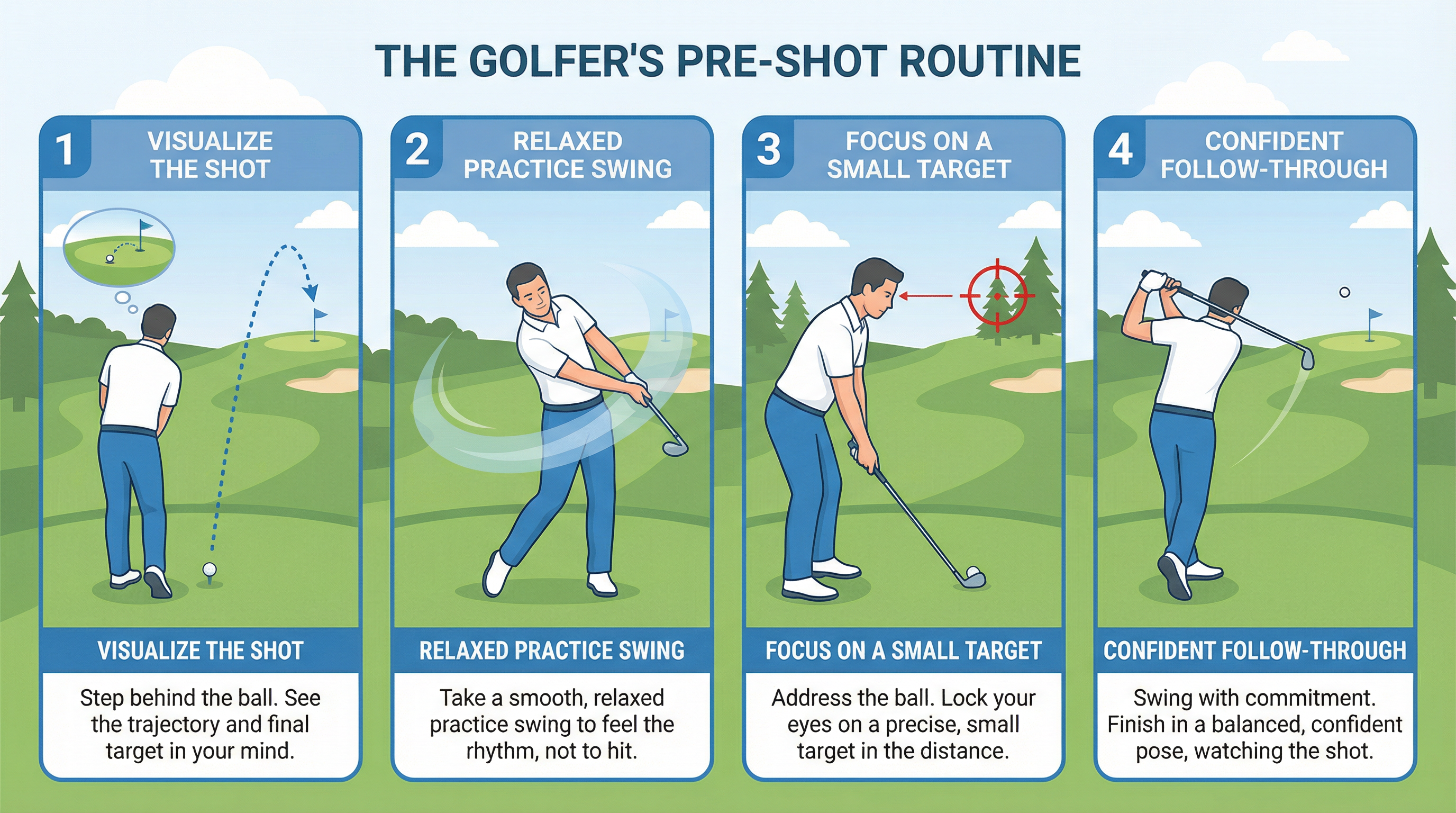
The Power of a “Pre-Shot Creation”
Instead of a rigid, robotic pre-shot routine, think of it as a “pre-shot creation.” This concept, inspired by the approach of players like Tiger Woods, reframes the process as an artistic and imaginative one . Rather than just going through the motions, you should feel the shot, engage your senses, and become genuinely interested in the unique puzzle each shot presents. This fosters a state of deep presence and curiosity, quieting the analytical mind.
Tiger Woods worked extensively with navy psychologist Dr. Jay Brunza early in his career, developing what he called “game training.” Woods emphasized the importance of bringing attention to “THIS SHOT in THIS moment” and described feeling the shot in his fingers rather than relying solely on visualization. At his best, Woods found a way to be immensely interested in each shot, playing from a position of curiosity rather than anxiety .
Mastering Your Mind: Awareness Over Control
One of the biggest paradoxes in golf psychology is that trying to control your thoughts often backfires. Telling yourself “don’t hit it in the water” only makes the water a more prominent feature in your mind . The key is not to suppress negative thoughts but to change your relationship with them through mindfulness and awareness. Acknowledge the thought without judgment, and then gently guide your focus back to your target and your breathing. The best players don’t have fewer negative thoughts; they are simply more skilled at not letting them take over.
Research shows that the average person has approximately 70,000 thoughts per day, with more than two-thirds being negative . The difference between elite golfers and amateurs is not the quantity of negative thoughts but how they respond to them. Elite players have developed the skill of awareness—noticing thoughts without becoming entangled in them—allowing the thoughts to pass like clouds in the sky.
Breathe Like a Champion
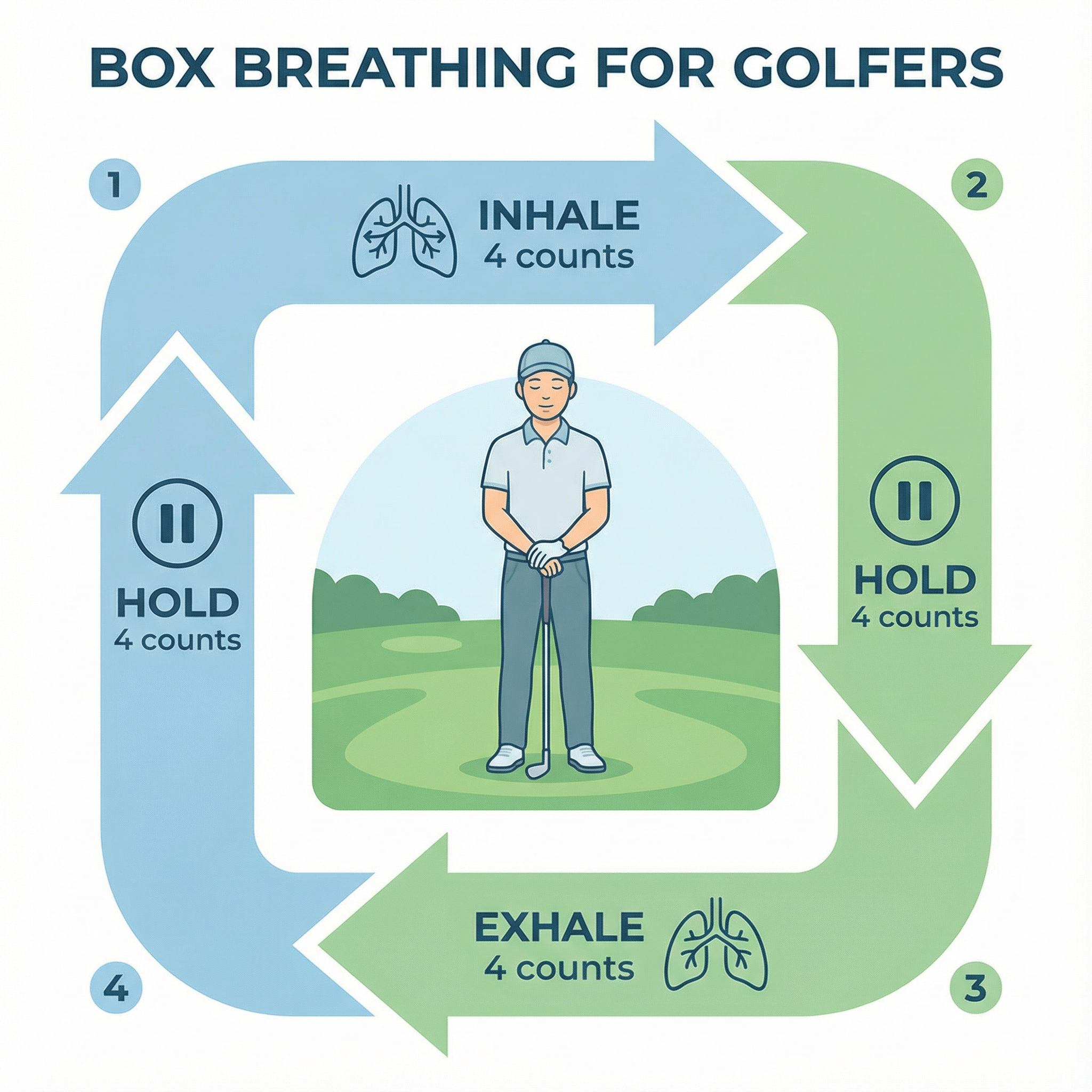
Breathing is one of the most powerful and simple tools for managing your physiological state. When you feel pressure mounting, your breathing becomes shallow and rapid. By consciously slowing it down, you can signal to your nervous system that it’s time to calm down. A popular and effective technique is Box Breathing:
1.Inhale slowly for a count of four.
2.Hold your breath for a count of four.
3.Exhale slowly for a count of four.
4.Hold your breath for a count of four.
Repeating this cycle just a few times can significantly lower your heart rate and reduce muscle tension, allowing you to approach the shot from a state of calm focus .
The Science Behind Mental Training
Recent research validates what professional golfers have known intuitively for decades. A brain training study conducted with UCLA Golf demonstrated remarkable results: participants increased their greens in regulation by 12% and decreased three-putts per round by 9.7%. Perhaps most impressively, these improvements were sustained eight weeks after the training concluded . This demonstrates that mental skills, like physical skills, can be trained and improved with consistent practice.
A 2024 neuroscience study revealed that expert golfers exhibit distinct brain activity patterns during successful putts compared to unsuccessful ones. The research emphasized that mental preparation—not just physical technique—is the key differentiator between making and missing putts . This finding underscores the importance of developing a consistent mental routine before every shot.
Putting It Into Practice: Drills for a Stronger Mind
Improving your mental game requires consistent practice, just like your swing. Here are a few drills you can incorporate into your routine:
Pressure Putting Drill: Place three balls at 3, 6, and 9 feet from the hole. You must make all three in a row to complete the drill. If you miss, you start over. This simulates pressure and forces you to focus on your routine for each putt. As you improve, increase the difficulty by adding more balls or extending the distances.
Mindfulness on the Range: During your practice sessions, take a few moments between shots to simply be present. Feel the grip in your hands, notice the breeze, and listen to the sounds around you. This trains your ability to stay in the present moment, which is essential for peak performance on the course.
Post-Round Journaling: After each round, take five minutes to write down one thing you did well mentally and one mental challenge you faced. This builds self-awareness and helps you identify patterns in your mental game. Over time, you will notice recurring themes that you can address in your practice.
Target Practice with Consequences: On the range, pick a specific target for every shot—not just a general area. If you miss your target, perform a small penalty like five push-ups or hitting the next shot with your opposite hand. This adds consequences to your practice, making it more similar to on-course conditions where every shot matters.
Key Takeaways for Your Next Round
As you prepare for your next round, keep these fundamental principles in mind:
Trust over control. The more you try to consciously control your swing, the more tension you create. Trust the swing you have practiced and let your body execute naturally.
Process over outcome. Make your pre-shot routine your primary goal for every shot. When you focus on executing your process flawlessly, good scores follow naturally.
Awareness over suppression. You cannot eliminate negative thoughts, but you can change your relationship with them. Notice them, acknowledge them, and gently return your focus to the present moment.
Precision over generality. Always pick the smallest possible target. This sharpens your focus and gives your subconscious mind a clear objective.
Compassion over criticism. Treat yourself with the same kindness and encouragement you would offer a playing partner. Negative self-talk only compounds mistakes and drains your confidence.
Conclusion
The journey to mastering the mental game of golf is ongoing, but it is one of the most rewarding pursuits in the sport. By understanding the profound impact of your mind on your performance, recognizing common mental errors, and consistently practicing proven psychological techniques, you can unlock a new level of consistency, resilience, and enjoyment on the golf course. Remember, the next time you step onto the tee, your most powerful tool isn’t in your bag—it’s in your head. The difference between a good round and a great round often comes down to how well you manage the six inches between your ears.
Start small. Pick one technique from this article—perhaps developing a consistent pre-shot routine or practicing Box Breathing before important shots—and commit to it for your next three rounds. Track your progress, notice the changes, and gradually incorporate additional mental skills into your game. The mental game is not a quick fix, but a lifelong practice that will serve you well both on and off the course.
References
[1] NeuroTrackerX. (2023, December 1). Why Golf Performance is 90% Mental.
[2] McCarthy, P. (2025, November 8). The Mental Game of Golf: Pro Secrets You Haven’t Heard Before.
[3] Colorado Senior Golfers’ Association. The Brain Game – Spring Edition.
[4] McCarthy, P. (2025, November 8). The Mental Game of Golf: Pro Secrets You Haven’t Heard Before.
[5] Pan, X., et al. (2025). Mental fatigue in golf: A systematic review. PLOS ONE.
[7] Mind Caddie. (2025, November 9). Tiger Woods’ Mental Strategies.
[9] MyTPI. Mental Game: Brain Training Study With UCLA Golf.
[10] PsyPost. (2024, August 15). Golf: New neuroscience study reveals the secrets of better putting.
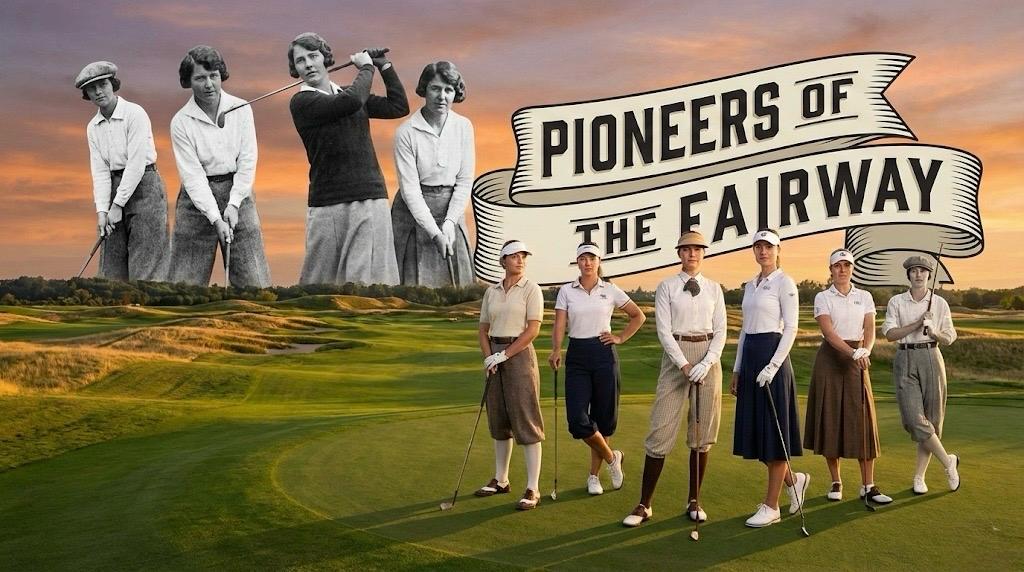
Golf, often perceived as a male-dominated sport, has seen numerous women defy norms, break barriers, and challenge the status quo. These pioneering women have not only made significant strides in the game but have also played a crucial role in reshaping the sport’s landscape. This article delves into the impressive careers of some of these groundbreaking women in golf, highlighting their incredible achievements and the enduring impact they’ve had on the sport.

Babe Didrikson Zaharias: The Woman Who Redefined Golf
Named “Woman Athlete of the Half Century” by the Associated Press in 1950, Babe Didrikson Zaharias is undoubtedly one of the most remarkable athletes in history. Her golfing career was nothing short of extraordinary.
Triumph Against the Odds
Despite facing resistance from the golfing establishment for her flamboyant personality and style of play, Zaharias refused to be sidelined. She won a staggering 10 LPGA major championships and 41 LPGA tour events, setting stage records and leaving an indelible mark on the sport.
Paving the Way for Others
Zaharias also co-founded the Ladies Professional Golf Association (LPGA), creating more opportunities for women in professional golf. Her tenacity and resilience inspired countless women to pursue their golfing aspirations, forever changing the face of the sport.

Nancy Lopez: A Beacon of Inspiration
Nancy Lopez is another trailblazing woman in golf. A child prodigy, Lopez first made waves in the golfing world when she won the New Mexico Women’s Amateur at just 12 years old.
.jpg)
A Stellar Career
Lopez turned professional at the age of 21 and quickly established herself as a dominant force in women’s golf. She won 48 LPGA Tour events, including three major championships, and was inducted into the World Golf Hall of Fame in 1987.
Inspiring Future Generations
Lopez’s impact extends far beyond her impressive record. She is widely respected for her sportsmanship, dedication, and spirit, and her success has inspired many young girls to take up golf.
Annika Sorenstam: Shattering Glass Ceilings
Annika Sorenstam is widely considered one of the greatest female golfers of all time. The Swedish star boasts an astounding 72 LPGA Tour victories, including 10 majors.
Making History
In 2003, Sorenstam made history by becoming the first woman in 58 years to compete in a PGA Tour event. This monumental moment not only put the spotlight on women’s golf but also challenged the gender divide in the sport.
Championing Women’s Golf
Post-retirement, Sorenstam has remained a powerful advocate for women’s golf. Through the Annika Foundation, she works to provide opportunities for young female golfers and promote the sport at the grassroots level.
Conclusion: The Legacy of These Trailblazing Women
The contributions of Zaharias, Lopez, and Sorenstam to golf are immeasurable. They’ve not only shattered records and broken barriers but also opened doors for countless women in the sport. Their legacies serve as a testament to the power of determination, talent, and hard work. They have reshaped the world of golf, proving that the fairway is no longer just a man’s domain.
These women have paved the way for the next generation of female golfers, who continue to push boundaries and redefine the sport. As we celebrate these pioneering women, we look forward to seeing more women rise, conquer, and leave their own mark on the fairways.
Today, women in golf continue to make strides, thanks in part to the trail blazed by these pioneering women. Let their stories inspire you to break barriers in your own field, whatever that may be. Because when it comes to achieving greatness, the most important shot in golf, as in life, is the next one.
Blog
Sustainability in Golf: The Future of Eco-Friendly Greens
Read about the environmental impact of golf courses.


Golf, a sport often associated with pristine, manicured greens and lush landscapes, isn’t historically perceived as eco-friendly. However, with growing concerns about climate change and sustainability, the golf industry is steadily transitioning towards more sustainable practices. This article will explore how golf courses around the world are becoming greener and more eco-friendly while maintaining their appeal to golf enthusiasts.

The Environmental Impact of Golf Courses
Golf courses traditionally use extensive resources, including water, pesticides, and fertilizers, which can have detrimental effects on the environment.
-
-
- Water Usage: Maintaining the verdant landscapes of a golf course requires enormous amounts of water. This is particularly concerning in regions where water scarcity is a significant issue.
- Pesticides and Fertilizers: To keep golf courses lush and free of pests, large amounts of chemicals are often used. These substances can seep into the ground, polluting water sources and harming local wildlife.
- Habitat Disruption: Golf courses often displace natural habitats, upsetting local ecosystems and reducing biodiversity.
-

Green Initiatives in Golf: Sustainability on the Fairways
Recognizing the environmental impact, many golf courses are now implementing sustainable practices to reduce their ecological footprint.

Water Conservation
Water conservation is a significant focus in eco-friendly golf course design. Methods employed include:

-
-
- Recycled Water: Many golf courses are now using recycled water or rainwater for irrigation, significantly reducing the use of freshwater resources.
- Drought-resistant Grass: Some courses are opting for drought-resistant varieties of grass that require less watering.
- Irrigation Technology: Advanced irrigation systems can efficiently distribute water, minimizing waste.
-

Reducing Chemical Usage
Reducing the use of harmful chemicals is another crucial step towards sustainability in golf. This can be achieved through:
-
-
- Organic Fertilizers and Pesticides: Many golf courses are switching to organic alternatives, which are less harmful to the environment.
- Integrated Pest Management: This approach focuses on long-term prevention of pests through biological control and habitat manipulation, reducing the need for chemical pesticides.
-

Preserving Local Habitats
Golf courses are increasingly being designed to coexist harmoniously with local ecosystems. This involves:
-
-
- Preserving Natural Features: Instead of altering the landscape to fit the course, designers are now incorporating existing natural features into the design.
- Creating Wildlife Habitats: Some golf courses are creating habitats for local wildlife, promoting biodiversity.
-
Case Studies: Sustainable Golf Courses Around the World
There are several golf courses worldwide that serve as excellent examples of sustainability in the industry.
- Pebble Beach Golf Links, USA: This renowned golf course uses recycled water for irrigation, reducing its freshwater use by 50%.
- St Andrews Links, Scotland: Known as the “Home of Golf”, St Andrews Links has implemented an extensive environmental management plan, including water conservation, habitat protection, and the use of organic fertilizers.
- Vineyard Golf Club, USA: This golf course in Massachusetts is one of the first to become fully organic, using only organic fertilizers and pesticides.
The Future of Sustainable Golf
The golf industry’s move towards sustainability is not just about eco-friendly practices on the course. It’s also about educating players and visitors about the importance of sustainability, thus promoting a culture of environmental consciousness.
While the transition to greener practices may be challenging, the benefits are immeasurable. Sustainable golf courses not only help protect the environment, but they can also enhance the playing experience, offering golfers the chance to play their favorite sport while surrounded by thriving, natural landscapes.
In conclusion, as awareness of environmental issues continues to grow, the question of “how green can the greens get?” is being answered by golf courses worldwide. Through innovative practices and a commitment to sustainability, the future of golf looks set to be greener than ever. As players, supporters, and enthusiasts of the sport, we can all contribute to this positive change by supporting golf courses that prioritize sustainability and by advocating for green practices within the golfing community.
- Advertisment


Golf Fitness for the Off-Season: Build Strength, Flexibility, and Power Before Spring

The Smart Player’s Guide to Shaving Strokes Without Changing Your Swing

The Mental Game of Golf: Mastering the Psychology Behind Lower Scores



-
 Product Review6 years ago
The Perfect Practice Putting Mat Review by Jason Tenzer
-
 Blog4 years ago
Loophole Rule Offers PGA Tour Pros a Mulligan
-
Blog4 years ago
2021 Buyer’s Guide: The Top 10 Value Golf Balls For Distance & Feel
-
Blog5 years ago
Golf Marriage Counselor
-
 Blog6 years ago
9 Biggest Chokes Of The Past Decade
-
 Product Review6 years ago
THE ADJUSTABLE IRONS: WALKING STICKS GOLF CLUBS
-
Blog5 years ago
What Your Golf Clubs Say About You
-
Equipment6 years ago
OHK Sports Interview by Jason Tenzer