Competitive Edge
Golf Mental Game: How to Stay Calm After a Bogey Spiral
Bogey spirals ruin rounds. James Fairway shares 6 golf mental game techniques PGA Tour pros use to reset, refocus, and stop the bleeding.


The golf mental game usually breaks one shot before the scorecard admits it. You leave a wedge in the bunker on No. 3, miss the six-footer coming back, and carry double bogey to the next tee. The fairway looks narrower. Your grip tightens. You try to win two shots back with one swing and snap it left. One mistake has become a bogey spiral.
Disclosure: This article contains affiliate links. If you buy through these links, ClickitGolf may earn a commission at no additional cost to you.
The goal is not to become emotionless. Good players get irritated. The difference is that they notice the reaction, contain it, and return to the next useful task before frustration starts choosing clubs and targets for them.
The Problem Most Golfers Face: Frustration Travels
A poor shot creates more than a bad number. It changes breathing, muscle tension, attention, and decision-making. Under pressure, golfers hurry the routine, squeeze the handle, choose an aggressive target, or search for a swing fix they did not need 30 seconds earlier.
That is why the bogey spiral feels physical. Your body is preparing for danger while the shot demands touch, tempo, and precise attention. Slow-paced breathing can improve markers associated with regulation, but it does not automatically straighten the next shot. In a 2026 pilot study of 15 low-handicap competitive golfers, adding slow breathing to a pre-shot routine lowered heart rate and increased an HRV measure; under simulated pressure, however, lateral accuracy did not improve.
That finding matters. Calmness is not a cheat code. It gives you a better operating state from which to make a sensible decision and execute the swing you already own.
What Is the Fastest Golf Mental Game Reset After a Bogey?
Give the mistake ten seconds, use one long exhale, and identify the next shot’s target—not the score you want back. This sequence interrupts the emotional replay, reduces rushed decision-making, and returns attention to a controllable task. The reset works best when practiced before you desperately need it.
Reset stage Your job Useful cue Release Acknowledge the miss without holding a committee meeting “That was poor.” Regulate Slow the body with deliberate breathing “Long exhale.” Refocus Choose a specific target and conservative miss “Next shot.” Commit Run the same routine you use after a birdie “See it, set it, swing.”
6 Golf Mental Game Techniques That Stop a Bogey Spiral
1. Put the Mistake on a 10-Second Clock
You are allowed to be annoyed. Pretending otherwise usually creates a golfer who says, “I’m fine,” while attempting to bend a seven-iron with his bare hands.
Give yourself ten seconds after a damaging shot or completed hole. Name the error accurately: poor strike, bad read, rushed tempo, reckless target. Avoid identity language such as “I always choke” or “I cannot putt.” One describes an event; the other turns an event into a biography.
Create a physical endpoint. When the club goes back into the bag or your feet leave the green, the review closes. If the shot requires technical work, make a note after the round. Mid-round diagnosis tends to become a scavenger hunt for positions, and the prize is usually another bogey.
2. Use Your Pre-Shot Routine as an Anchor
In the golf mental game, a routine is a sequence that protects attention when your emotions try to improvise.
Sport-psychology research supports pre-performance routines as useful tools, but it does not identify one universal routine that every athlete should copy. Build a short sequence you can repeat under any score: view the shot from behind the ball, select a start line, make one rehearsal, step in, look once, and go.
Practice it on the range. Hit one ball at a time to a defined target, then step away. The point is to make the routine familiar enough that it survives the sixth hole, a slow group ahead, and the sudden realization that your best round of the month is still alive.
3. Box-Breathe Between Holes, Not Over the Ball
In the golf mental game, breathing belongs in the walk, the cart, or the wait—not over a five-footer.
Try three cycles of box breathing: inhale for four seconds, hold for four, exhale for four, and hold empty for four. If breath holds feel uncomfortable, skip them and simply make the exhale longer than the inhale. The objective is a smoother state, not a personal-best breath-hold.
The golf study cited above used a different 4-2-8 rhythm, so it should not be treated as proof of box breathing specifically. What the evidence does support is practicing slow breathing as part of a repeatable routine. Test your pattern on the range and during casual rounds before trusting it in a match.
4. Train Regulation Off the Course With Narbis Edge
The Narbis Edge is an on and off-course wellness tool for golfers who want feedback while practicing resonance-frequency breathing. It pairs with an ear-clip sensor or compatible heart-rate monitor, calibrates a personal breathing pace, and uses electrochromic lenses that change tint to provide real-time feedback.
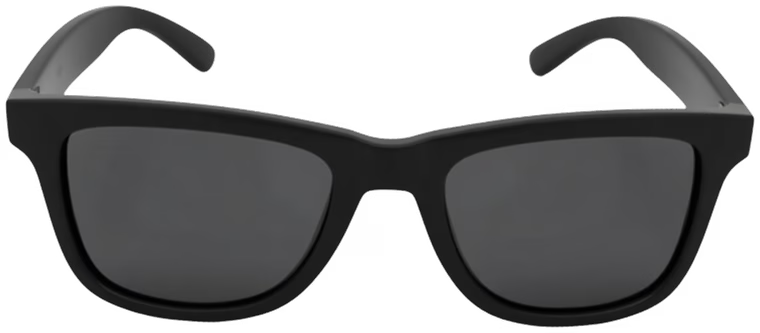

Narbis recommends sessions of roughly ten minutes. The golf mental game benefit is off-course practice: learning to recognize an agitated state before pressure arrives.














Keep the claim in bounds: Edge is marketed as a wellness product, not a device intended to diagnose, treat, cure, or prevent disease. Research on Heart Rate Variability (HRV) biofeedback and slow breathing does not guarantee a specific scoring result from this product. You still need a sound target, a committed routine, and a golf swing.
5. Shrink the Round to the “Next Shot”
A golf mental game spiral stretches attention in both directions. You replay the three-putt, then project a future score. Neither thought helps with the 164-yard shot in front of you.
Use a short phrase—“next shot,” “start line,” or “center green”—to return to the present task. Instructional self-talk is most useful when it is brief, accurate, and tied to something controllable.
Then define the shot in plain language: “Seven-iron to the fat side, committed finish.” If trouble is short-sided left, choose a target that keeps the miss right. Mental discipline is not forcing yourself to feel confident. It is making a sane decision even when confidence has temporarily left the property.
6. Compartmentalize the Score and Reframe the Talk
For a steadier golf mental game, stop treating the round as one emotional account. Divide it into three-hole blocks, or judge only the current hole’s process. A double on No. 5 does not require a birdie on No. 6. It requires a playable tee shot on No. 6.
Between shots, ask two questions: Did I choose a smart target? Did I commit to the routine? Those answers give you information without turning the scorecard into a courtroom.
Self-talk should follow the same rule. A study of 170 precision-sport athletes found self-talk was associated with motivation, interest, effort value, and perceived competence, though it did not prove that a phrase directly improves golf scores. Replace “My swing is gone” with “My last two strikes were thin; smooth tempo and center contact.” Neutral language keeps the problem small enough to solve.
Practice Drills for a Calmer Golf Mental Game
Mental techniques fail when their first rehearsal happens during a medal round. Train them before pressure arrives.
Drill How to do it What it trains One-ball range Pick a new target and run your full routine before every ball for 15 shots Routine fidelity Bogey simulation Start a practice hole by declaring yourself one over par, then play conservative targets Decision-making without score chasing Breath-and-putt Complete three slow breaths, then hole five putts from four feet State change followed by execution Three-hole boxes Reset the score to zero every three holes while keeping the real score separately Compartmentalization Cue-card round Write “release, breathe, target, commit” on a card in your bag Reliable recall under stress
Ten disciplined minutes twice a week beats one heroic session before the club championship.
Common Mistakes That Keep the Spiral Alive
The first mistake is trying to become calm instantly. A racing pulse does not mean the technique failed. Your job is to reduce the reaction enough to make a clear decision.
The second is using breathwork as another performance test. If you are counting seconds so aggressively that you feel lightheaded, stop. Breathe normally and walk. Regulation should make the next task simpler.
The third is confusing positive self-talk with fantasy. “I am the greatest putter alive” is not useful after four tentative strokes. “Start it over the right edge with committed speed” is believable and actionable.
Finally, do not change the routine after every bad result. A good process can produce a poor shot. Judge the routine over multiple rounds, then adjust deliberately.
Two Books Worth Keeping in the Golf Bag
These are not quick motivational reads. Both give the serious golfer a framework for understanding attention, tension, and the interference created by overthinking.
Book Best for Verified edition details Golf: The Mind Game by Marlin M. Mackenzie, with Ken Denlinger Situation-specific exercises and the golfer who overanalyzes every miss Paperback, 224 pages; ISBN-10/ASIN 0440502098 The Inner Game of Golf by W. Timothy Gallwey Relaxed concentration, awareness, and performance without constant mechanical instruction 2009 trade paperback, 272 pages; ISBN-10/ASIN 0812979702
Golf: The Mind Game

Mackenzie uses specific situations and exercises. It suits the player who wants concrete work rather than inspirational lines.
The Inner Game of Golf

Gallwey’s “relaxed concentration” means observing without smothering motion in instructions. It suits players whose real swing becomes a committee project.
Quick Recap: Your Between-Holes Reset
After a bad hole, allow ten seconds for an honest reaction. Then complete three controlled breaths, choose a conservative target for the next shot, say your cue, and run the normal routine. Review decisions after the round—not while standing beside the next tee marker.
The golf mental game is not about never feeling anger. It is about shortening anger’s jurisdiction. One bad shot can cost one stroke. The spiral begins when you let it choose the next shot too.
Frequently Asked Questions
How long does it take to improve the golf mental game?
You can use a reset phrase or slower breathing immediately, but reliable mental habits take repeated practice. Rehearse them on the range and in casual rounds for several weeks. Improvement looks less like permanent calm and more like noticing frustration sooner, making fewer reckless decisions, and returning to your routine faster.
Can breathing exercises really lower my golf score?
Breathing cannot repair poor contact or guarantee a lower score. It can help regulate heart rate and attention, creating a better state for decision-making and execution. A small 2026 golf study found physiological benefits from slow breathing, but accuracy did not consistently improve under simulated pressure.
What is the best way to practice a pre-shot routine?
Hit one range ball at a time to a specific target. Step away after every shot, change the target, and complete the same visual, rehearsal, setup, and commitment sequence. Avoid scraping balls into place. The goal is to rehearse the behavior you need on the course, not merely accumulate swings.
Is negative self-talk always harmful on the golf course?
Honest criticism is useful when it describes a behavior: “That target was too aggressive.” It becomes harmful when it attacks identity: “I always choke.” Use neutral, task-specific language that directs the next action. “Smooth tempo” or “center green” gives your attention somewhere productive to go.
How do I stop thinking about my total score?
Divide the round into three-hole blocks and track process goals separately. Before each shot, judge only target quality, routine, and commitment. You may keep the official total, but do not calculate projected scores between holes. The next sensible decision matters more than the number you hope to post.
Related ClickitGolf Reading
Equipment doubt can feed mental noise. Settle the basics away from the course with ClickitGolf’s best golf ball by swing speed guide. Players in the faster amateur range can narrow the choice with our 95–105 mph golf ball fit guide.
Want more golf tips every Friday? Join over 350,000 golfers—subscribe to The 19th Hole Newsletter.
Follow James Fairway and ClickitGolf on social for more practical work on the mental side of the game.
References
[1] Integrating Slow-paced Breathing into Pre-shot Routine
[2] Pre-performance routines in sport: current understanding and future directions
[4] Optimize performance through positive self-talk
[5] The Effects of Self-Talk on Shooting Athletes’ Motivation
[6] Golf: The Mind Game by Marlin M. Mackenzie
[7] The Inner Game of Golf by W. Timothy Gallwey