Drills
The 5 Golf Fundamentals That Never Go Out of Style
Master these 5 timeless golf fundamentals that every golfer needs to know. From grip to stance, these basics will improve your game for life.

I’ve been playing golf for over two decades, and if there’s one thing I’ve learned in all those years of chasing that little white ball around perfectly manicured courses, it’s this: the fundamentals never go out of style. While golf instruction trends come and go like fashion seasons, the basic building blocks of a solid golf swing remain as relevant today as they were when Old Tom Morris was teaching the game in Scotland.
You see, golf is a lot like building a house. You can have the most beautiful architectural plans, the finest materials, and the most skilled craftsmen, but if your foundation isn’t solid, everything else will eventually crumble. The same principle applies to your golf game. You can buy the latest driver that promises to add twenty yards to your tee shots, or spend hours watching YouTube videos about the newest swing theory, but without mastering the fundamentals, you’ll always be fighting an uphill battle.
I remember when I first started playing golf seriously. I was that guy who thought I could skip the basics and jump straight to the advanced stuff. I wanted to hit bombs off the tee like John Daly and stick approach shots like Tiger Woods. What I got instead was a collection of bad habits that took years to unlearn and a handicap that seemed to have a mind of its own. It wasn’t until I swallowed my pride and went back to basics with a patient instructor that my game truly began to improve.
The beauty of golf fundamentals is their timeless nature. The grip that worked for Ben Hogan in the 1950s still works today. The stance principles that helped Jack Nicklaus win eighteen majors are just as effective for weekend warriors trying to break 90. These fundamentals have stood the test of time because they’re based on simple physics and human biomechanics, not fleeting trends or marketing gimmicks.
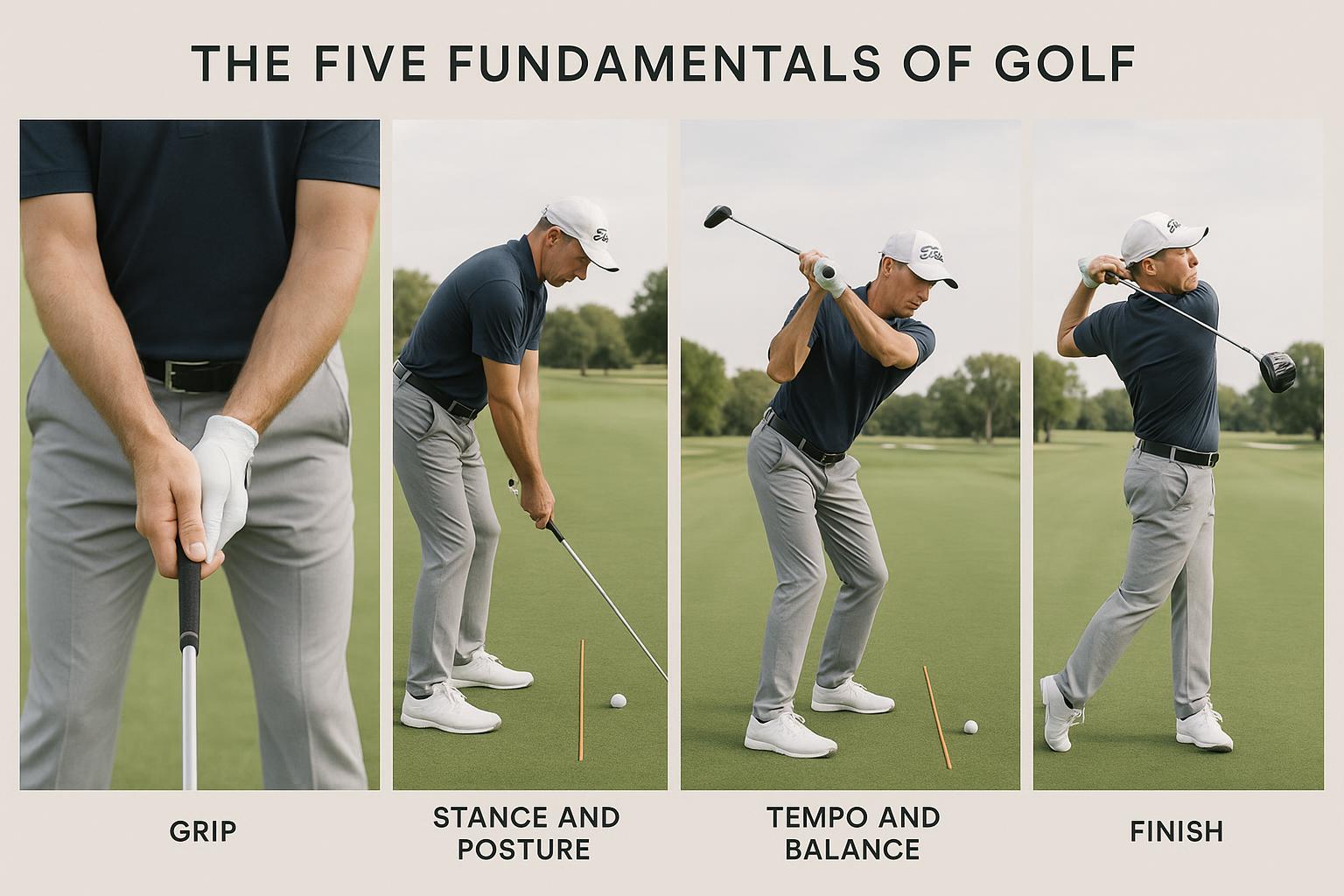
In this comprehensive guide, we’ll explore the five fundamental elements that form the foundation of every great golf swing. Whether you’re a complete beginner picking up a club for the first time or a seasoned player looking to refine your technique, mastering these basics will pay dividends for years to come. These aren’t just tips or quick fixes; they’re the building blocks that will support every aspect of your golf game for the rest of your playing days.
Fundamental #1: The Perfect Grip – Your Connection to the Club
If the golf swing is a chain, the grip is the first link, and as we all know, a chain is only as strong as its weakest link. Your grip is literally your only connection to the golf club, making it perhaps the most crucial fundamental of all. I’ve seen countless golfers struggle with their games, trying everything from new equipment to swing overhauls, when the real culprit was something as simple as how they held the club.
The grip affects everything in your swing. It influences the clubface position at impact, determines how much power you can generate, and even affects your ability to control the ball’s flight. Get your grip wrong, and you’ll spend the rest of your swing trying to compensate for that initial mistake. Get it right, and you’ve given yourself the best possible chance for success.
There are three main grip styles that have proven effective over the decades: the overlapping grip (also called the Vardon grip), the interlocking grip, and the baseball grip. Each has its merits, and the best choice often depends on your hand size, finger length, and personal comfort.
The overlapping grip, named after the great Harry Vardon who popularized it in the early 1900s, involves placing the pinky finger of your trailing hand (right hand for right-handed golfers) over the index finger of your lead hand. This grip is favored by many professional golfers because it promotes unity between the hands while allowing for good clubface control. If you have average to large hands, this grip often feels the most natural and provides excellent feedback from the club.
The interlocking grip takes the connection between hands one step further by actually interlocking the pinky finger of the trailing hand with the index finger of the lead hand. This grip was famously used by Jack Nicklaus and is currently employed by Tiger Woods. It’s particularly beneficial for golfers with smaller hands or shorter fingers, as it creates a very secure connection between the hands. Some golfers find this grip feels more unified, though it can sometimes restrict the natural hinge of the wrists if held too tightly.
The baseball grip, where all ten fingers are on the club without any overlapping or interlocking, is often dismissed as a beginner’s grip, but that’s not entirely fair. While it’s true that most professional golfers don’t use this grip, it can be very effective for certain players, particularly those with small hands, arthritis, or limited hand strength. The baseball grip allows for maximum leverage and can help generate clubhead speed, though it may sacrifice some control.
Regardless of which grip style you choose, the positioning of your hands on the club follows the same fundamental principles. Your lead hand should be placed on the club first, with the grip running diagonally across your palm from the base of your pinky finger to just above the pad below your index finger. When you close your hand around the grip, you should be able to see two to three knuckles of your lead hand when you look down at address.
The trailing hand is then placed on the club with the palm facing the target. The lifeline of your trailing hand should fit snugly over the thumb of your lead hand, creating a unified grip where both hands work together rather than fighting each other. The thumb and index finger of your trailing hand form what’s often called a “trigger finger” position, which helps control the club throughout the swing.
Grip pressure is another critical aspect that many golfers overlook. Sam Snead, one of the greatest ball strikers in golf history, famously said you should hold the club like you’re holding a bird – firm enough that it won’t fly away, but gentle enough that you won’t hurt it. On a scale of one to ten, with ten being as tight as you can squeeze, most golf instructors recommend a grip pressure of about four or five.
Too tight a grip creates tension that travels up your arms and into your shoulders, restricting your swing and reducing clubhead speed. It also makes it difficult to release the club properly through impact, often leading to pushed or sliced shots. Conversely, too loose a grip can cause the club to slip or twist in your hands, leading to inconsistent contact and loss of control.
I learned this lesson the hard way during a particularly frustrating round at my home course. I was gripping the club so tightly that my forearms were burning by the third hole, and my shots were flying everywhere except where I was aiming. My playing partner, a wise old gentleman who’d been playing golf longer than I’d been alive, noticed my white knuckles and suggested I try loosening my grip. The difference was immediate and dramatic. My swing felt more fluid, my shots were more accurate, and I actually started enjoying the round again.
The grip is also where you can make subtle adjustments to influence ball flight. A slightly stronger grip (where you can see more knuckles of your lead hand) tends to promote a draw or help eliminate a slice, while a weaker grip (fewer visible knuckles) can help prevent hooks or promote a fade. These adjustments should be made gradually and with the understanding that changing your grip will initially feel uncomfortable, even if it’s technically correct.
One of the biggest mistakes I see golfers make is constantly changing their grip based on the result of their last shot. If they hit a slice, they immediately strengthen their grip. If the next shot hooks, they weaken it. This approach leads to inconsistency and confusion. Once you find a grip that feels comfortable and produces generally good results, stick with it and give it time to become natural.
Practice your grip away from the golf course. Keep a club in your office or at home and practice gripping it correctly several times a day. The more you handle the club with proper grip fundamentals, the more natural it will feel when you’re actually playing. Remember, changing your grip is like learning to write with your opposite hand – it takes time and repetition to feel comfortable.
Fundamental #2: Stance and Posture – Building Your Athletic Foundation
If the grip is your connection to the club, then your stance and posture form the foundation from which everything else in your swing operates. Think of a professional athlete in any sport – a tennis player preparing to return a serve, a basketball player getting ready to defend, or a baseball batter stepping into the box. They all share certain characteristics: they’re balanced, athletic, and ready to move in any direction. Your golf setup should embody these same qualities.
I often tell my playing partners that golf is the only sport where you have unlimited time to get into the perfect position before you make your move. In tennis, you have to react to where your opponent hits the ball. In basketball, you’re constantly adjusting to the flow of the game. But in golf, you can take as much time as you need to set up correctly. It’s a luxury that we should take full advantage of, yet I’m amazed by how many golfers rush through their setup and then wonder why their shots don’t go where they intended.
Your stance begins with your feet, and the width of your stance is more important than many golfers realize. For most full swings, your feet should be approximately shoulder-width apart, measured from the inside of your heels. This provides a stable base while still allowing for proper weight transfer during the swing. A stance that’s too narrow will make you feel unstable and limit your ability to generate power. A stance that’s too wide will restrict your hip turn and make it difficult to shift your weight properly.
The positioning of your feet also matters. Both feet should be flared out slightly – about 20 to 30 degrees for most golfers. This flare helps your hips turn more freely during the swing. Your lead foot (left foot for right-handed golfers) can be flared out a bit more than your trailing foot, as this helps facilitate the hip rotation through impact and into the follow-through.
Weight distribution at address is another crucial element that many golfers get wrong. For most shots, you want your weight evenly distributed between both feet, with perhaps a slight favor toward your trailing foot. You should feel balanced and centered, not leaning toward your toes or back on your heels. A good test is to have someone gently push you from different directions while you’re in your setup position. If you’re properly balanced, you should be able to resist these pushes without losing your footing.
Your posture is where the athletic position really comes into play. Start by standing tall with your feet in position, then bend forward from your hips – not your waist. This is a crucial distinction that many golfers miss. Bending from your hips maintains the natural curve in your spine and puts you in a powerful, athletic position. Bending from your waist rounds your back and restricts your ability to turn properly.
As you bend forward from your hips, let your arms hang naturally from your shoulders. Your knees should have a slight flex – think of a basketball player in a defensive stance. You want to feel athletic and ready to move, not rigid or uncomfortable. Your weight should be balanced on the balls of your feet, not back on your heels or forward on your toes.
The angle of your spine is critical for a consistent swing. Your spine should be tilted slightly away from the target, with your trailing shoulder lower than your lead shoulder. This spine tilt is created naturally when you place your trailing hand lower on the club than your lead hand. This position helps promote an inside-out swing path and proper weight transfer.
Ball position is an often-overlooked aspect of stance that can dramatically affect your ball striking. For a driver, the ball should be positioned opposite your lead heel or slightly forward of that point. For middle irons, the ball should be positioned in the center of your stance or slightly forward of center. For short irons and wedges, the ball can be positioned in the center of your stance or even slightly back of center.
The reason for these different ball positions relates to the arc of your swing and where the club naturally bottoms out. With a driver, you want to catch the ball on the upswing, so you position it forward in your stance. With irons, you want to hit down on the ball slightly, so you position it more toward the center of your stance.
I learned the importance of proper ball position during a lesson with a PGA professional several years ago. I was struggling with inconsistent contact, sometimes hitting the ball fat and sometimes thin. The instructor noticed that I was playing every shot with the ball in the same position – right in the center of my stance. Once I learned to adjust ball position based on the club I was using, my contact improved dramatically almost overnight.
Your distance from the ball is another element of stance that requires attention. Stand too close, and you’ll feel cramped and likely swing too upright. Stand too far away, and you’ll have to reach for the ball, leading to poor balance and inconsistent contact. A good rule of thumb is to let your arms hang naturally from your shoulders when you’re in your posture, then grip the club. The butt end of the club should be about a fist-width away from your body.
Alignment is technically part of your stance, though it’s so important that it deserves its own section. For now, just remember that your feet, knees, hips, and shoulders should all be parallel to your target line. Think of standing on railroad tracks – your body is on one track, and the ball and target are on the other track.
One of the most common posture mistakes I see is golfers who set up with their weight too far forward on their toes. This creates a feeling of falling toward the ball during the swing and often leads to pulls and slices. Another common error is standing too upright, which restricts the shoulder turn and leads to an arms-only swing.
The key to developing good posture is practice and repetition. Spend time in front of a mirror working on your setup position. It should feel athletic and balanced, not forced or uncomfortable. Remember, you’re trying to create a position that allows for maximum power and consistency while maintaining good balance throughout the swing.
Your stance and posture set the stage for everything that follows in your golf swing. Get these fundamentals right, and you’re well on your way to more consistent, powerful golf shots. Rush through your setup or ignore these basics, and you’ll spend the rest of your swing trying to recover from a poor foundation.













Fundamental #3: Alignment – Aiming for Success
If I had a dollar for every time I’ve seen a golfer make a beautiful swing only to watch their ball sail into the trees because they were aimed in the wrong direction, I’d have enough money to join Augusta National. Alignment is perhaps the most underestimated fundamental in golf, yet it’s absolutely critical for consistent play. You can have the most technically perfect swing in the world, but if you’re not aimed where you think you’re aimed, you’re going to be disappointed with the results.
The challenge with alignment is that golf is the only sport where you stand to the side of your target rather than facing it directly. In basketball, you face the basket. In tennis, you face the net. In golf, you stand parallel to your target line, which creates an optical illusion that fools even experienced players. What feels like perfect alignment to you might actually have you aimed twenty or thirty yards off target.
I remember playing with a friend who was constantly complaining about his “bad luck” with trees. Every drive seemed to find the woods, and he couldn’t understand why. When I finally stood behind him during his setup, the problem was immediately obvious – he was aimed directly at the trees he kept hitting. His swing was actually quite good, but his alignment was sending his shots exactly where he was aimed, which unfortunately wasn’t where he wanted them to go.
The foundation of good alignment starts with understanding the concept of parallel lines. Imagine you’re standing on railroad tracks. The ball and your target are on one track, while your feet, knees, hips, and shoulders are on the parallel track. This is often called “parallel left” alignment for right-handed golfers, because your body lines are parallel to the target line but positioned to the left of it.
Setting up your alignment begins before you even address the ball. Start by standing behind your ball and picking out your target. Don’t just aim for the general area of the fairway or green – pick a specific target like a tree in the distance, a bunker, or a specific section of the fairway. The more specific your target, the better your alignment will be.
Next, pick an intermediate target about two to three feet in front of your ball that lies on the line between your ball and your ultimate target. This could be a divot, a discolored piece of grass, or even a leaf. This intermediate target is much easier to align to than something 150 yards away, and it helps ensure that your clubface is aimed correctly.
Now comes the critical part: setting up your body parallel to the target line. Place your clubface behind the ball so it’s aimed at your intermediate target, then build your stance around that clubface position. Your feet should be parallel to the line from your ball to your target, not aimed directly at the target itself.
This is where many golfers go wrong. They aim their body directly at the target, which actually aims them to the right of where they want to go (for right-handed golfers). Remember, you’re standing to the side of the target line, so your body should be parallel to it, not aimed at it.
A great way to practice proper alignment is to use alignment sticks or even golf clubs laid on the ground during practice sessions. Place one stick or club on the ground pointing toward your target, then place another stick parallel to the first one where your feet will be positioned. This visual aid helps train your eyes to recognize what proper alignment looks like.
Your shoulder alignment is particularly important because your shoulders largely determine your swing plane. If your shoulders are open (aimed left of target for right-handed golfers), you’ll tend to swing across the ball from outside to inside, often resulting in pulls or slices. If your shoulders are closed (aimed right of target), you’ll tend to swing too much from inside to outside, often resulting in pushes or hooks.
I learned a valuable lesson about shoulder alignment from a teaching professional who noticed that I was consistently pulling my iron shots. He had me set up to a shot, then placed a club across my shoulders to show me where they were aimed. I was shocked to see that my shoulders were aimed about fifteen yards left of my target, even though my feet were properly aligned. Once I learned to check my shoulder alignment as part of my setup routine, my iron play improved dramatically.
Hip alignment works in conjunction with shoulder alignment to influence your swing path. Your hips should also be parallel to your target line at address. Some golfers have a tendency to drop their trailing hip back, which closes their hip line and can lead to an overly inside swing path.
Clubface alignment deserves special attention because it has the greatest influence on where your ball starts and how it curves. At address, your clubface should be aimed directly at your target or slightly left of target if you’re trying to hit a draw. The clubface position at impact determines about 75-85% of where your ball starts, so getting this right at address is crucial.
One common alignment mistake is what I call “compensation aiming.” This happens when golfers know they have a tendency to hit the ball in a certain direction, so they aim away from their target to compensate. For example, a golfer who slices might aim way left, hoping the slice will bring the ball back to the target. While this might work occasionally, it’s not a long-term solution and often leads to even bigger misses when the compensation doesn’t work as expected.
The better approach is to work on fixing the swing fault that’s causing the unwanted ball flight while maintaining proper alignment. This might take longer to achieve, but it leads to much more consistent and predictable results.
Weather conditions can also affect alignment. Wind, in particular, can influence how you aim. In a crosswind, you might need to aim slightly into the wind to account for how it will affect your ball’s flight. However, these adjustments should be made to your target selection, not your alignment fundamentals. Pick a target that accounts for the wind, then align properly to that target.
Course design can also create alignment challenges. Many golf course architects deliberately design holes that create optical illusions or make proper alignment difficult. Bunkers, water hazards, and even the shape of the fairway can influence where you think you should aim versus where you actually should aim.
Developing good alignment habits requires consistent practice and attention to detail. Make alignment checks part of your pre-shot routine. Take the time to stand behind your ball, pick your target and intermediate target, then carefully build your setup around proper alignment to those targets.
Remember, good alignment doesn’t guarantee good shots, but poor alignment almost guarantees poor results. It’s one of those fundamentals that might seem boring or unimportant, but it’s absolutely essential for consistent golf. Take the time to get it right, and you’ll be amazed at how much more often your shots end up where you’re actually trying to hit them.
Fundamental #4: Tempo and Rhythm – The Heartbeat of Your Swing
If you’ve ever watched professional golfers on television, you’ve probably noticed that despite their different swing styles, body types, and personalities, they all share one common characteristic: smooth, rhythmic tempo. Whether it’s the languid swing of Fred Couples, the powerful but controlled motion of Rory McIlroy, or the precise timing of Jordan Spieth, great golfers understand that tempo and rhythm are the glue that holds a golf swing together.
Tempo in golf refers to the overall speed of your swing, while rhythm refers to the relationship between the different parts of your swing – the backswing, transition, downswing, and follow-through. Think of tempo as the metronome and rhythm as the music. You can have good tempo but poor rhythm, or good rhythm but poor tempo, but to play your best golf, you need both working in harmony.
I learned the importance of tempo the hard way during a particularly memorable round at a challenging mountain course. I was playing well through the first few holes, hitting fairways and greens with what felt like effortless swings. Then I came to a long par-4 with water down the left side and trees on the right. Instead of sticking with the smooth tempo that had been working, I decided I needed to swing harder to clear the trouble. The result was a quick, jerky swing that sent my ball directly into the water. The lesson was clear: when you abandon good tempo in favor of trying to hit the ball harder, trouble usually follows.
The beauty of good tempo is that it’s very personal. There’s no single “correct” tempo that works for everyone. Some golfers naturally swing faster, while others prefer a more deliberate pace. The key is finding your natural tempo and then maintaining it consistently, regardless of the situation or the club you’re using.
One of the best ways to discover your natural tempo is to make practice swings without a ball. Take your normal setup position and make several swings, focusing on what feels smooth and balanced. Don’t try to swing fast or slow – just swing at a pace that feels natural and athletic. This is likely very close to your optimal tempo.
The transition from backswing to downswing is where tempo is most often lost. This is the moment where many golfers feel the urge to “hit” the ball rather than swing through it. The transition should be smooth and gradual, not abrupt or violent. Think of it like changing direction while walking – you don’t come to a complete stop and then jerk into motion in the opposite direction. Instead, you gradually slow down, change direction, and accelerate smoothly.
A helpful thought for maintaining good tempo is to imagine that you’re swinging underwater. This mental image encourages a smooth, flowing motion rather than a quick, jerky one. Another useful visualization is to think of your swing as a pendulum – smooth acceleration in both directions with a natural pause at the top.
The length of your backswing can significantly affect your tempo. A backswing that’s too long often leads to a loss of control and timing, while a backswing that’s too short can create a rushed, quick tempo. Your backswing should be long enough to create power but short enough to maintain control. For most golfers, this means turning your shoulders about 90 degrees while keeping your left arm (for right-handed golfers) reasonably straight.
Rhythm involves the sequencing of your swing movements. In a well-timed golf swing, the lower body starts the downswing while the upper body is still completing the backswing. This creates a stretching or coiling effect that generates tremendous power when released properly. The hips begin to turn toward the target, followed by the torso, then the arms, and finally the hands and club.
This sequencing might sound complicated, but it’s actually quite natural when you maintain good tempo. Think about throwing a ball – you don’t consciously think about the sequence of movements, but your body naturally coordinates the motion for maximum efficiency and power. The golf swing works the same way when you allow it to happen naturally rather than forcing it.
One of the biggest tempo killers is tension. When you grip the club too tightly or tense up your arms and shoulders, it becomes impossible to maintain smooth tempo. Tension creates jerky, uncontrolled movements that destroy timing and rhythm. This is why grip pressure is so important – a relaxed grip promotes relaxed arms, which in turn promotes good tempo.
Mental state also plays a huge role in tempo. When you’re nervous, angry, or trying too hard, your tempo almost always suffers. I’ve noticed that my tempo tends to quicken when I’m behind in a match or facing a particularly challenging shot. Learning to recognize these situations and consciously slow down your tempo can save you strokes and frustration.
Practicing with a metronome can be helpful for developing consistent tempo. Set the metronome to a comfortable beat and practice making swings in time with it. Many golfers find that a 3:1 ratio works well – three beats for the backswing and one beat for the downswing. However, the specific ratio is less important than finding something that feels natural and repeatable for you.
Another excellent tempo drill is to practice hitting balls with your feet together. This forces you to maintain good balance and tempo because any quick or violent movements will cause you to lose your footing. Start with short irons and work your way up to longer clubs as you become more comfortable with the drill.
Counting during your swing can also help maintain tempo. Some golfers like to count “one” during the backswing and “two” during the downswing. Others prefer “back” and “through” or even humming a simple tune. The specific words or sounds don’t matter – what matters is that they help you maintain a consistent rhythm.
Weather conditions can affect tempo as well. In windy conditions, many golfers instinctively try to swing harder, which usually leads to poor tempo and worse results. Instead, focus on maintaining your normal tempo and perhaps taking one more club to account for the wind resistance.
The same principle applies when you need extra distance. Rather than swinging harder and faster, try making a slightly longer backswing while maintaining your normal tempo. This approach generates more power through increased arc rather than increased speed, and it’s much more likely to produce solid contact.
Good tempo and rhythm are skills that develop over time with practice and attention. They can’t be perfected in a single practice session, but they can be improved with conscious effort and repetition. Pay attention to your tempo during practice sessions, and try to recreate the feeling of your best swings. Over time, good tempo will become more natural and automatic, leading to more consistent and enjoyable golf.
Fundamental #5: Balance and Finish – Completing the Athletic Motion
The finish position of your golf swing tells the story of everything that came before it. Show me a golfer who consistently finishes in balance with a full, complete follow-through, and I’ll show you someone who has mastered the fundamental of dynamic balance throughout their swing. Conversely, a golfer who stumbles, falls backward, or can’t hold their finish position is revealing swing flaws that likely began at address.
Balance in golf is dynamic, not static. You’re not trying to remain perfectly still like a statue; instead, you’re maintaining control of your body while it moves through a complex athletic motion. Think of a figure skater performing a spin or a dancer executing a pirouette – they’re in constant motion, but they maintain perfect balance and control throughout the movement.
The concept of balance begins at address with your setup position, but it becomes most apparent in your finish. A proper finish position should feel stable and comfortable, with your weight fully transferred to your lead foot, your belt buckle facing the target, and your trailing foot up on its toe with just the tip touching the ground. You should be able to hold this position for several seconds without wavering or adjusting.
Weight transfer is the engine that drives both power and balance in the golf swing. During the backswing, your weight should shift slightly to your trailing foot – not dramatically, but enough that you feel loaded and ready to push off that foot during the downswing. This is similar to a baseball pitcher who rocks back before delivering the ball, or a basketball player who loads up before jumping.
The downswing is where the magic of weight transfer really happens. As you start down, your weight should begin shifting toward your lead foot, with the majority of your weight ending up on your lead side by impact. This weight shift isn’t just about moving your body – it’s about creating a powerful chain reaction that delivers maximum energy to the golf ball.
I remember struggling with this concept early in my golf journey. I was trying so hard to keep my head still and maintain my spine angle that I was actually preventing proper weight transfer. My instructor finally told me to imagine I was throwing a punch – you don’t throw a punch while leaning away from your target. This simple analogy helped me understand that some movement toward the target is not only acceptable but necessary for power and balance.
The finish position is where all the elements of balance come together. Your weight should be almost entirely on your lead foot, with your trailing foot serving mainly for balance. Your hips should be fully turned toward the target, and your chest should be facing the target or even slightly left of it. Your hands should finish high, somewhere around your lead shoulder, and the club should wrap around your body in a controlled manner.
One of the most telling aspects of the finish position is how long you can hold it. If you can maintain your finish position for at least three seconds without adjusting or losing your balance, it’s a good indication that your swing was well-balanced throughout. If you find yourself stumbling, falling backward, or having to take steps to regain your balance, it suggests that something went wrong earlier in the swing.
Common balance problems often stem from trying to help the ball into the air or trying to swing too hard. When golfers try to lift the ball, they often fall back onto their trailing foot through impact, which not only hurts their balance but also leads to thin or topped shots. When they try to swing too hard, they often lose their center of gravity and end up off-balance at the finish.
The relationship between balance and clubface control is often overlooked but critically important. When you’re off-balance during the swing, your body instinctively tries to compensate, often by manipulating the clubface with your hands. This leads to inconsistent ball striking and unpredictable ball flight. Maintaining good balance allows your body to work naturally and efficiently, leading to more consistent clubface control.
Practicing balance doesn’t require a golf course or even a driving range. You can work on balance drills at home or in your backyard. One effective drill is to make slow-motion swings while focusing on maintaining your balance throughout the motion. Start with half swings and gradually work up to full swings, always prioritizing balance over speed or power.
Another excellent balance drill is to practice swinging with your feet together. This forces you to maintain your center of gravity and prevents any excessive lateral movement. Start with short irons and work your way up to longer clubs as your balance improves. You’ll be surprised at how well you can hit the ball even with your feet together when your balance is good.
The “finish and hold” drill is also valuable for developing balance awareness. After each practice swing or shot, hold your finish position for at least five seconds. This trains your body to complete the swing properly and helps you develop a feel for what a balanced finish should feel like.
Core strength plays a significant role in maintaining balance throughout the golf swing. Your core muscles – the muscles around your midsection – act as stabilizers that help you maintain your posture and balance while your arms and legs are in motion. Simple exercises like planks, rotational movements, and balance board work can significantly improve your golf balance.
Flexibility also contributes to balance. If you’re too tight to make a full shoulder turn or hip turn, you’ll likely compensate with movements that throw you off balance. Regular stretching, particularly of your hips, shoulders, and thoracic spine, can help you maintain better balance throughout your swing.
Mental focus on balance can also be helpful. Instead of thinking about hitting the ball hard or making perfect contact, try focusing on making a balanced swing. Often, when you prioritize balance, the other elements of the swing fall into place naturally.
The finish position is also a great diagnostic tool for understanding what happened during your swing. A finish where you’re leaning back usually indicates that you tried to help the ball into the air. A finish where you’re falling toward the target often suggests that you swung too hard or lost your posture during the swing. Learning to read your finish position can help you make adjustments for the next shot.
How to Practice These Fundamentals
Understanding the fundamentals is only the first step – the real improvement comes from deliberate, focused practice. The beauty of golf fundamentals is that they can be practiced almost anywhere, not just on the golf course or driving range. In fact, some of the most effective fundamental practice can be done in your living room, backyard, or office.
Start with grip practice. Keep a golf club at home and practice gripping it correctly several times throughout the day. The more you handle the club with proper grip fundamentals, the more natural it will feel. Pay attention to grip pressure, hand position, and the unity between your hands. This type of repetitive practice helps build muscle memory that will serve you well on the course.
Posture and stance can be practiced in front of a mirror. Set up in your golf posture and check your reflection from both face-on and down-the-line views. Are you maintaining good spine angle? Is your weight balanced? Are your knees properly flexed? This visual feedback is invaluable for developing proper setup habits.
For alignment practice, use alignment sticks, golf clubs, or even yardsticks laid on the ground during range sessions. Place one stick pointing toward your target and another parallel to it where your feet will be positioned. This visual aid helps train your eyes to recognize proper alignment and makes it easier to set up correctly on the course where you won’t have these aids.
Tempo and rhythm can be practiced with slow-motion swings. Make swings at about 25% of normal speed, focusing on the sequence of movements and the smooth transition from backswing to downswing. This slow-motion practice helps ingrain proper timing and makes it easier to maintain good tempo when you speed up to normal swing speed.
Balance drills should be a regular part of your practice routine. The feet-together drill mentioned earlier is excellent, as is practicing swings while standing on one foot. These drills force you to maintain your center of gravity and develop better body awareness.
When practicing on the driving range, dedicate time specifically to fundamentals rather than just hitting balls. Spend the first ten minutes of each practice session working on setup fundamentals before you start hitting shots. This ensures that you’re reinforcing good habits rather than practicing with poor fundamentals.
Video analysis can be extremely helpful for fundamental work. Have someone record your swing from face-on and down-the-line views, then compare your positions to the fundamentals described in this article. Often, what you think you’re doing and what you’re actually doing are quite different.
Practice with purpose and patience. Fundamental changes take time to feel natural, and they often feel worse before they feel better. Don’t expect immediate improvement when you make fundamental changes – instead, focus on the process and trust that better results will follow.
Building a Foundation for Lifelong Improvement
As we wrap up our journey through the five fundamental elements of golf, I want you to remember that these aren’t just tips or quick fixes – they’re the building blocks that will support your golf game for years to come. Every great golfer, from weekend warriors to major champions, has built their success on a foundation of solid fundamentals.
The beauty of focusing on fundamentals is that improvement in one area often leads to improvement in others. Better grip leads to better clubface control. Better posture leads to better balance. Better alignment leads to more consistent ball striking. It’s all interconnected, which is why taking the time to master these basics pays such tremendous dividends.
I’ve seen golfers transform their games by focusing on fundamentals, and I’ve also seen talented players struggle because they neglected the basics in favor of quick fixes and swing tips. The golfers who commit to mastering fundamentals might not see immediate dramatic improvement, but they build a foundation that allows for steady, sustainable progress over time.
Remember that golf is a journey, not a destination. Even professional golfers constantly work on their fundamentals because they understand that these basics are the foundation of consistent performance. There’s no shame in going back to basics – in fact, it’s often the mark of a smart, dedicated golfer who understands what really matters for long-term improvement.
The next time you’re on the practice range or playing a round, resist the temptation to focus solely on results. Instead, pay attention to your fundamentals. Are you gripping the club correctly? Is your posture athletic and balanced? Are you aligned properly to your target? Is your tempo smooth and controlled? Are you finishing in balance?
These five fundamentals – grip, stance and posture, alignment, tempo and rhythm, and balance and finish – have stood the test of time because they work. They worked for golfers a hundred years ago, they work for today’s professionals, and they’ll work for you. Commit to mastering them, be patient with the process, and enjoy the journey of improvement that follows.
Golf is a game that can be enjoyed for a lifetime, and a solid foundation of fundamentals ensures that you’ll continue to improve and enjoy the game for years to come. Whether you’re just starting your golf journey or you’re a seasoned player looking to take your game to the next level, these fundamentals will serve you well.
Now get out there, practice with purpose, and remember – every great golf shot starts with great fundamentals.