Golf Hacks
The Smart Player’s Guide to Shaving Strokes Without Changing Your Swing
Learn what it takes to shave strokes without changing your swing.


Every golfer has spent countless hours on the driving range, grinding away in pursuit of a technically perfect swing. But what if the secret to consistently lower scores isn’t found in a swing change, but in a mind change? What if you could shave 3, 5, or even 7 strokes off your handicap without altering your mechanics at all? Welcome to the world of course management—the art and science of thinking your way around the golf course like a seasoned professional.
This is the strategy that allows Tour pros to post a solid score even when they don’t have their “A-game.” It’s how Viktor Hovland transformed into a FedEx Cup champion, crediting a renewed focus on course management for his ascent to the top of the golf world . After a comprehensive review of his statistics with Tour player and data analyst Eduardo Molinari, Hovland discovered he was being too aggressive with his approach shots and short-siding himself far too often. By adopting a more conservative, Tiger Woods-inspired strategy—birdie the par 5s, add a couple more birdies, and avoid mistakes—Hovland became one of the world’s best players.
This guide will break down the core principles of smart golf, giving you a professional-grade framework to make better decisions and, ultimately, shoot lower scores.
The Foundation: It All Starts with Knowing Your Game
Before you can manage the course, you must first manage yourself. The biggest disconnect between amateur golfers and professionals is a realistic understanding of their own abilities. Smart strategy is built on honest data, not wishful thinking or selective memory of that one perfect shot.
Know Your Actual Distances: The most common mistake amateur golfers make is overestimating how far they hit the ball . For every club in your bag, you need to know your carry distance (how far the ball flies in the air) on a typical, 75% effort swing. This number is far more important than your total distance, as it dictates how you navigate hazards and approach greens. Spend a session on a launch monitor or use a GPS device to get honest numbers for each club. Write them down. Commit them to memory. These numbers are the foundation of every strategic decision you will make on the course.
Understand Your Shot Pattern: No golfer hits the ball perfectly straight every time. Every player has a shot dispersion pattern—a grouping of where their shots tend to land. Do you typically miss left? Right? Is your miss a hook or a slice? Understanding your pattern is critical. If you know your 7-iron has a 30-yard wide dispersion, you can aim in a way that keeps both your good shots and your common misses in a safe position. The goal of course management isn’t to hit more perfect shots, but to make your misses less destructive .
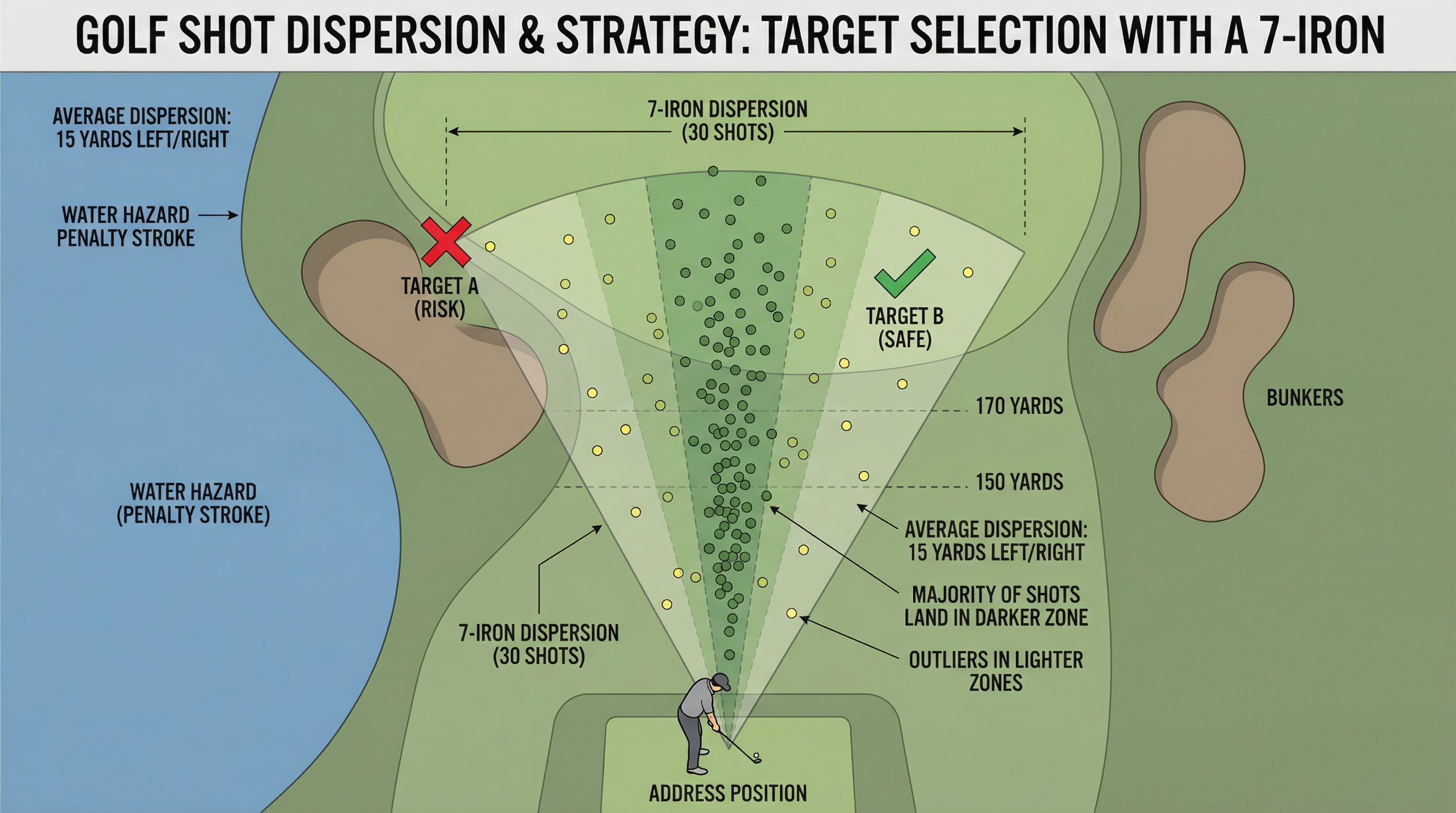
Tour professionals use launch monitors and statistical tracking to understand their dispersion patterns in granular detail. If a player knows that 70% of their shots with a particular club will land within a certain cone, they can pick a target that ensures even the edges of that cone avoid serious trouble. This approach transforms the mental game. When you’re standing over a shot and you know your strategy allows for almost all the possible outcomes with that club, you’re going to swing a lot more freely and with far less tension.
A Pro’s Game Plan: Hole-by-Hole Strategy
Armed with an honest assessment of your game, you can now approach each hole like a chess match, thinking one or two moves ahead. The best players in the world don’t just react to what’s in front of them; they plan the entire hole backward from the green.
From the Tee Box: Setting Up Success
The goal of the tee shot is not always maximum distance; it’s to set up the ideal approach shot. Before you even pull a club, ask yourself: “Where is the best place to hit my next shot from?” This simple question will revolutionize your strategy.
Use the Angles: Don’t automatically tee up in the middle of the tee box. If there’s trouble down the right side of the hole, tee up on the far right side of the box and aim up the left. This creates a better angle away from the hazard and visually opens up the fairway . Conversely, if the trouble is on the left, tee up on the left side and aim right. This is one of the simplest yet most underutilized tactics in amateur golf.
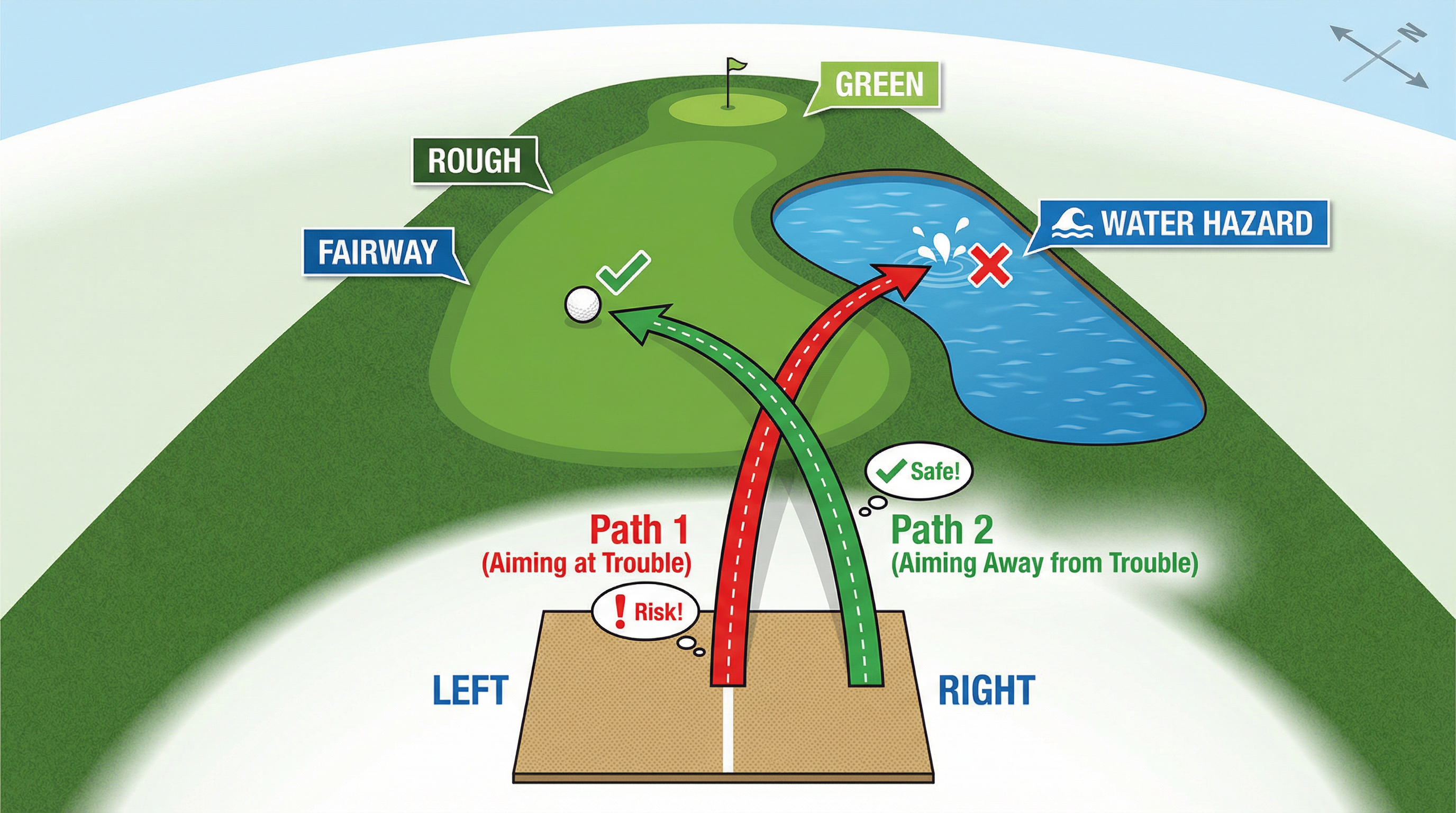
Golf course architects are masters of visual deception. They design holes to make fairways look narrower than they actually are from ground level. One of the best pre-round preparation techniques used by Tour professionals is to study aerial views of the course using yardage books or Google Earth imagery . From above, you can see the true size of landing areas, which often reveals significantly more room than what the designer wants you to see from the tee. This knowledge allows you to swing more freely, trusting that you have plenty of space to accommodate your shot pattern.
Club Selection Isn’t About Ego: A par-4 isn’t automatically a driver. If a 3-wood or hybrid leaves you in the fairway with a comfortable full swing into the green, it’s often the smarter play than a driver that brings bunkers, water, or out-of-bounds into play. Remember, the goal is to set up the easiest possible approach shot, not to impress your playing partners with distance.
The Approach Shot: Playing the Percentages
This is where most amateurs lose strokes by chasing glory. Tour professionals, on the other hand, play a disciplined game of percentages. They understand that the cumulative effect of many smart decisions far outweighs the occasional hero shot.













The Golden Rule: Aim for the Center of the Green. The middle of the green is your best friend. Even for the best players in the world, this is the primary target for any club longer than a 9-iron . Despite what you might think from watching television coverage, Tour pros rarely aim directly at pins. When you see those shots that land close to the pin, it’s usually because the ball landed at the very edge of their shot dispersion. Their actual target was the safe side of the green to avoid being short-sided or bringing a big number into play.
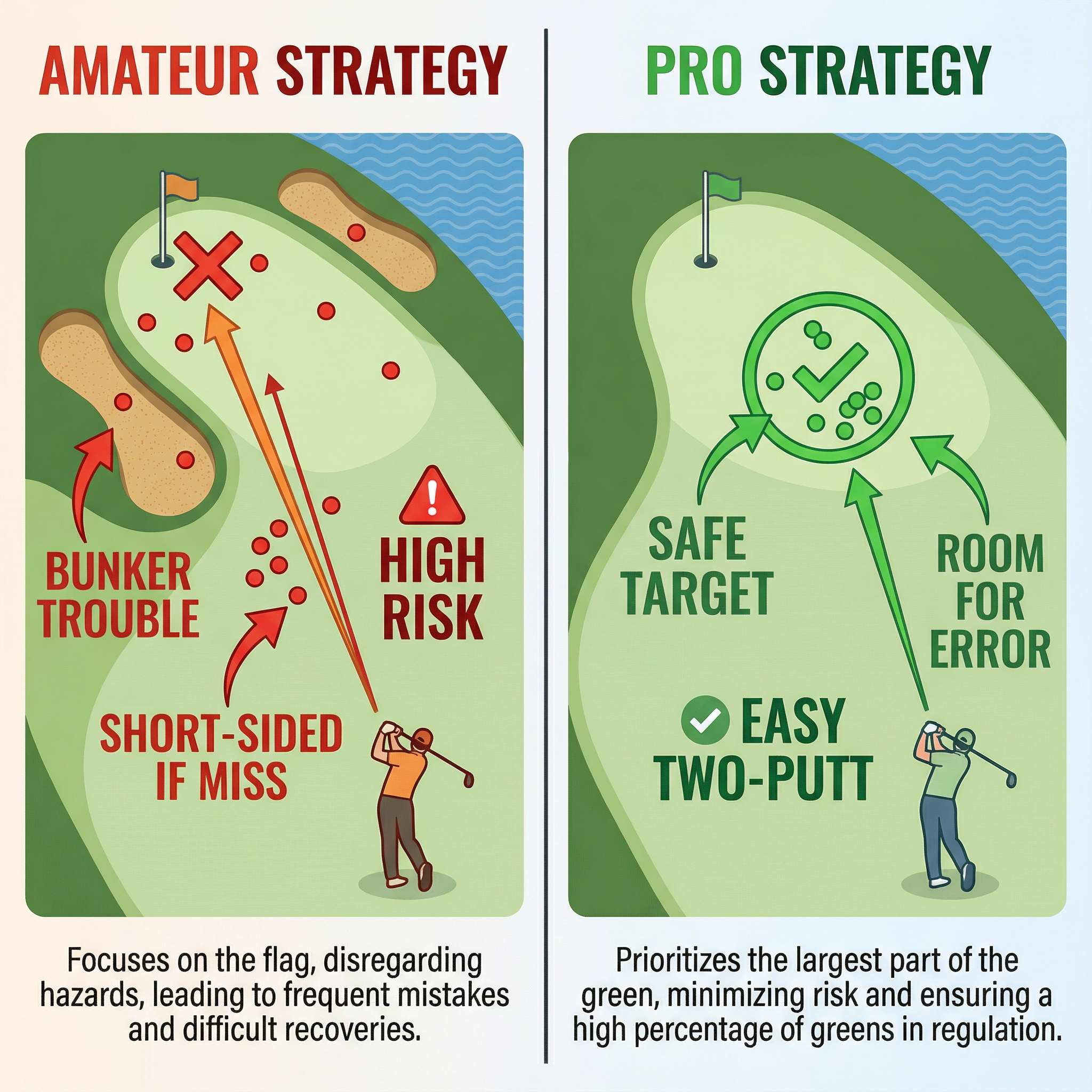
Avoid the “Sucker Pin”: When a pin is located just over a bunker or water hazard, it’s called a “sucker pin” for a reason. The risk far outweighs the reward. The difference between a 15-foot birdie putt and a 30-foot birdie putt is negligible compared to the difference between a 30-foot putt and a bunker shot. Aim for the fat part of the green, take your two-putt par, and walk to the next tee without a big number on your scorecard.
Know Your “Good Miss”: Before every approach, identify the “safe” place to miss. For every shot you play, there is a good miss and a bad miss . If the pin is on the right side of the green with a bunker guarding it, the safe miss is almost always to the left, leaving you with more green to work with for your chip or pitch. Being “short-sided” (missing on the same side as the pin with little green to work with) is one of the fastest ways to make a bogey or worse. Tour professionals meticulously mark their yardage books with safe zones and danger zones for every pin position, ensuring they always know where they can afford to miss.
Around the Green: The Art of the Easy Up-and-Down
Not every short game shot requires a high-spinning, flop-shot miracle. In fact, the best short game strategy is often the simplest one. The goal is to get the ball on the green and rolling as quickly as possible, minimizing the variables that can lead to a poor outcome.
Play to Your Strengths: Golf is not a static game. On some days, your chipping will be sharp; on others, it will be shaky. The smartest players adapt their short game choices based on what’s working that day . If your chipping is letting you down, don’t be afraid to use your putter from farther off the green than you normally would. The worst putt is often better than the worst chip. This kind of honest self-assessment and tactical flexibility is a hallmark of intelligent course management.
Prioritize Uphill Putts: When chipping or pitching, always try to leave yourself an uphill putt. They are significantly easier to judge for speed and line than slippery downhill putts. This principle should influence your target selection on approach shots as well. Staying below the hole is one of the most valuable yet underappreciated strategies in golf.
The Data Revolution: Thinking Like a Tour Analyst
The modern professional game is driven by data. Statistics like Strokes Gained, developed by Columbia Business School professor Mark Broadie, have revolutionized how players approach strategy . This metric analyzes every shot a player hits and compares it to the PGA Tour average, revealing exactly where a player is gaining or losing strokes relative to the field.
What has this data overwhelmingly proven? The fastest way to lower your score is to avoid big numbers. A single triple-bogey can undo the benefit of three birdies. Data-driven systems like Scott Fawcett’s DECADE Golf, used by numerous Tour pros, are built on this principle. They use statistical probabilities to map out the highest-percentage play on every shot, which almost always involves a more conservative strategy than most amateurs instinctively employ. Fawcett’s system assigns a negative value to different miss locations, helping players move their target to minimize potential damage.
Situation The Amateur Play The Pro (Smart) Play Tee Shot Automatically pulls driver to hit it as far as possible. Chooses the club that best avoids hazards and sets up the ideal approach angle. Approach Shot Aims directly at the flag, regardless of its location. Aims for the center of the green, ensuring the worst-case miss is still playable. Trouble Shot Tries the low-percentage hero shot through the trees. Takes their medicine, punches out sideways to the fairway, and relies on their short game. Putting Tries to make every long putt, often leaving a tricky 6-footer back. Lags long putts to a 3-foot circle, guaranteeing a stress-free two-putt.
The statistics also reveal another critical insight: course knowledge can be worth up to five strokes per round for a golfer who typically shoots in the 80s, and even more for higher handicappers . This advantage is magnified on courses with forced carries, tight fairways, and severe green undulations. The more you understand about a course before you play it, the better your strategic decisions will be.
Assessing Risk: The Green, Orange, Red System
One of the most sophisticated elements of professional course management is the ability to dynamically assess risk based on how you’re playing on a given day. On some days you will have your “A game,” where you are more in control of your ball, but on others you might have your B, C, or even D game. The key is recognizing which game you have and adjusting your strategy accordingly .
Many Tour professionals use a simple traffic light system to evaluate shots:
Green Light: You’re playing well, feeling confident, and can take on more risk. This is the time to aim at a tucked pin or attempt a more aggressive line off the tee.
Orange Light: You’re playing reasonably well but not at your best. Stick to standard, percentage-based strategy. Aim for centers of greens and safe sides of fairways.
Red Light: You’re struggling with your ball-striking. Assume a wider dispersion pattern and choose safer targets. Don’t try to force birdies to catch up—this almost always leads to more mistakes and bigger numbers.
The worst thing you can do when you’re not playing well is to become more aggressive in an attempt to make up ground. This adds pressure, increases tension, and typically makes the situation worse. The smartest players know when to play defensively and grind out a respectable score with the game they have that day.
Your Action Plan for the Next Round
Improving your golf game doesn’t have to mean a complete swing overhaul or months of intensive practice. By adopting the same strategic principles used by the best players in the world, you can make an immediate and lasting impact on your scores. It requires discipline, an honest assessment of your skills, and a willingness to prioritize a lower score over a single heroic shot.
For your next round, commit to these three fundamental principles:
Pick a specific, conservative target for every single shot. Vague targets like “the fairway” or “the green” are not sufficient. Choose a precise spot—a tree in the distance, a specific section of the fairway, or the center of the green—and commit to it.
Aim for the center of every green. Unless you’re inside 9-iron distance and the pin is in a safe location, your default target should always be the middle of the putting surface. This single change can save you multiple strokes per round.
After a bad shot, take a deep breath and focus entirely on the next one. Don’t compound one mistake by trying a low-percentage recovery shot. Play smart, get back into position, and move on.
You may be shocked at how a simple shift in mindset can lead to your best scores yet. That’s the power of smart course management. The golf course is a puzzle to be solved, not a battle to be won through brute force. Start thinking like a strategist, and watch your handicap drop.
References
[3] USGA. (2024, March 18). Importance of Strokes Gained Statistic.
[4] Reddit r/golf. (2024). How many strokes do you attribute to course knowledge?








Blog
The 5 Most Overrated Golf Tips (And What to Do Instead)
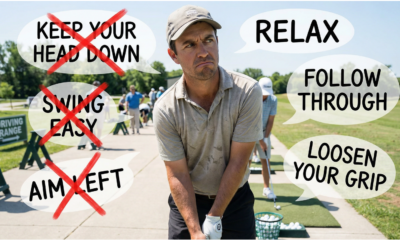
Stop following bad golf advice! The Golf Hacker debunks 5 overrated tips (keep your head down, swing easy, aim left) and shares what actually works for mid-handicappers.
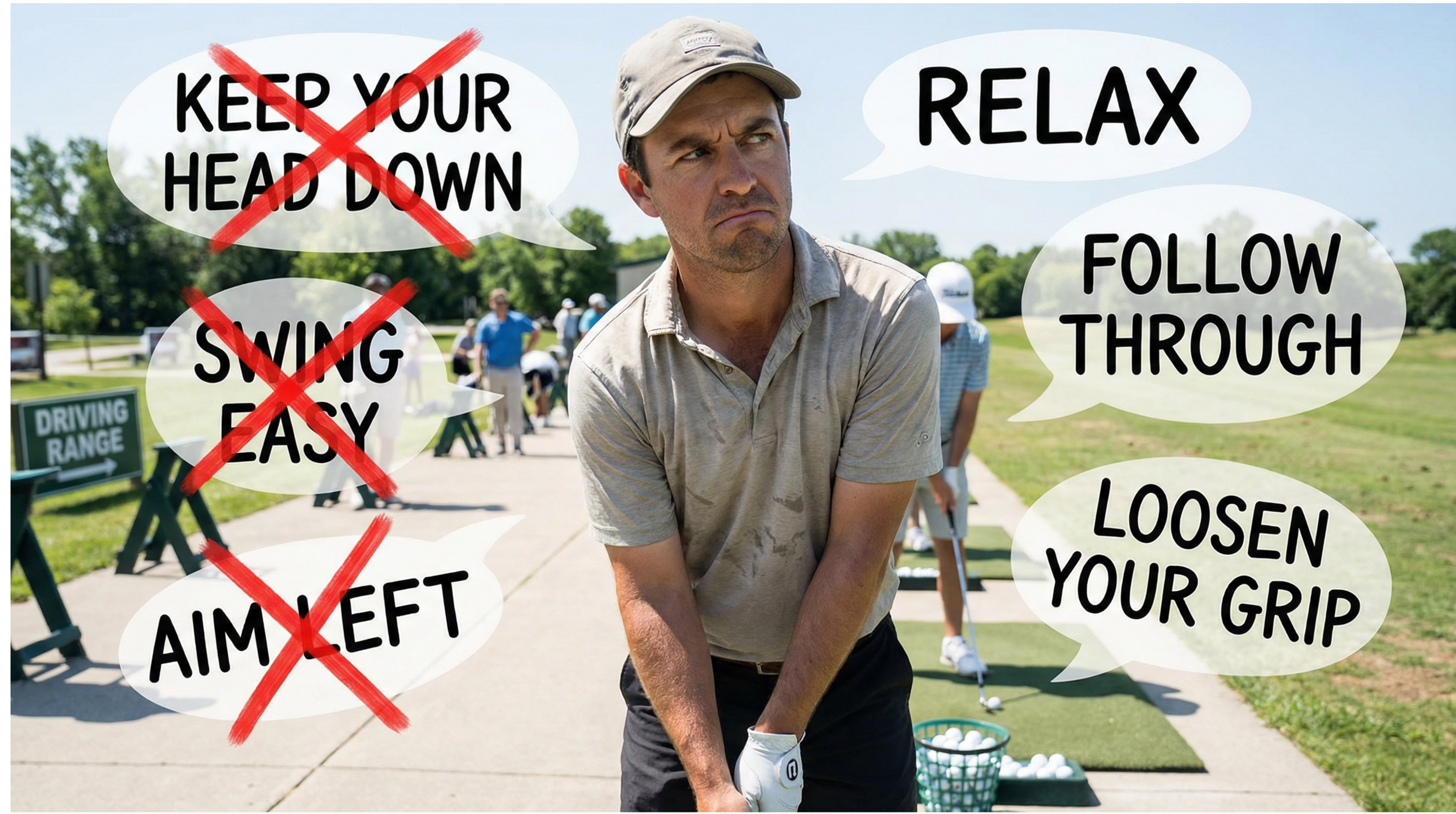
Let’s talk about bad golf advice. The golf world is drowning in it. Every magazine, every YouTube video, every well-meaning buddy at the range has a tip that’s supposed to transform your game. “Keep your head down.” “Swing easy.” “Grip it and rip it.” Most of it is garbage. Not because the people giving the advice are trying to mislead you, but because generic tips don’t work for specific problems. What helps a tour pro with a hundred-twenty-mile-per-hour swing speed might wreck a weekend warrior who barely breaks ninety. What fixes a hook won’t help a slice. And yet, we keep repeating the same tired advice like it’s gospel.
I’ve spent years trying every tip, drill, and swing thought imaginable. Some helped. Most didn’t. And a few actually made my game worse. So I’m here to save you some time and frustration by calling out the five most overrated golf tips I’ve encountered—and more importantly, telling you what to do instead. These aren’t just my opinions. These are lessons learned through trial, error, and way too many balls hit into the woods. Let’s get into it.
Why Generic Advice Fails Golfers
Before we dive into the specific tips, let’s talk about why so much golf advice falls flat. The problem is that golf instruction has become one-size-fits-all. Instructors, magazines, and influencers dish out tips without knowing anything about your swing, your tendencies, or your skill level. They’re throwing spaghetti at the wall and hoping something sticks.
But here’s the thing: golf swings are individual. Your body type, flexibility, strength, and coordination are different from mine. Your miss pattern is different. Your goals are different. So when someone tells you to “keep your left arm straight” or “turn your hips faster,” they’re making assumptions about your swing that might not be true. And if the advice doesn’t match your actual problem, it’s not just unhelpful—it can make things worse.
The best golf instruction is diagnostic. It identifies your specific issue and addresses it with a tailored solution. Generic tips skip the diagnosis and jump straight to the prescription. That’s why they fail. So as we go through these overrated tips, remember: the goal isn’t to bash people who give advice. The goal is to help you think more critically about what advice actually applies to you.
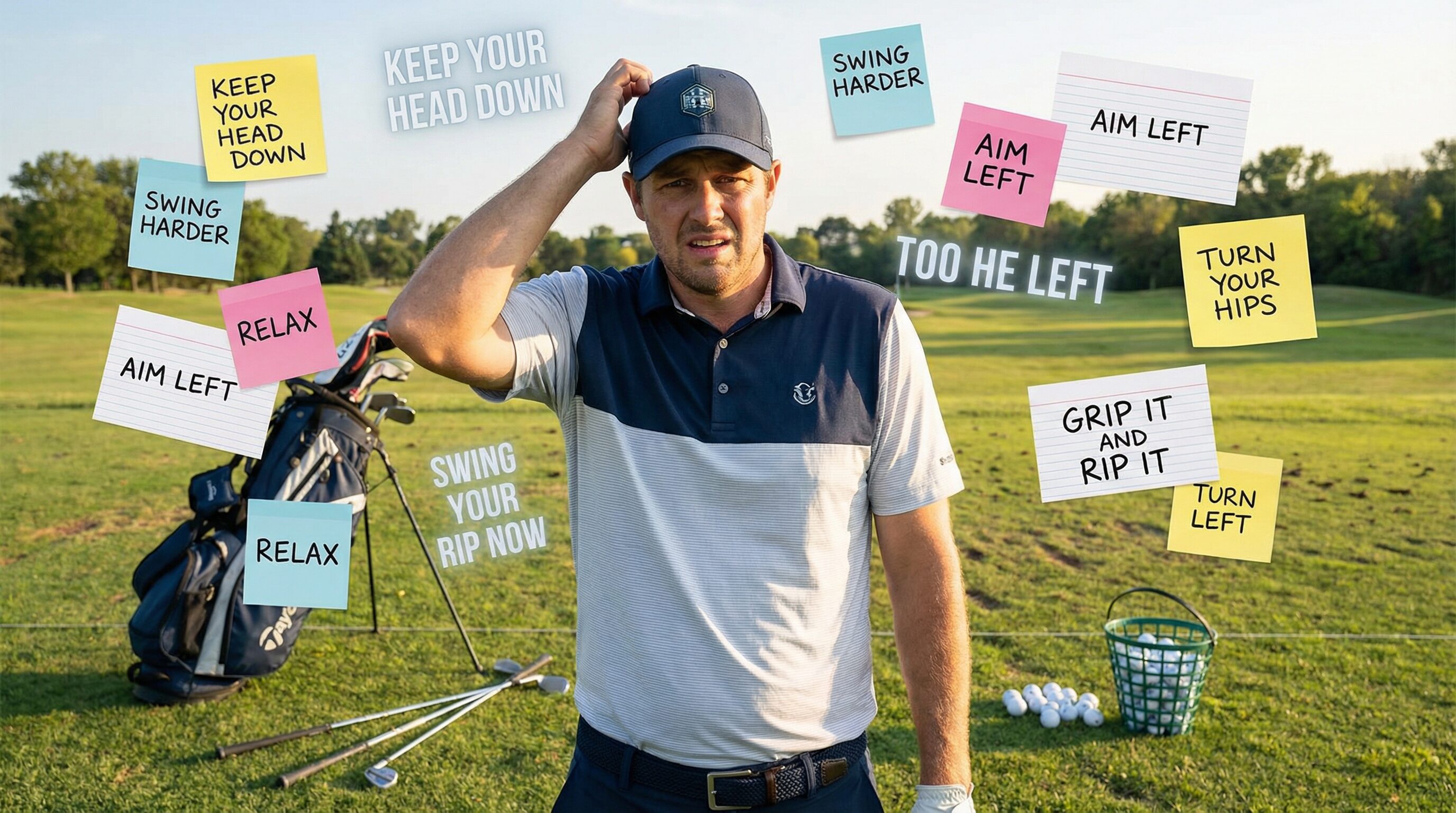
Overrated Golf Tip #1: “Keep Your Head Down” Ruins Your Swing (Do This Instead)
This is probably the most common piece of golf advice ever given, and it’s also one of the most damaging. How many times have you hit a bad shot and had someone say, “You looked up”? It’s become a reflex. Bad shot? Must have lifted your head. But here’s the truth: keeping your head rigidly down through impact doesn’t help most golfers. In fact, it often hurts.
When you focus on keeping your head down, you restrict your body’s natural rotation. Your shoulders can’t turn fully. Your hips get stuck. Your weight stays on your back foot. You end up with a cramped, restricted swing that produces weak, inconsistent contact. And ironically, trying to keep your head down often causes you to lift it anyway, because your body is fighting against an unnatural position.
Watch any tour pro in slow motion. Their head moves. Not wildly, but it moves. It rotates slightly during the backswing and follows the ball through impact. That’s natural. That’s efficient. The head isn’t an anchor—it’s part of a dynamic athletic motion.
What to Do Instead:
Focus on keeping your eyes on the ball, not your head down. There’s a difference. Your eyes can track the ball while your head rotates naturally with your body. This allows for a full, unrestricted turn and proper weight transfer. Practice making swings where you let your head rotate naturally. You’ll feel less restricted, generate more power, and make better contact. If you’re really worried about looking up too early, try this drill: after you hit the ball, keep your eyes on the spot where the ball was for a count of one before looking up. This trains you to stay down through impact without restricting your rotation.
Overrated Golf Tip #2: “Swing Easy” (Why This Advice Backfires)
“Swing easy” sounds like great advice. It’s calming. It’s zen. The problem is that it’s vague and often counterproductive. When most golfers try to “swing easy,” they decelerate through the ball. They get tentative. They lose rhythm and tempo. The result? Weak contact, inconsistent ball flight, and frustration.
The advice usually comes from a good place. Someone sees you swinging out of your shoes, losing your balance, and spraying balls all over the range. So they tell you to swing easy. But “easy” isn’t the same as “smooth” or “controlled.” Easy implies less effort, and less effort in golf usually means less speed, less compression, and worse results.
Tour pros don’t swing easy. They swing smooth. They swing with tempo. They swing with control. But they’re still generating tremendous speed through the ball. The difference is that their speed is efficient and well-timed, not wild and uncontrolled.
What to Do Instead:
Focus on tempo and balance, not effort level. A good tempo is the key to consistency. Try this: count “one” on your backswing and “two” on your downswing. The ratio should be about three-to-one—your backswing takes three times as long as your downswing. This creates a smooth, rhythmic motion that generates speed without feeling rushed or out of control.
As for balance, make it a rule: you should be able to hold your finish position for three seconds after every swing. If you can’t, you’re swinging too hard or too out of control. Work on finishing in balance, and your swing will naturally find the right amount of effort. You’ll generate plenty of speed, but it will be controlled speed—the kind that produces consistent, solid contact.

Overrated Golf Tip #3: “Grip It and Rip It” (The Truth About Power)
If you slice the ball, you’ve probably been told to aim left (for right-handed golfers) to compensate. This is terrible advice. It doesn’t fix your slice—it just accommodates it. And worse, it often makes your slice worse.
Here’s why: when you aim left, your brain knows the ball is going to curve right, so you subconsciously swing even more across the ball to get it started left. This creates an even steeper, more out-to-in swing path, which produces more sidespin and a bigger slice. You’re not fixing the problem; you’re reinforcing it. And now you’re also dealing with alignment issues that make it harder to hit straight shots even if you do fix your swing.
Aiming left to compensate for a slice is like putting a bucket under a leaky roof. Sure, it catches the water, but it doesn’t fix the leak. And eventually, the leak gets worse.
What to Do Instead:
Fix the root cause of your slice: an open clubface at impact relative to your swing path. The most common reason for an open clubface is a weak grip. Check your grip. When you look down at your hands, you should see two to three knuckles on your left hand (for right-handed golfers). If you only see one knuckle or none, your grip is too weak, and you’re going to struggle to square the clubface.
Strengthen your grip by rotating both hands slightly to the right on the club. This will help you close the clubface through impact and reduce your slice. Pair this with a focus on swinging more from the inside (imagine swinging out toward right field instead of pulling across your body), and you’ll start hitting straighter shots. It takes practice, but it’s a real fix, not a band-aid.
Overrated Tip #4: “Hit Down on the Ball”
“Hit down on the ball” is advice you’ll hear constantly, especially with irons. And to be fair, it’s not entirely wrong—you do want to make contact with the ball before the ground. But the way this tip is usually interpreted causes more problems than it solves.
When most golfers hear “hit down on the ball,” they think they need to chop at it. They get steep. They drive their hands down aggressively. They try to pound the ball into the turf. The result? Fat shots, thin shots, and a lot of frustration. They’re working harder, not smarter.
The reality is that good ball-first contact comes from proper swing mechanics, not from consciously trying to hit down. If your weight is shifting correctly and your swing path is on plane, you’ll naturally hit the ball first and then the ground. The divot happens as a byproduct of a good swing, not as the goal.
What to Do Instead:
Focus on weight transfer and low point control. Your low point—the lowest point of your swing arc—should be a few inches in front of the ball. This happens naturally when you shift your weight properly from your back foot to your front foot during the downswing.
Here’s a simple drill: place a tee in the ground a few inches in front of your ball. Your goal is to brush the ground where the tee is, not where the ball is. This trains you to move your low point forward, which creates the ball-first contact you’re looking for. You don’t have to think about hitting down. Just shift your weight, let your swing bottom out in front of the ball, and the contact will take care of itself.

Overrated Tip #5: “Keep Your Left Arm Straight”
The left arm straight tip (for right-handed golfers) is a classic. It’s been around forever, and it’s based on the idea that a straight left arm creates width and power in the swing. And again, there’s some truth to it. But the way it’s taught and practiced often creates more problems than it solves.
When golfers obsess over keeping their left arm perfectly straight, they create tension. Tension is the enemy of a good golf swing. A tense left arm restricts your shoulder turn, limits your backswing, and makes it harder to release the club through impact. You end up with a rigid, mechanical swing that lacks fluidity and speed.
Look at tour pros. Yes, their left arms are relatively straight at address and through most of the backswing. But they’re not locked. There’s a slight bend, and more importantly, there’s no tension. The arm is extended, not rigid. That’s a huge difference.
What to Do Instead:
Focus on extension, not rigidity. Your left arm should be comfortably extended, not locked straight. Think of it like reaching for something on a high shelf—your arm is extended, but there’s no tension. You’re not forcing it.
Here’s a good checkpoint: at the top of your backswing, your left arm should feel extended but relaxed. If you feel tension in your shoulder or elbow, you’re overdoing it. Let your arm bend slightly if that’s what feels natural. The goal is width and control, not a perfectly straight line. A relaxed, extended left arm will give you better rotation, more speed, and more consistent contact than a rigid, locked arm ever will.
How to Filter Golf Advice Going Forward
Now that we’ve debunked five overrated tips, let’s talk about how to evaluate golf advice in general. Because the truth is, there will always be more tips, more drills, and more “secrets” to better golf. How do you know what’s worth trying and what’s a waste of time?
1. Consider the Source
Who’s giving the advice? Is it a qualified instructor who’s seen your swing, or is it a random guy at the range who shoots a hundred and five? Context matters. The best advice is personalized. If someone is giving you a tip without knowing your swing, your tendencies, or your goals, take it with a grain of salt.
2. Ask: Does This Address My Specific Problem?
Generic advice rarely works. Before you try a new tip, ask yourself: does this address a problem I actually have? If you don’t slice the ball, advice about fixing a slice isn’t relevant. If you already have good tempo, being told to “slow down” won’t help. Focus on tips that target your specific weaknesses.
3. Test It, But Give It Time
Golf changes take time. If you try a new grip or a new swing thought, don’t expect immediate results. Give it a few range sessions. But also, don’t stick with something that clearly isn’t working. If a tip makes your ball flight worse after a fair trial, move on. Trust your results, not your hopes.
4. Prioritize Fundamentals Over Quick Fixes
The most valuable advice is usually the least sexy. Grip, stance, posture, alignment—these fundamentals matter more than any swing thought or magic drill. If your fundamentals are solid, everything else gets easier. If they’re not, no amount of tips will save you.
5. Record Your Swing
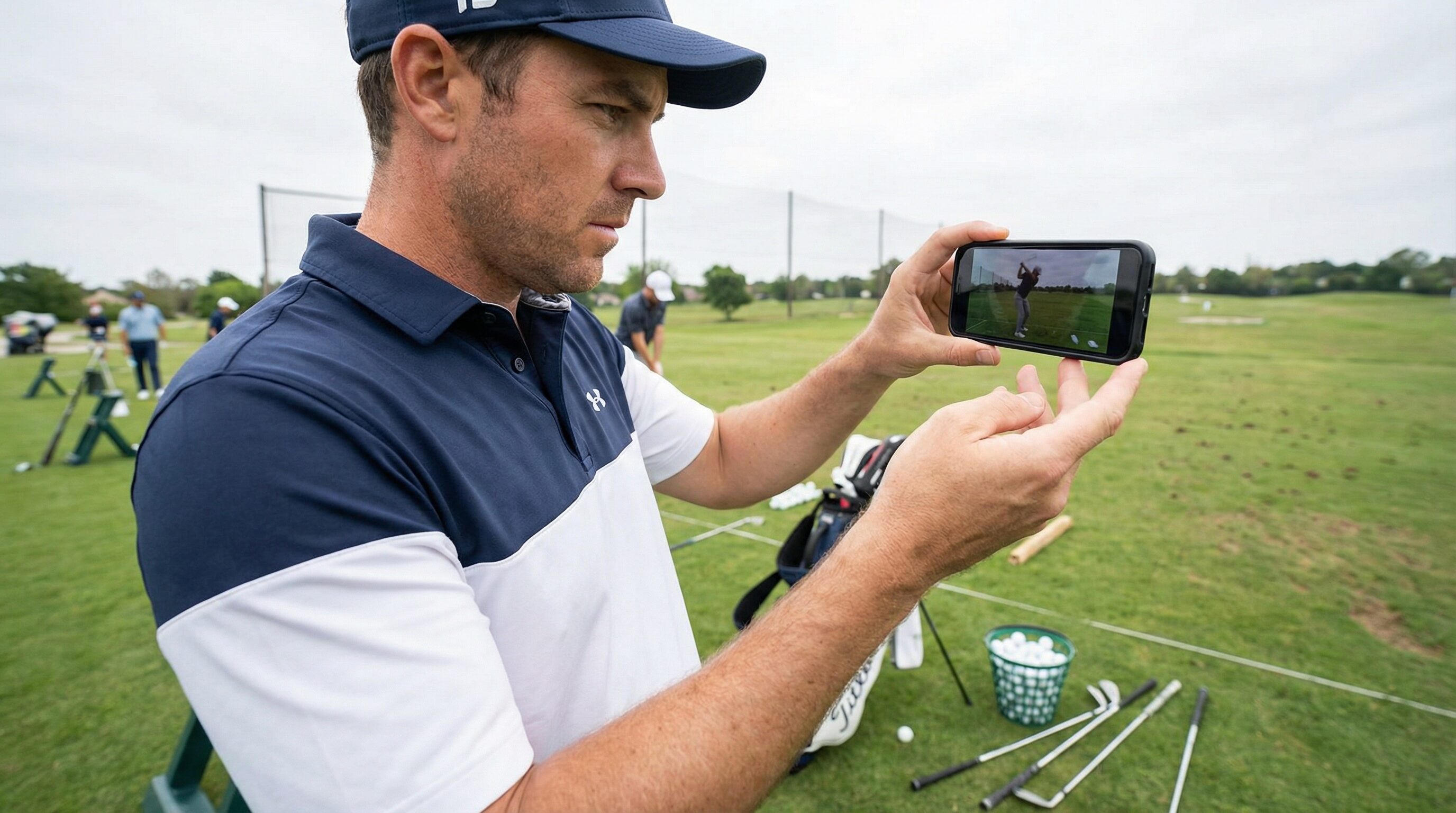
One of the best ways to filter advice is to see your swing for yourself. Record your swing on your phone. Watch it in slow motion. Compare it to what good swings look like. This gives you objective data. You’ll know if your head is actually moving too much, if your left arm is bending excessively, or if you’re really swinging out of control. Video doesn’t lie.
The Bottom Line: Think Critically, Swing Better
Golf instruction is full of well-meaning advice that doesn’t actually help most golfers. “Keep your head down,” “swing easy,” “aim left to fix your slice”—these tips sound good, but they’re either too vague, too generic, or just plain wrong for most players. The key to improving your game isn’t collecting more tips. It’s learning to think critically about the advice you receive and focusing on solutions that address your specific problems.
So the next time someone offers you a tip, ask yourself: does this make sense for my swing? Does it address a problem I actually have? Is it based on sound mechanics, or is it just conventional wisdom that’s been repeated so many times it sounds true? If the answer to any of those questions is no, feel free to ignore it. Your golf game will thank you.
And remember: the best tips are the ones that work for you. Not for tour pros. Not for your buddy who plays twice a year. For you. So stop wasting range time on overrated advice, start focusing on what actually matters, and go play better golf.
Equipment
The Best Golf Balls for Average Golfers (And How to Choose Yours)
Stop wasting money on the wrong golf balls. This guide helps average golfers choose the right ball based on swing speed, handicap, and budget, not hype.
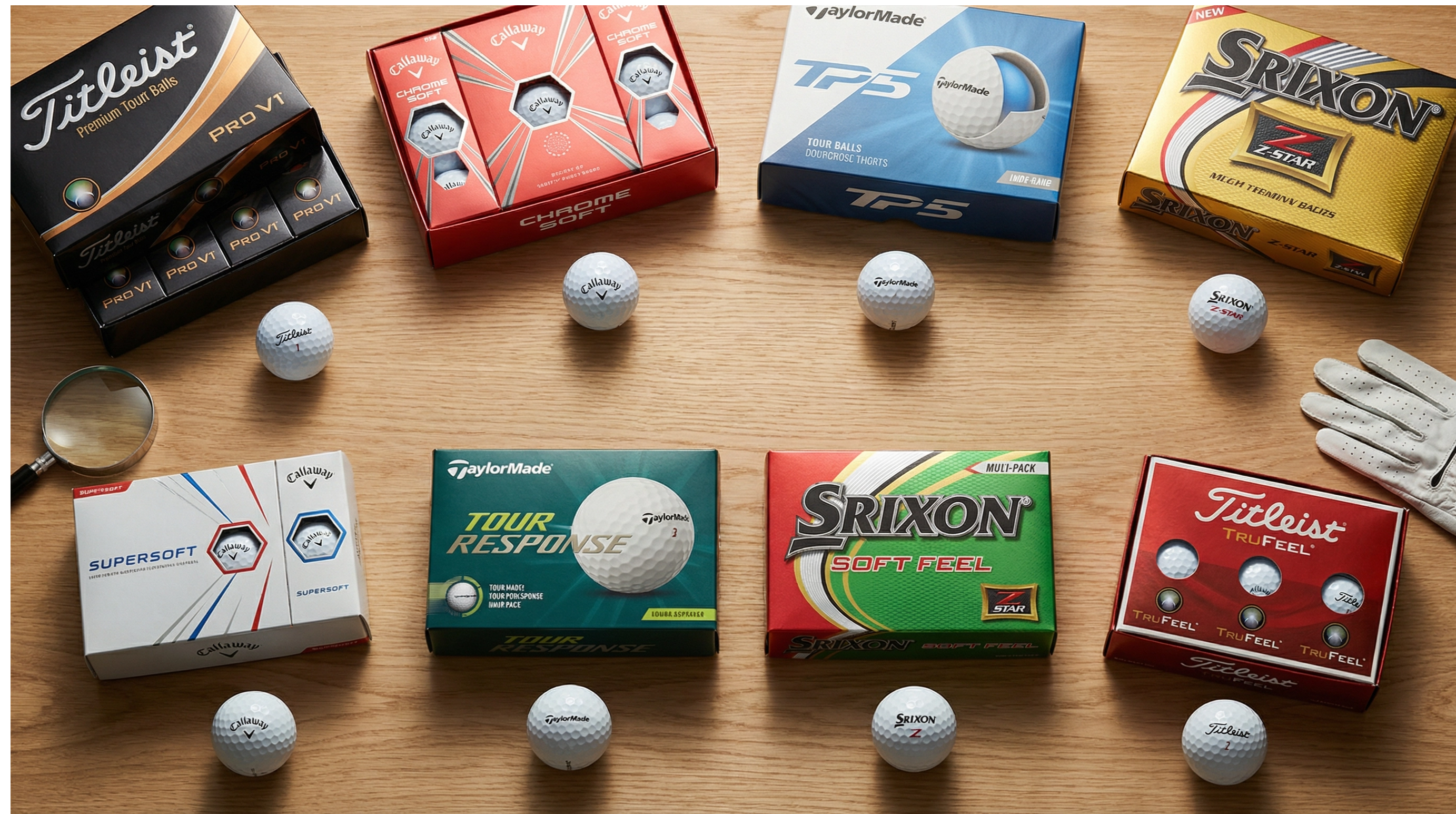
Let’s get something out of the way right up front: you’re probably playing the wrong golf ball. I don’t mean that as an insult—most golfers are playing the wrong ball because the golf industry has spent decades convincing us that we need tour-level equipment to play decent golf. The truth is that ninety percent of amateur golfers would benefit more from switching to a ball that actually matches their swing speed and skill level than from buying a new driver or taking another lesson. In this guide, I’m going to cut through the marketing nonsense and help you find a ball that will actually improve your game without emptying your wallet.
Why Most Golfers Use the Wrong Ball
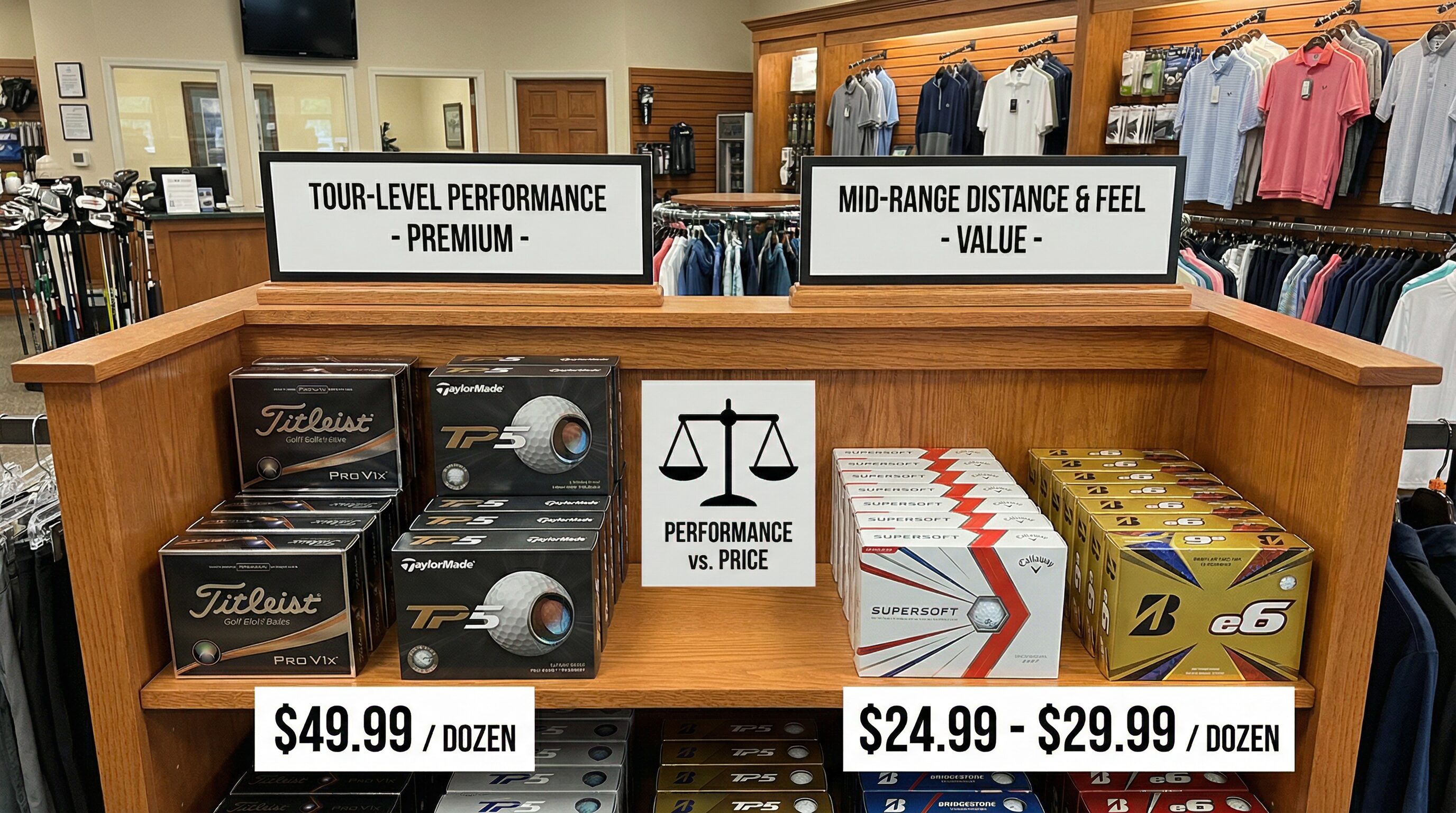
Walk into any pro shop and you’ll see walls of premium golf balls with names like “Pro V1,” “TP5,” and “Chrome Soft.” These balls cost fifty dollars a dozen or more, and they’re marketed with images of tour pros hitting perfect shots. The implication is clear: if you want to play good golf, you need these balls. But here’s what the marketing doesn’t tell you: these tour-level balls are designed for swing speeds of one hundred miles per hour or more and players who can consistently compress the ball at impact. If you’re swinging slower than that—and most amateurs are—you’re not getting any benefit from these expensive balls. In fact, you might be hurting your game.
The problem is compression. Tour balls are built with firm cores that require high swing speeds to compress properly. When you compress the ball, you maximize distance and control. But if your swing speed is in the eighty to ninety-five mile per hour range, you’re not compressing that Pro V1 enough to get its benefits. You’re essentially paying premium prices for performance you can’t access. Meanwhile, there are balls designed specifically for your swing speed that cost half as much and will give you better results. It’s one of golf’s dirty little secrets, and it’s time someone said it out loud.
What Actually Matters: Compression, Spin, and Feel
Let’s break down the three factors that actually matter when choosing a golf ball: compression, spin characteristics, and feel. Compression is a measure of how much the ball deforms at impact. Lower compression balls (around seventy to eighty) are easier to compress and work better for slower swing speeds. Higher compression balls (ninety to one hundred plus) require more speed to compress properly. If you’re not sure what your swing speed is, a good rule of thumb is that most amateur golfers with a driver swing speed under ninety-five miles per hour should be playing a lower compression ball.
Why You Don’t Need New Clubs to Play Better Golf
Spin is the next consideration, and this is where things get interesting. High spin balls give you more control around the greens, which sounds great until you realize that they also amplify your mistakes off the tee. If you slice or hook the ball, a high spin ball will make those curves more dramatic. For most average golfers, a mid-spin or low-spin ball is actually better because it reduces sidespin and keeps your drives straighter. Yes, you’ll sacrifice some greenside spin, but let’s be honest—if you’re a fifteen handicapper, you’re not spinning wedge shots back anyway. You’re better off with a ball that keeps your drives in play.
Feel is the most subjective factor, but it matters. Some golfers love the soft feel of a urethane-covered ball around the greens. Others prefer a firmer feel that gives them more feedback. The only way to know what you like is to try different balls. But here’s my advice: don’t obsess over feel until you’ve figured out compression and spin. Those two factors will have a much bigger impact on your scores than whether the ball feels slightly softer on chip shots.
Ball Recommendations by Swing Speed and Handicap
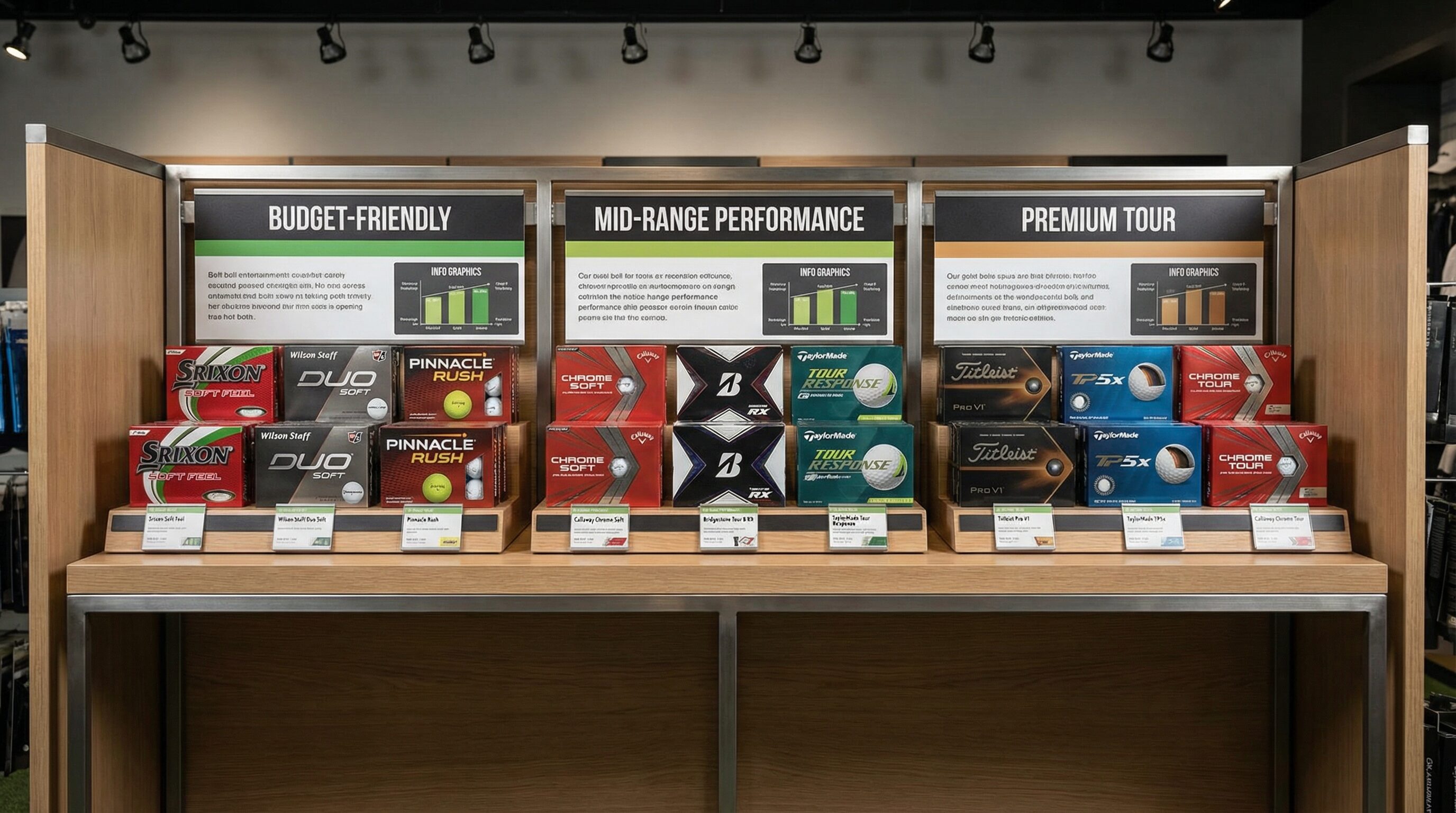
Now let’s get to the good stuff: specific recommendations. I’m going to break this down by swing speed and handicap because those are the two factors that matter most. These are balls that real golfers actually use and trust, not just whatever the tour pros are playing this week.
For Slower Swing Speeds (Under 85 MPH) and Higher Handicaps (20+):
If you’re in this category, you need a low compression ball that maximizes distance and minimizes spin. The Callaway Supersoft is the gold standard here. It has a compression rating of thirty-eight, which is incredibly soft, and it’s designed to help slower swingers get more distance. It’s also affordable, usually around twenty-five dollars a dozen. Another great option is the TaylorMade Soft Response, which has a similar compression and costs about the same. Both of these balls will give you straighter drives and more distance than any tour ball ever could.
For Moderate Swing Speeds (85-95 MPH) and Mid Handicaps (10-20):
This is where most amateur golfers fall, and this is where you have the most options. The Titleist Tour Soft is my top recommendation for this group. It has a compression of around sixty-five, which is perfect for moderate swing speeds, and it offers a nice balance of distance and control. It costs about thirty-five dollars a dozen, which is reasonable for the performance you’re getting. Another excellent choice is the Srixon Q-Star Tour, which has similar specs and costs a bit less. If you want to save even more money, the Wilson Duo Soft+ is a solid budget option that performs surprisingly well for its price point.
For Faster Swing Speeds (95+ MPH) and Lower Handicaps (Under 10):
If you’re consistently swinging ninety-five miles per hour or faster and you’re a single-digit handicapper, then yes, you can start looking at tour-level balls. The Titleist Pro V1 is the industry standard for a reason—it offers exceptional control and consistency. But it’s not the only option. The TaylorMade TP5 and Callaway Chrome Soft are both excellent alternatives that some golfers prefer for their feel or spin characteristics. These balls cost around fifty dollars a dozen, but if you have the swing speed to compress them properly, they’re worth it. Just be honest with yourself about whether you’re really in this category. If you’re not breaking eighty regularly, you’re probably better off with a mid-range ball.
Common Mistakes When Buying Golf Balls
Let’s talk about the mistakes I see golfers make when buying balls. The biggest one is buying based on what tour pros use. I can’t stress this enough: you are not Rory McIlroy. His swing speed is one hundred twenty miles per hour. Yours is probably eighty-five to ninety. What works for him will not work for you. Stop buying Pro V1s just because you see them on TV.
The second mistake is buying balls based on brand loyalty alone. Yes, Titleist makes great balls, but so do TaylorMade, Callaway, Srixon, and others. Don’t limit yourself to one brand just because that’s what you’ve always played. Try different options and see what works best for your game. You might be surprised.
The Ultimate Guide to Buying Used Golf Clubs
The third mistake is not considering your budget realistically. If you lose three balls per round, you’re going through three dozen balls a month. At fifty dollars a dozen, that’s one hundred fifty dollars a month on golf balls. That’s insane. There’s no shame in playing a twenty-five dollar ball if it means you can afford to play more often. In fact, I’d argue that playing more often with cheaper balls will improve your game more than playing less often with expensive balls.
The fourth mistake is ignoring swing speed. I’ve said it before, but it bears repeating: if you don’t know your swing speed, you’re guessing. Most golf shops and driving ranges have launch monitors that can measure your swing speed in about five minutes. Get it measured. It’s free, it’s fast, and it will save you from wasting money on the wrong balls.
A Simple Decision Framework
Here’s a simple framework to help you choose the right ball. First, figure out your driver swing speed. If you don’t have access to a launch monitor, you can estimate based on how far you hit your driver: if you’re hitting it two hundred yards or less, you’re probably under eighty-five miles per hour. If you’re hitting it two hundred to two hundred thirty yards, you’re probably in the eighty-five to ninety-five range. If you’re hitting it over two hundred forty yards, you’re probably over ninety-five.
Second, consider your handicap and your biggest weakness. If you’re a higher handicapper who struggles with slicing or hooking, prioritize a low-spin ball that will keep your drives straighter. If you’re a lower handicapper who wants more control around the greens, you can afford to play a higher spin ball.
Third, set a realistic budget. Decide how much you’re willing to spend per dozen and stick to it. There are good balls at every price point, so don’t feel like you need to spend fifty dollars to get decent performance.
Finally, buy a sleeve or two of a few different balls and test them. Play a round with each one and see which one gives you the best results. Pay attention to distance off the tee, accuracy, and how the ball feels around the greens. The ball that performs best for you might not be the one you expected.

The Truth About Premium Balls
Let me be blunt about premium balls: they’re amazing if you have the swing speed and skill to use them properly. But for most golfers, they’re overkill. It’s like buying a Ferrari to drive in city traffic. Sure, it’s a great car, but you’re never going to use its full capabilities. A Pro V1 is a phenomenal golf ball, but if you’re not compressing it properly, you’re wasting your money.
Here’s another truth: the difference between a thirty-five dollar ball and a fifty dollar ball is much smaller than the difference between a twenty-five dollar ball and a thirty-five dollar ball. In other words, you get diminishing returns as you move up in price. For most golfers, the sweet spot is in the twenty-five to thirty-five dollar range. That’s where you get the best performance for your money.
What About Used and Refurbished Balls?
This is a question I get all the time, and my answer is: it depends. If you’re buying used balls, make sure they’re in good condition. Look for balls graded as “mint” or “near mint” with no visible scuffs or cuts. A ball with a cut or deep scuff will not perform the same as a new ball, no matter how cheap it is.
Refurbished balls are a different story. These are balls that have been cleaned and sometimes repainted. The problem is that the refurbishing process can affect the ball’s performance, especially if the outer layer has been altered. I generally recommend avoiding refurbished balls unless you’re just practicing or playing a casual round where performance doesn’t matter as much.
If you want to save money, a better option is to buy last year’s model. Golf ball technology doesn’t change dramatically from year to year, and you can often find last year’s premium balls at mid-range prices. That’s a much better value than buying refurbished balls.
Stop Overthinking It
Here’s the bottom line: the golf ball matters, but it’s not going to fix your swing. If you’re slicing the ball thirty yards into the woods, switching from a Pro V1 to a Supersoft isn’t going to magically straighten out your drives. But it will help a little, and those little improvements add up.
The best ball for you is the one that matches your swing speed, fits your budget, and gives you confidence when you tee it up. It doesn’t have to be the most expensive ball on the market. It doesn’t have to be what the tour pros play. It just has to work for your game.
So stop buying balls based on marketing hype. Stop trying to play the same ball as Rory or Tiger. Figure out your swing speed, set a realistic budget, and choose a ball that’s designed for golfers like you. I guarantee you’ll see better results, and you’ll probably save money in the process.
Now get out there and play. And when you hit that drive down the middle of the fairway with a ball that actually fits your game, you’ll know exactly what I’m talking about.
Golf Hacks
How to Play in the Wind: A Hacker’s Survival Guide
Learn how to play better golf in windy conditions with this practical guide. Discover club selection, ball flight control, and course management strategies to lower your scores when the wind picks up.

There’s nothing quite like showing up to the course with high hopes for a great round, only to be greeted by howling winds that turn your normally reliable game into a complete mess. The wind is one of golf’s great equalizers, humbling scratch golfers and weekend warriors alike. But here’s the good news: with the right strategies and a few simple adjustments, you can not only survive windy conditions but actually use them to your advantage. In this guide, we’ll break down the practical tactics that will help you play smarter golf when Mother Nature decides to crash your tee time.
Accept Reality: The Wind Always Wins
The first and most important lesson about playing golf in wind is this: you cannot overpower it. I’ve watched countless golfers try to muscle their way through windy conditions, swinging harder and gripping tighter, only to see their scores balloon. The wind doesn’t care about your ego or your handicap. The sooner you accept that you need to work with the wind rather than against it, the better your round will be. This mental shift is the foundation of everything else we’re going to discuss.
Club Selection: When in Doubt, Take More
One of the biggest mistakes amateur golfers make in the wind is underestimating its impact on distance. A strong headwind can easily cost you two or three clubs, meaning your normal seven-iron shot might require a four-iron instead. The key is to make peace with this reality and commit to the extra club. There’s no shame in hitting a longer club into a green when the wind is in your face. In fact, it’s the smart play.
When you’re facing a headwind, take at least one extra club and make a smooth, controlled swing. The goal is to keep the ball flight lower and more penetrating, which we’ll discuss in the next section. Conversely, when you have a tailwind, you might need one or two fewer clubs than normal. The wind will carry the ball farther than you expect, so resist the urge to swing out of your shoes. A smooth tempo with the right club will produce better results every time.
Ball Flight: Keep It Low in the Headwind
Wind amplifies everything. A high ball flight in a headwind will balloon and lose distance dramatically. The solution is to keep your ball flight lower and more controlled. To achieve this, make a few simple adjustments at address. Move the ball back slightly in your stance, perhaps an inch or two toward your back foot. This will naturally deloft the club and produce a lower trajectory. You can also grip down on the club slightly, which gives you more control and helps keep the ball down.
The swing itself should be smooth and controlled, with a focus on making solid contact rather than generating maximum power. Think of it as a three-quarter swing with full commitment. You’re not trying to hit it as hard as you can; you’re trying to flight the ball under the wind. This approach will give you more consistency and better distance control in challenging conditions.

Crosswinds: Aim and Let It Ride
Crosswinds are tricky because they require you to trust the wind to move your ball. Many golfers try to fight a crosswind by aiming directly at the target and attempting to hold the ball straight. This rarely works. Instead, embrace the wind and use it to your advantage. If the wind is blowing from left to right, aim left of your target and let the wind bring the ball back. The amount you aim off depends on the strength of the wind, but a good rule of thumb is to aim at least 10 to 20 yards off your target line for a strong crosswind.
The mental challenge here is trusting the process. It feels counterintuitive to aim away from where you want the ball to go, but this is exactly what the situation demands. Commit to your aim, make a normal swing, and let the wind do the work. You’ll be surprised at how often the ball ends up exactly where you wanted it.
Putting in the Wind: Stability Is Everything
Putting in windy conditions is often overlooked, but it can be one of the most frustrating aspects of a breezy day on the course. The wind can affect your balance and make it difficult to maintain a steady stroke. The key is to widen your stance slightly to create a more stable base. This will help you resist the wind’s push and keep your body still during the stroke.
Additionally, focus on making a shorter, more controlled stroke. A long, flowing putting stroke is beautiful on a calm day, but in the wind, it’s a recipe for inconsistency. Keep your hands quiet, your head still, and trust your read. The wind will affect the ball’s roll less than you think, especially on shorter putts, so don’t overthink it.
Course Management: Play the Percentages
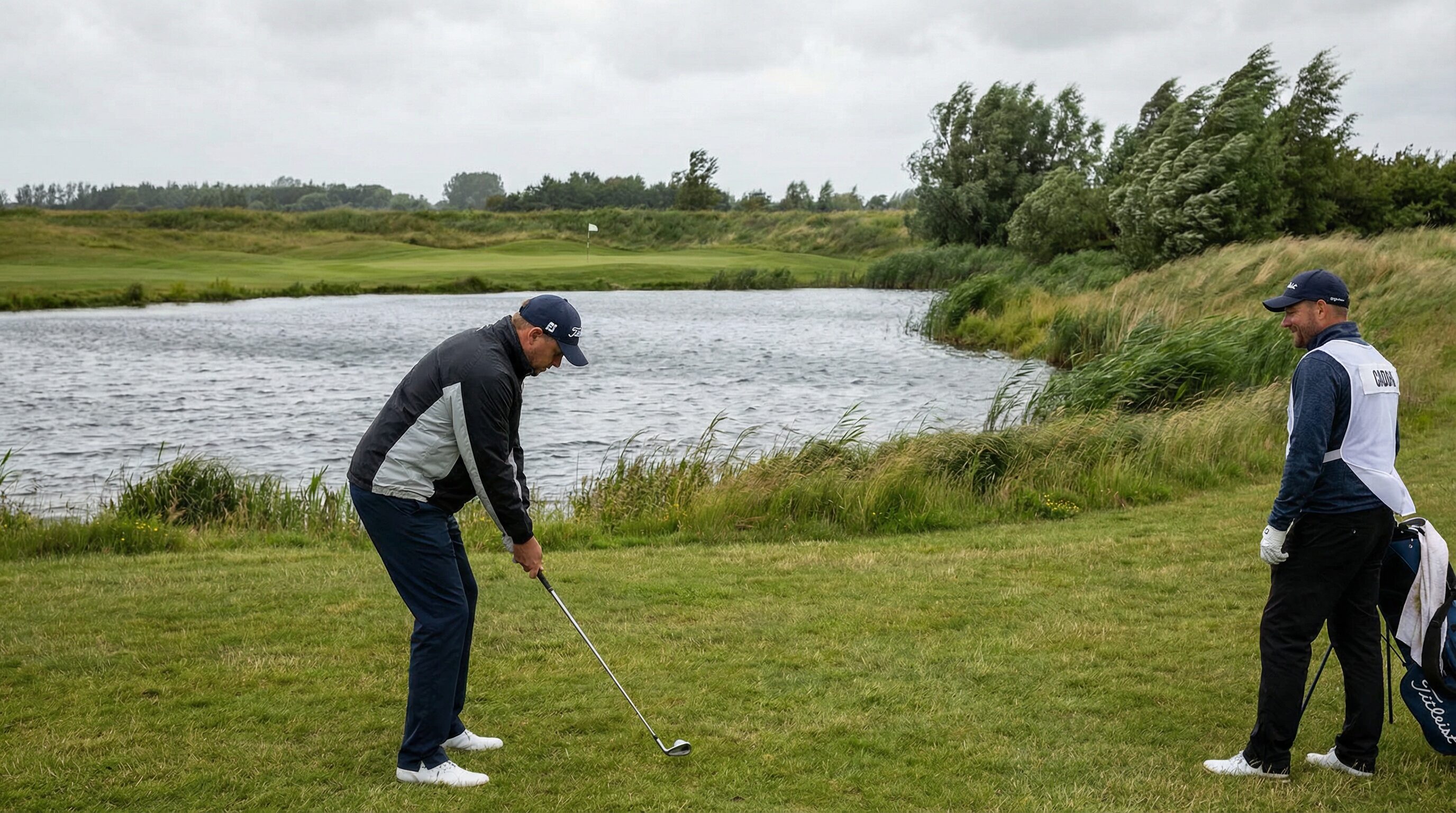
Windy conditions demand smart course management. This is not the day to take on risky shots or aim for tight pins. Instead, play to the fat part of the greens and avoid trouble at all costs. If there’s water on the left and the wind is blowing that direction, give yourself extra room to the right. Accept that pars are great scores in the wind, and bogeys are not disasters.
Think of your round as a chess match rather than a boxing match. You’re trying to outthink the conditions, not overpower them. Lay up when necessary, take the safe route off the tee, and focus on keeping the ball in play. The golfer who makes the fewest mistakes in the wind is almost always the one who posts the best score.
The Mental Game: Stay Patient and Positive
Perhaps the most important aspect of playing in the wind is maintaining a positive attitude. It’s easy to get frustrated when the wind knocks down a well-struck shot or pushes your ball into trouble. But remember, everyone on the course is dealing with the same conditions. The golfer who stays patient, accepts the challenge, and focuses on executing one shot at a time will always have an advantage.
Embrace the wind as an opportunity to test your skills and creativity. Some of my most memorable rounds have been on windy days when I had to dig deep and figure out how to navigate tough conditions. These are the rounds that make you a better golfer and give you confidence for future challenges.
Key Takeaways for Playing in the Wind
When the wind picks up, remember these essential strategies. Take extra club into headwinds and trust that the wind will affect your distance more than you expect. Keep your ball flight low by moving the ball back in your stance and making a controlled, three-quarter swing. Aim off your target line in crosswinds and let the wind bring the ball back. Widen your putting stance for stability and make shorter, more controlled strokes. Finally, play smart course management by avoiding trouble and accepting that pars are victories in tough conditions.
The wind is one of golf’s great challenges, but it doesn’t have to ruin your round. With the right approach and a willingness to adapt, you can turn a windy day into an opportunity to showcase your skills and resilience. What are your best tips for playing in the wind? Share your strategies in the comments below!













The 5 Most Overrated Golf Tips (And What to Do Instead)

How to Practice Golf When You Don’t Have Time

A Justin Thomas-Inspired Drill to Improve Your Backswing




-
 Product Review6 years ago
The Perfect Practice Putting Mat Review by Jason Tenzer
-
 Blog5 years ago
Loophole Rule Offers PGA Tour Pros a Mulligan
-
Blog5 years ago
2021 Buyer’s Guide: The Top 10 Value Golf Balls For Distance & Feel
-
Blog5 years ago
Golf Marriage Counselor
-
 Product Review6 years ago
THE ADJUSTABLE IRONS: WALKING STICKS GOLF CLUBS
-
 Blog7 years ago
9 Biggest Chokes Of The Past Decade
-
Blog5 years ago
What Your Golf Clubs Say About You
-

 Golf News2 months ago
The latest news in golf