Competitive Edge
The Unplayable Lie Golf Rule Explained: Examples & How to Use It
The unplayable lie golf rule gives you 3 options when your ball is stuck — but most golfers pick the wrong one. Here’s exactly how to use each option.


Let’s get one thing straight right off the first tee: the unplayable lie golf rule is not a punishment. It is a strategic tool. Too many amateur golfers look at a ball buried deep in a bush, wedged between tree roots, or sitting in an impossible lie and think they have to play hero golf. They grab a wedge, take a wild hack, advance the ball three inches, and end up taking a triple bogey. As a teaching professional, I see this every single week.
You don’t have to play it as it lies if the lie is impossible. The Rules of Golf give you a way out. Yes, it costs you a penalty stroke — but taking your medicine early is almost always the smarter play. Today, we are going to break down exactly how this rule works, what your three options are, and when you should use each one to protect your scorecard.
What Is the Unplayable Lie Golf Rule?
The unplayable lie golf rule (USGA Rule 19) allows a player to declare their ball unplayable anywhere on the golf course, except in a penalty area, and take relief for one penalty stroke. The player is the sole judge of whether their ball is unplayable, and this decision can be made at any time.
That last point is crucial. You do not need permission from your playing partners, your opponent, or a rules official. If your ball is sitting in the middle of the fairway and you simply do not want to hit it, you can technically declare it unplayable. (You would be making a terrible decision, but the rules allow it.) The rule exists to give you options when making a normal stroke is either physically impossible or highly likely to result in injury or disaster.
The 3 Unplayable Lie Relief Options Explained
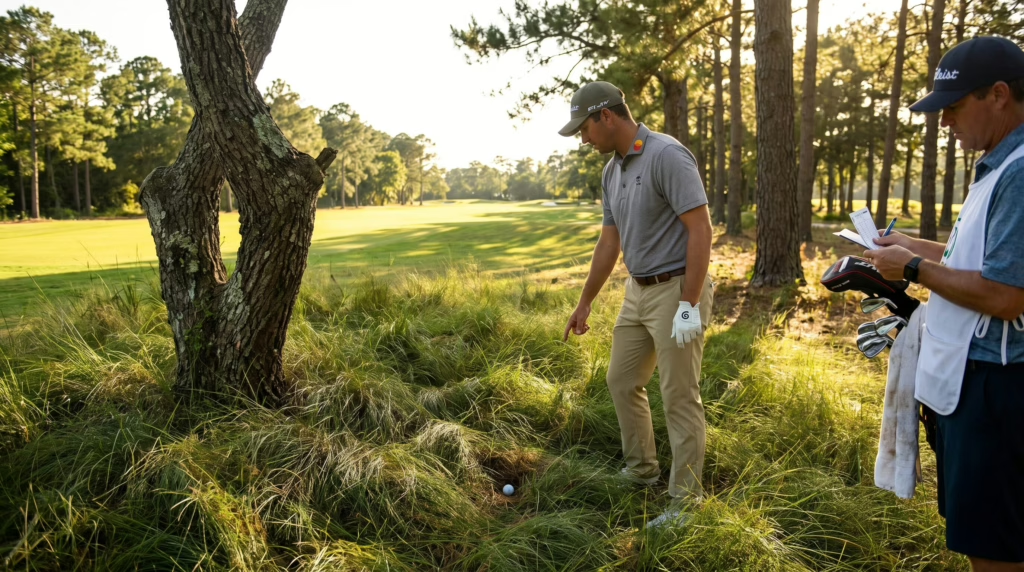
Golfer and caddie assessing the three relief options for an unplayable lie.
When you declare your ball unplayable, you add one penalty stroke to your score. In exchange, you receive three distinct relief options. Understanding the mechanics of each one is the key to using this rule effectively.
Relief Option How It Works Penalty Strokes Stroke-and-Distance Return to the spot of your previous stroke and play again 1 Back-on-the-Line Drop on a line extending from the hole through the ball, going backward as far as you like 1 Lateral Relief Drop within two club-lengths of the ball’s position, no closer to the hole 1
Option 1: Stroke-and-Distance Relief
This is the simplest option, but often the most painful to execute. You return to the spot where you played your previous stroke and play again from there. If your previous stroke was from the teeing area, you can tee the ball up again. If it was from the fairway or rough, you drop a ball within one club-length of that previous spot, no closer to the hole. The benefit here is certainty — you know exactly where you are going and you know you will have a clean lie. The cost is distance. You are essentially giving back the yardage you gained on your previous shot, plus the penalty stroke.
Option 2: Back-on-the-Line Relief
This option requires a little geometry. Imagine a straight line running from the hole, through the spot where your unplayable ball currently lies, and extending backward away from the hole. You can travel back along that line as far as you want. Once you pick your reference point on that line, you drop a ball. Under the updated 2023 Rules of Golf, the ball must be dropped on the line and come to rest within one club-length of where it first touches the ground, not nearer the hole. The further back you go, the more distance you give up — but you gain the ability to escape from deep trouble.
Option 3: Lateral Relief
This is the option most golfers are familiar with, and it should be your first instinct to check. You measure two club-lengths from the spot where your unplayable ball lies, in any direction except closer to the hole, and drop a ball anywhere within that relief area. You can use any club in your bag to measure those two club-lengths, which means you should always use your longest club — typically your driver — to maximize the size of your relief area.
Unplayable Lie Golf Rule: When Should You Use Each Option?
Knowing the rules is one thing. Knowing how to apply them strategically is what separates smart golfers from the rest. Here is a practical decision framework.
Default to Lateral Relief first. Before you do anything else, measure two club-lengths from your ball in all directions and look at what that relief area gives you. If those two club-lengths get you out of the bush, away from the tree roots, or into a position where you can make a full swing, take it. It keeps you as close to the green as possible while giving you a clean lie.
Use Back-on-the-Line when two club-lengths are not enough. Imagine your ball is buried in the middle of a dense, thorny bush. Two club-lengths might just drop you into a different part of the same bush. By going back-on-the-line, you can walk backward 10, 20, or even 50 yards until you find a clear spot in the rough or fairway that gives you a clean shot over or around the trouble.
Use Stroke-and-Distance only as a last resort. If your ball is deep in the woods and both of the other options leave you in an equally terrible position, swallow your pride, walk back to where you hit your last shot, and try again. Sometimes the best play is the one that gets you back to a known, manageable situation.
Unplayable Lie Golf Rule: Real Examples from the Course
Let’s look at three scenarios you are likely to encounter during your next round.

A ball plugged into the steep face of a bunker — one of the trickiest unplayable lie situations.
Scenario 1: The Tree Root Trap
Your drive misses the fairway and comes to rest directly against a thick, exposed tree root. You could try to chop it out, but you risk breaking your club, injuring your wrist, or simply advancing the ball three inches into more trouble.
The Play: Declare it unplayable. Measure two club-lengths away from the root (no closer to the hole). If that gets you into clear grass, drop the ball there, take your one-stroke penalty, and hit your approach shot safely. You are likely still making bogey at worst — far better than the snowman you were heading for.
Scenario 2: The Deep Bunker Face














Your approach shot plugs deeply into the steep, grassy face just above a greenside bunker. You have no stance and no swing.
The Play: This one requires careful attention to where the ball actually lies. If the ball is in the general area (the grassy face, not the sand), you have the standard three options and can drop outside the bunker. If the ball is in the bunker itself, your lateral and back-on-the-line relief options require you to stay inside the bunker. However, you do have a fourth option: for two penalty strokes (not one), you can use the back-on-the-line option and drop outside the bunker. Sometimes paying two strokes to escape a buried bunker lie is still the right call.
Scenario 3: The Impenetrable Bush
You hit a wild shot into a massive, thorny bush. You find the ball, but you cannot get a club on it. Two club-lengths still leaves you in the thorns.
The Play: Use the back-on-the-line option. Keep the hole and the spot where the ball lies on a straight line, walk backward out of the bush until you find a clear spot, drop the ball, and play over or around the bush. You are giving up distance, but you are giving yourself a shot.
Can You Declare an Unplayable Lie Anywhere?
Almost anywhere. You can declare your ball unplayable in the general area (fairways, rough, trees), on the putting green, or in a bunker. The only location on the golf course where the unplayable lie rule does not apply is when your ball is in a penalty area — the zones marked by red or yellow stakes and lines, which typically include water hazards and areas of dense vegetation designated by the course.
If your ball is in a penalty area, you cannot invoke Rule 19. You must take relief under Rule 17, which governs penalty areas specifically.
Unplayable Lie vs. Penalty Area: What’s the Difference?
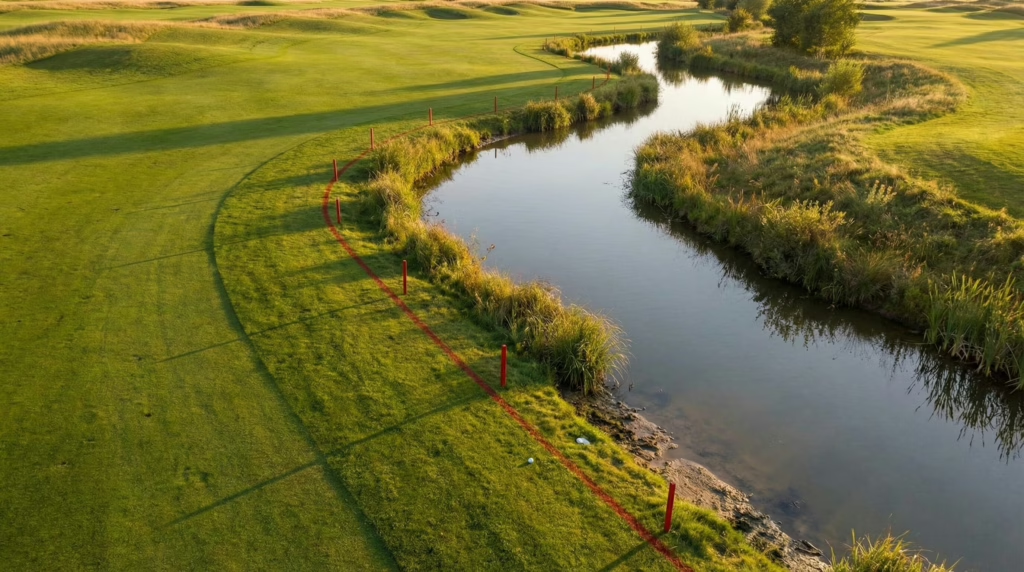
Red stakes mark a penalty area — the one place on the course where the unplayable lie rule does not apply.
This is one of the most common points of confusion I see among amateur golfers, and it is worth getting right.
When your ball is in a penalty area, you take relief under Rule 17. The relief options look similar — stroke-and-distance, back-on-the-line, and lateral — but the reference point is different. For a penalty area, you measure your relief from the point where the ball last crossed the edge of the penalty area, not from where the ball currently lies.
When your ball is in the general area and you declare it unplayable, you take relief under Rule 19. All three options are measured from the spot where the ball currently lies.
The practical difference matters most when the ball has rolled deep into a penalty area. In that case, you cannot use the unplayable lie rule to drop from where the ball is sitting — you must use the penalty area rule and measure from the crossing point.

The correct drop procedure: ball released from knee height, no spinning or throwing.
Understanding this distinction, and knowing exactly how to apply your three relief options, will save you strokes over the course of a season. Stop trying to hit miracle shots out of impossible lies. Take your penalty, take your drop, and keep your round alive. That is not giving up — that is playing smart golf.
Quick Reference: Unplayable Lie Golf Rule Checklist
Before you take relief, run through this checklist:
•Is my ball in a penalty area? If yes, use Rule 17, not Rule 19.
•Can two club-lengths get me into a clear lie? If yes, use lateral relief.
•Is two club-lengths not enough? Consider back-on-the-line relief and walk back until you find a clear spot.
•Are both options still leaving me in trouble? Use stroke-and-distance and replay from your previous position.
•Is my ball in a bunker? Lateral and back-on-the-line relief must stay inside the bunker unless you pay two penalty strokes.
Frequently Asked Questions
Can I declare my ball unplayable in a water hazard?
No. If your ball is in a penalty area (marked by red or yellow stakes), you must use Rule 17 for relief. The unplayable lie rule (Rule 19) does not apply inside penalty areas.
Do I have to show my ball to my playing partners before declaring it unplayable?
No. You are the sole judge of whether your ball is unplayable. You do not need to demonstrate that it is actually unplayable, and you do not need anyone else’s agreement.
Can I declare a ball unplayable if I haven’t found it yet?
No. You must find and identify your ball before you can declare it unplayable. If you cannot find your ball, it is a lost ball, and you must take stroke-and-distance relief under Rule 18.
What happens if my dropped ball rolls into another unplayable position?
You can declare it unplayable again and take relief again, adding another penalty stroke each time. There is no limit to how many times you can invoke the unplayable lie rule on the same ball.
Can I use the unplayable lie rule on the putting green?
Yes. If your ball somehow ends up in an unplayable position on the putting green — for example, against the flagstick base or in an unusual depression — you can declare it unplayable and use any of the three relief options.
What club do I use to measure two club-lengths for lateral relief?
You can use any club in your bag. Always use your longest club (typically your driver) to maximize the size of your relief area.
Related reading:
•What Your Handicap Really Says About Your Game
•The Etiquette Guide Every Golfer Needs (But Nobody Teaches)