Competitive Edge
The Smart Player’s Guide to Shaving Strokes Without Changing Your Swing
Learn what it takes to shave strokes without changing your swing.


Every golfer has spent countless hours on the driving range, grinding away in pursuit of a technically perfect swing. But what if the secret to consistently lower scores isn’t found in a swing change, but in a mind change? What if you could shave 3, 5, or even 7 strokes off your handicap without altering your mechanics at all? Welcome to the world of course management—the art and science of thinking your way around the golf course like a seasoned professional.
This is the strategy that allows Tour pros to post a solid score even when they don’t have their “A-game.” It’s how Viktor Hovland transformed into a FedEx Cup champion, crediting a renewed focus on course management for his ascent to the top of the golf world . After a comprehensive review of his statistics with Tour player and data analyst Eduardo Molinari, Hovland discovered he was being too aggressive with his approach shots and short-siding himself far too often. By adopting a more conservative, Tiger Woods-inspired strategy—birdie the par 5s, add a couple more birdies, and avoid mistakes—Hovland became one of the world’s best players.
This guide will break down the core principles of smart golf, giving you a professional-grade framework to make better decisions and, ultimately, shoot lower scores.
The Foundation: It All Starts with Knowing Your Game
Before you can manage the course, you must first manage yourself. The biggest disconnect between amateur golfers and professionals is a realistic understanding of their own abilities. Smart strategy is built on honest data, not wishful thinking or selective memory of that one perfect shot.
Know Your Actual Distances: The most common mistake amateur golfers make is overestimating how far they hit the ball . For every club in your bag, you need to know your carry distance (how far the ball flies in the air) on a typical, 75% effort swing. This number is far more important than your total distance, as it dictates how you navigate hazards and approach greens. Spend a session on a launch monitor or use a GPS device to get honest numbers for each club. Write them down. Commit them to memory. These numbers are the foundation of every strategic decision you will make on the course.
Understand Your Shot Pattern: No golfer hits the ball perfectly straight every time. Every player has a shot dispersion pattern—a grouping of where their shots tend to land. Do you typically miss left? Right? Is your miss a hook or a slice? Understanding your pattern is critical. If you know your 7-iron has a 30-yard wide dispersion, you can aim in a way that keeps both your good shots and your common misses in a safe position. The goal of course management isn’t to hit more perfect shots, but to make your misses less destructive .
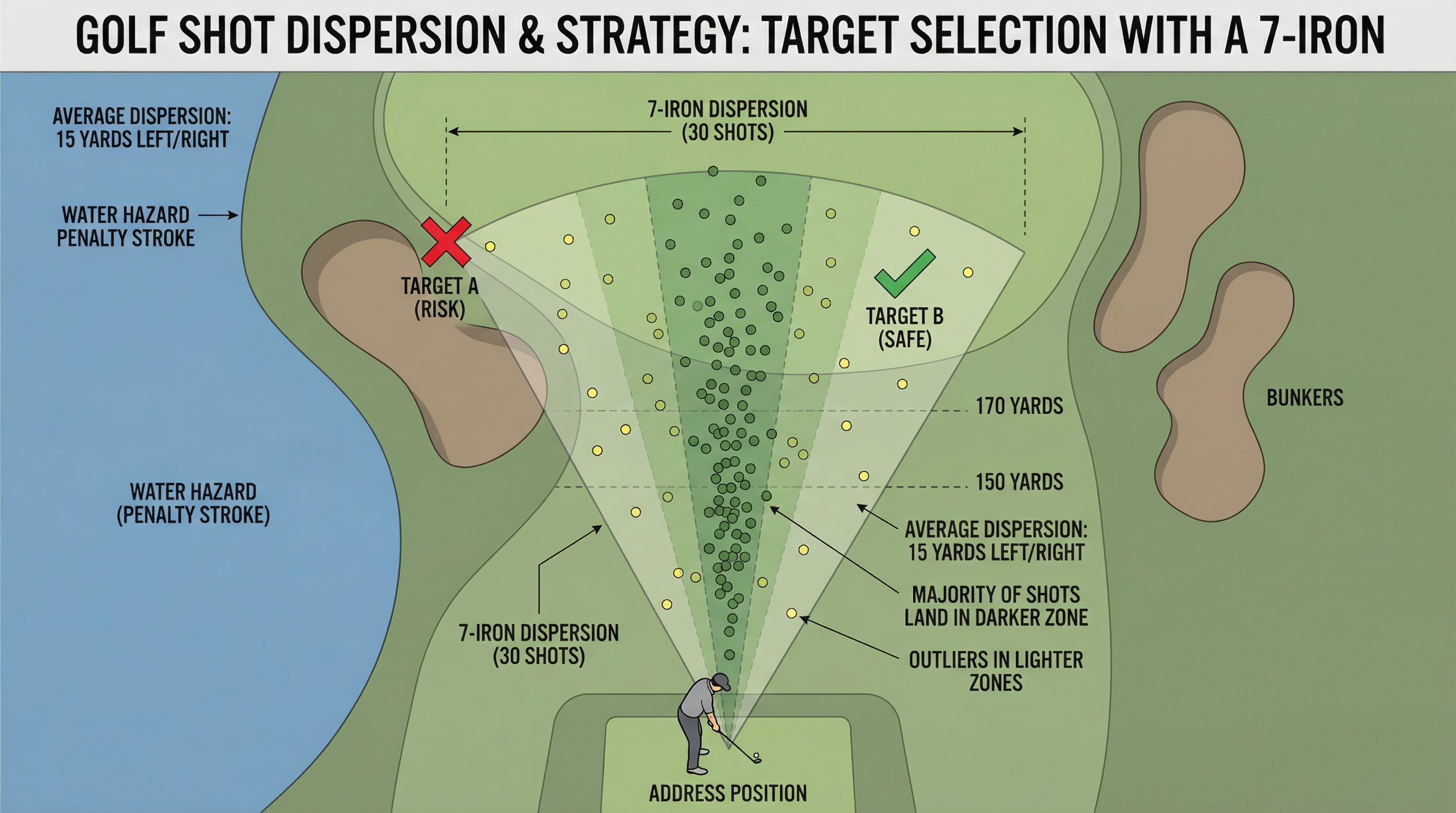
Tour professionals use launch monitors and statistical tracking to understand their dispersion patterns in granular detail. If a player knows that 70% of their shots with a particular club will land within a certain cone, they can pick a target that ensures even the edges of that cone avoid serious trouble. This approach transforms the mental game. When you’re standing over a shot and you know your strategy allows for almost all the possible outcomes with that club, you’re going to swing a lot more freely and with far less tension.
A Pro’s Game Plan: Hole-by-Hole Strategy
Armed with an honest assessment of your game, you can now approach each hole like a chess match, thinking one or two moves ahead. The best players in the world don’t just react to what’s in front of them; they plan the entire hole backward from the green.
From the Tee Box: Setting Up Success
The goal of the tee shot is not always maximum distance; it’s to set up the ideal approach shot. Before you even pull a club, ask yourself: “Where is the best place to hit my next shot from?” This simple question will revolutionize your strategy.
Use the Angles: Don’t automatically tee up in the middle of the tee box. If there’s trouble down the right side of the hole, tee up on the far right side of the box and aim up the left. This creates a better angle away from the hazard and visually opens up the fairway . Conversely, if the trouble is on the left, tee up on the left side and aim right. This is one of the simplest yet most underutilized tactics in amateur golf.
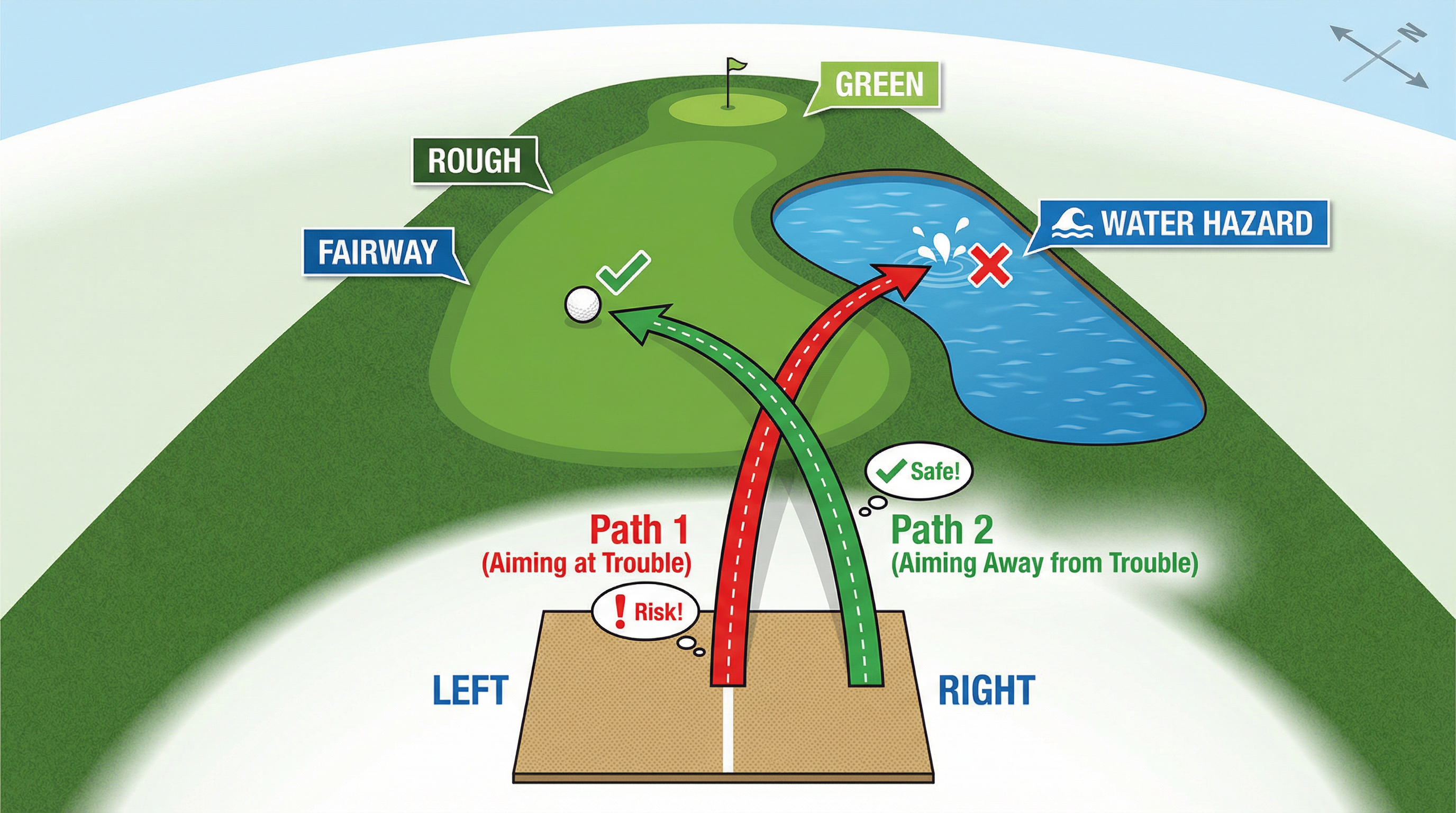
Golf course architects are masters of visual deception. They design holes to make fairways look narrower than they actually are from ground level. One of the best pre-round preparation techniques used by Tour professionals is to study aerial views of the course using yardage books or Google Earth imagery . From above, you can see the true size of landing areas, which often reveals significantly more room than what the designer wants you to see from the tee. This knowledge allows you to swing more freely, trusting that you have plenty of space to accommodate your shot pattern.
Club Selection Isn’t About Ego: A par-4 isn’t automatically a driver. If a 3-wood or hybrid leaves you in the fairway with a comfortable full swing into the green, it’s often the smarter play than a driver that brings bunkers, water, or out-of-bounds into play. Remember, the goal is to set up the easiest possible approach shot, not to impress your playing partners with distance.
The Approach Shot: Playing the Percentages
This is where most amateurs lose strokes by chasing glory. Tour professionals, on the other hand, play a disciplined game of percentages. They understand that the cumulative effect of many smart decisions far outweighs the occasional hero shot.

The Golden Rule: Aim for the Center of the Green. The middle of the green is your best friend. Even for the best players in the world, this is the primary target for any club longer than a 9-iron . Despite what you might think from watching television coverage, Tour pros rarely aim directly at pins. When you see those shots that land close to the pin, it’s usually because the ball landed at the very edge of their shot dispersion. Their actual target was the safe side of the green to avoid being short-sided or bringing a big number into play.
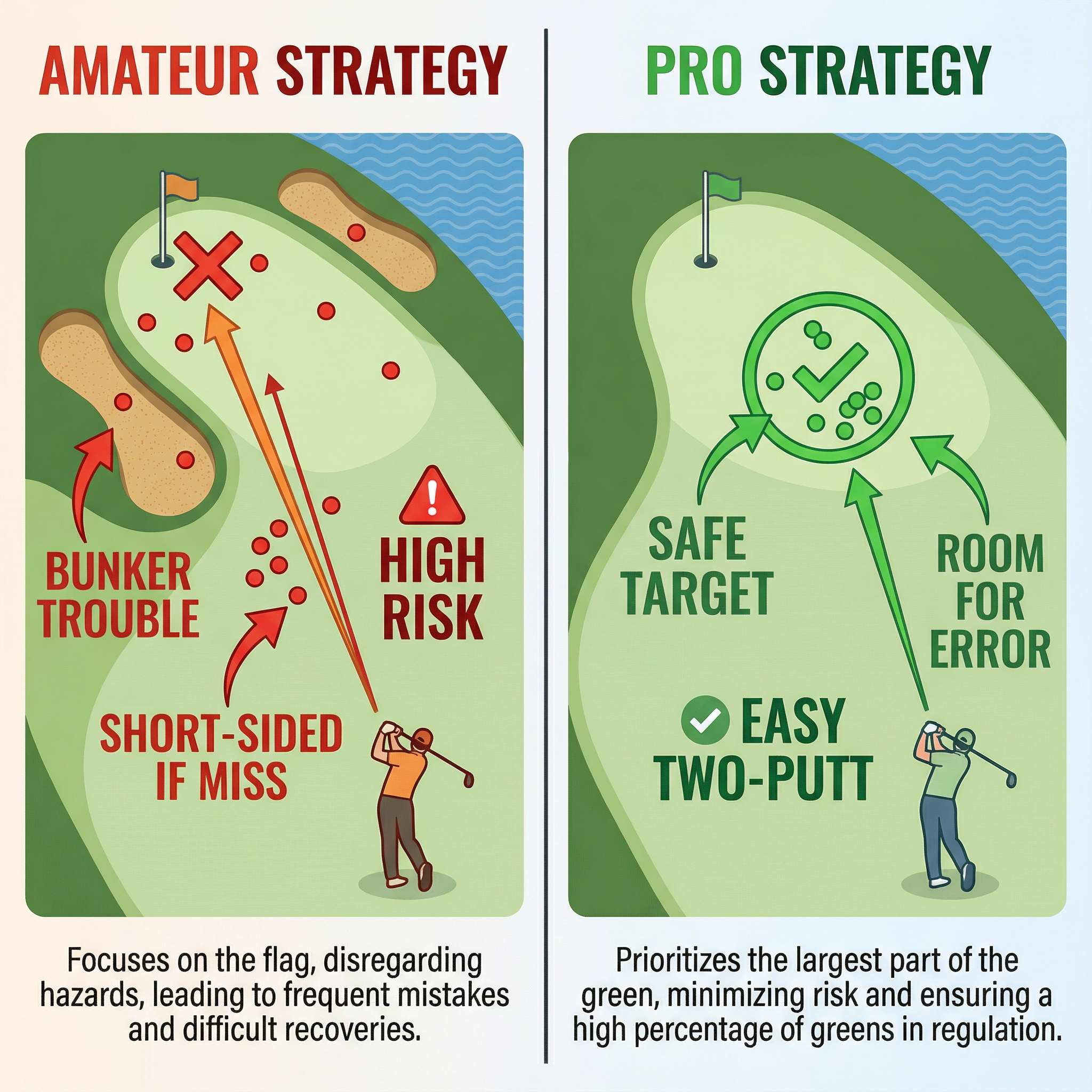
Avoid the “Sucker Pin”: When a pin is located just over a bunker or water hazard, it’s called a “sucker pin” for a reason. The risk far outweighs the reward. The difference between a 15-foot birdie putt and a 30-foot birdie putt is negligible compared to the difference between a 30-foot putt and a bunker shot. Aim for the fat part of the green, take your two-putt par, and walk to the next tee without a big number on your scorecard.
Know Your “Good Miss”: Before every approach, identify the “safe” place to miss. For every shot you play, there is a good miss and a bad miss . If the pin is on the right side of the green with a bunker guarding it, the safe miss is almost always to the left, leaving you with more green to work with for your chip or pitch. Being “short-sided” (missing on the same side as the pin with little green to work with) is one of the fastest ways to make a bogey or worse. Tour professionals meticulously mark their yardage books with safe zones and danger zones for every pin position, ensuring they always know where they can afford to miss.
Around the Green: The Art of the Easy Up-and-Down
Not every short game shot requires a high-spinning, flop-shot miracle. In fact, the best short game strategy is often the simplest one. The goal is to get the ball on the green and rolling as quickly as possible, minimizing the variables that can lead to a poor outcome.
Play to Your Strengths: Golf is not a static game. On some days, your chipping will be sharp; on others, it will be shaky. The smartest players adapt their short game choices based on what’s working that day . If your chipping is letting you down, don’t be afraid to use your putter from farther off the green than you normally would. The worst putt is often better than the worst chip. This kind of honest self-assessment and tactical flexibility is a hallmark of intelligent course management.
Prioritize Uphill Putts: When chipping or pitching, always try to leave yourself an uphill putt. They are significantly easier to judge for speed and line than slippery downhill putts. This principle should influence your target selection on approach shots as well. Staying below the hole is one of the most valuable yet underappreciated strategies in golf.
The Data Revolution: Thinking Like a Tour Analyst
The modern professional game is driven by data. Statistics like Strokes Gained, developed by Columbia Business School professor Mark Broadie, have revolutionized how players approach strategy . This metric analyzes every shot a player hits and compares it to the PGA Tour average, revealing exactly where a player is gaining or losing strokes relative to the field.
What has this data overwhelmingly proven? The fastest way to lower your score is to avoid big numbers. A single triple-bogey can undo the benefit of three birdies. Data-driven systems like Scott Fawcett’s DECADE Golf, used by numerous Tour pros, are built on this principle. They use statistical probabilities to map out the highest-percentage play on every shot, which almost always involves a more conservative strategy than most amateurs instinctively employ. Fawcett’s system assigns a negative value to different miss locations, helping players move their target to minimize potential damage.
Situation The Amateur Play The Pro (Smart) Play Tee Shot Automatically pulls driver to hit it as far as possible. Chooses the club that best avoids hazards and sets up the ideal approach angle. Approach Shot Aims directly at the flag, regardless of its location. Aims for the center of the green, ensuring the worst-case miss is still playable. Trouble Shot Tries the low-percentage hero shot through the trees. Takes their medicine, punches out sideways to the fairway, and relies on their short game. Putting Tries to make every long putt, often leaving a tricky 6-footer back. Lags long putts to a 3-foot circle, guaranteeing a stress-free two-putt.
The statistics also reveal another critical insight: course knowledge can be worth up to five strokes per round for a golfer who typically shoots in the 80s, and even more for higher handicappers . This advantage is magnified on courses with forced carries, tight fairways, and severe green undulations. The more you understand about a course before you play it, the better your strategic decisions will be.
Assessing Risk: The Green, Orange, Red System
One of the most sophisticated elements of professional course management is the ability to dynamically assess risk based on how you’re playing on a given day. On some days you will have your “A game,” where you are more in control of your ball, but on others you might have your B, C, or even D game. The key is recognizing which game you have and adjusting your strategy accordingly .
Many Tour professionals use a simple traffic light system to evaluate shots:
Green Light: You’re playing well, feeling confident, and can take on more risk. This is the time to aim at a tucked pin or attempt a more aggressive line off the tee.
Orange Light: You’re playing reasonably well but not at your best. Stick to standard, percentage-based strategy. Aim for centers of greens and safe sides of fairways.
Red Light: You’re struggling with your ball-striking. Assume a wider dispersion pattern and choose safer targets. Don’t try to force birdies to catch up—this almost always leads to more mistakes and bigger numbers.
The worst thing you can do when you’re not playing well is to become more aggressive in an attempt to make up ground. This adds pressure, increases tension, and typically makes the situation worse. The smartest players know when to play defensively and grind out a respectable score with the game they have that day.
Your Action Plan for the Next Round
Improving your golf game doesn’t have to mean a complete swing overhaul or months of intensive practice. By adopting the same strategic principles used by the best players in the world, you can make an immediate and lasting impact on your scores. It requires discipline, an honest assessment of your skills, and a willingness to prioritize a lower score over a single heroic shot.
For your next round, commit to these three fundamental principles:
Pick a specific, conservative target for every single shot. Vague targets like “the fairway” or “the green” are not sufficient. Choose a precise spot—a tree in the distance, a specific section of the fairway, or the center of the green—and commit to it.
Aim for the center of every green. Unless you’re inside 9-iron distance and the pin is in a safe location, your default target should always be the middle of the putting surface. This single change can save you multiple strokes per round.
After a bad shot, take a deep breath and focus entirely on the next one. Don’t compound one mistake by trying a low-percentage recovery shot. Play smart, get back into position, and move on.
You may be shocked at how a simple shift in mindset can lead to your best scores yet. That’s the power of smart course management. The golf course is a puzzle to be solved, not a battle to be won through brute force. Start thinking like a strategist, and watch your handicap drop.
References
[3] USGA. (2024, March 18). Importance of Strokes Gained Statistic.
[4] Reddit r/golf. (2024). How many strokes do you attribute to course knowledge?