Connect with us

Equipment

The Best Golf Balls for Average Golfers (And How to Choose Yours)

Stop wasting money on the wrong golf balls. This guide helps average golfers choose the right ball based on swing speed, handicap, and budget, not hype.

Avatar photo

Published

on

Let’s get something out of the way right up front: you’re probably playing the wrong golf ball. I don’t mean that as an insult—most golfers are playing the wrong ball because the golf industry has spent decades convincing us that we need tour-level equipment to play decent golf. The truth is that ninety percent of amateur golfers would benefit more from switching to a ball that actually matches their swing speed and skill level than from buying a new driver or taking another lesson. In this guide, I’m going to cut through the marketing nonsense and help you find a ball that will actually improve your game without emptying your wallet.

Why Most Golfers Use the Wrong Ball

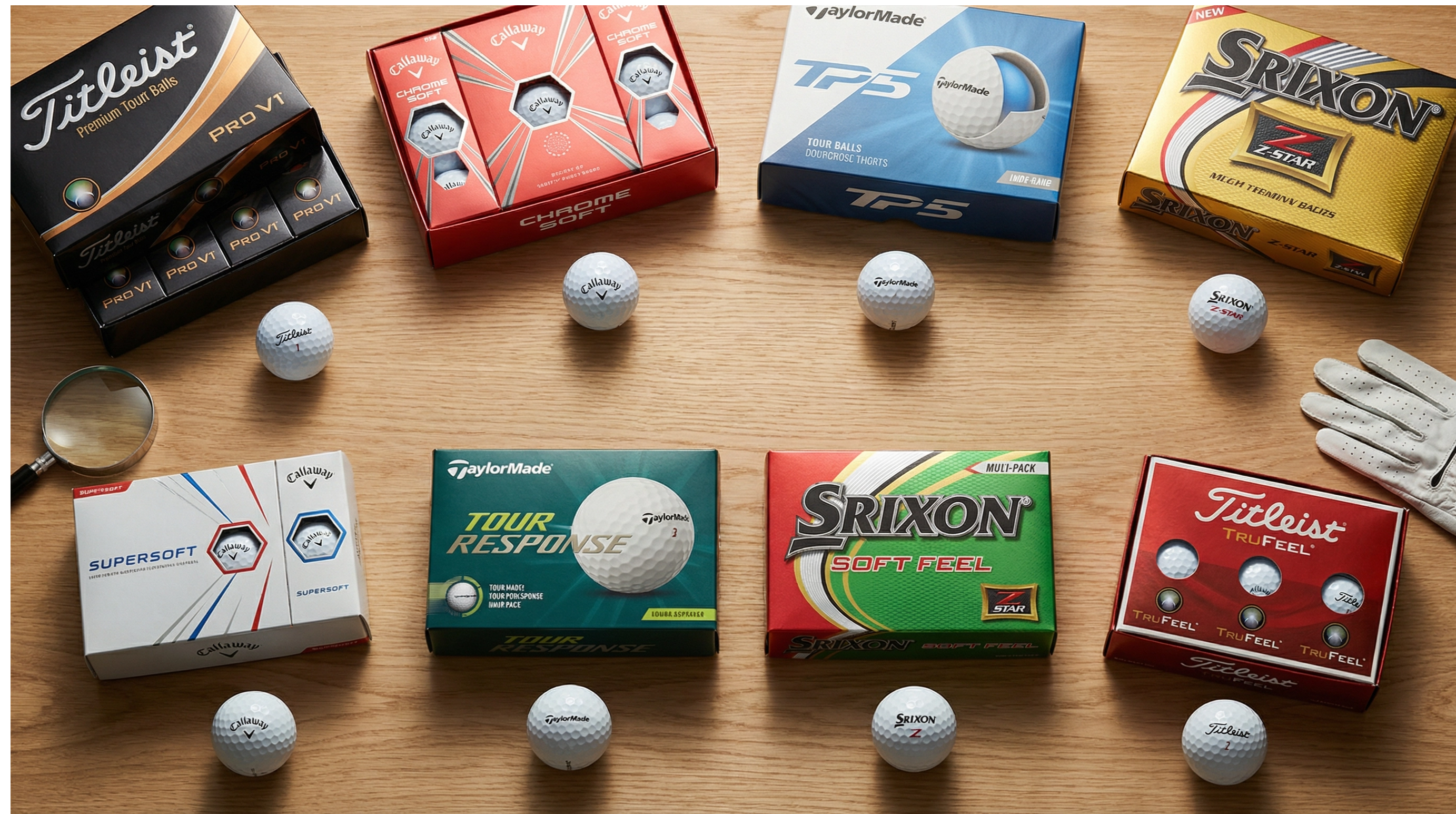
Walk into any pro shop and you’ll see walls of premium golf balls with names like “Pro V1,” “TP5,” and “Chrome Soft.” These balls cost fifty dollars a dozen or more, and they’re marketed with images of tour pros hitting perfect shots. The implication is clear: if you want to play good golf, you need these balls. But here’s what the marketing doesn’t tell you: these tour-level balls are designed for swing speeds of one hundred miles per hour or more and players who can consistently compress the ball at impact. If you’re swinging slower than that—and most amateurs are—you’re not getting any benefit from these expensive balls. In fact, you might be hurting your game.

The problem is compression. Tour balls are built with firm cores that require high swing speeds to compress properly. When you compress the ball, you maximize distance and control. But if your swing speed is in the eighty to ninety-five mile per hour range, you’re not compressing that Pro V1 enough to get its benefits. You’re essentially paying premium prices for performance you can’t access. Meanwhile, there are balls designed specifically for your swing speed that cost half as much and will give you better results. It’s one of golf’s dirty little secrets, and it’s time someone said it out loud.
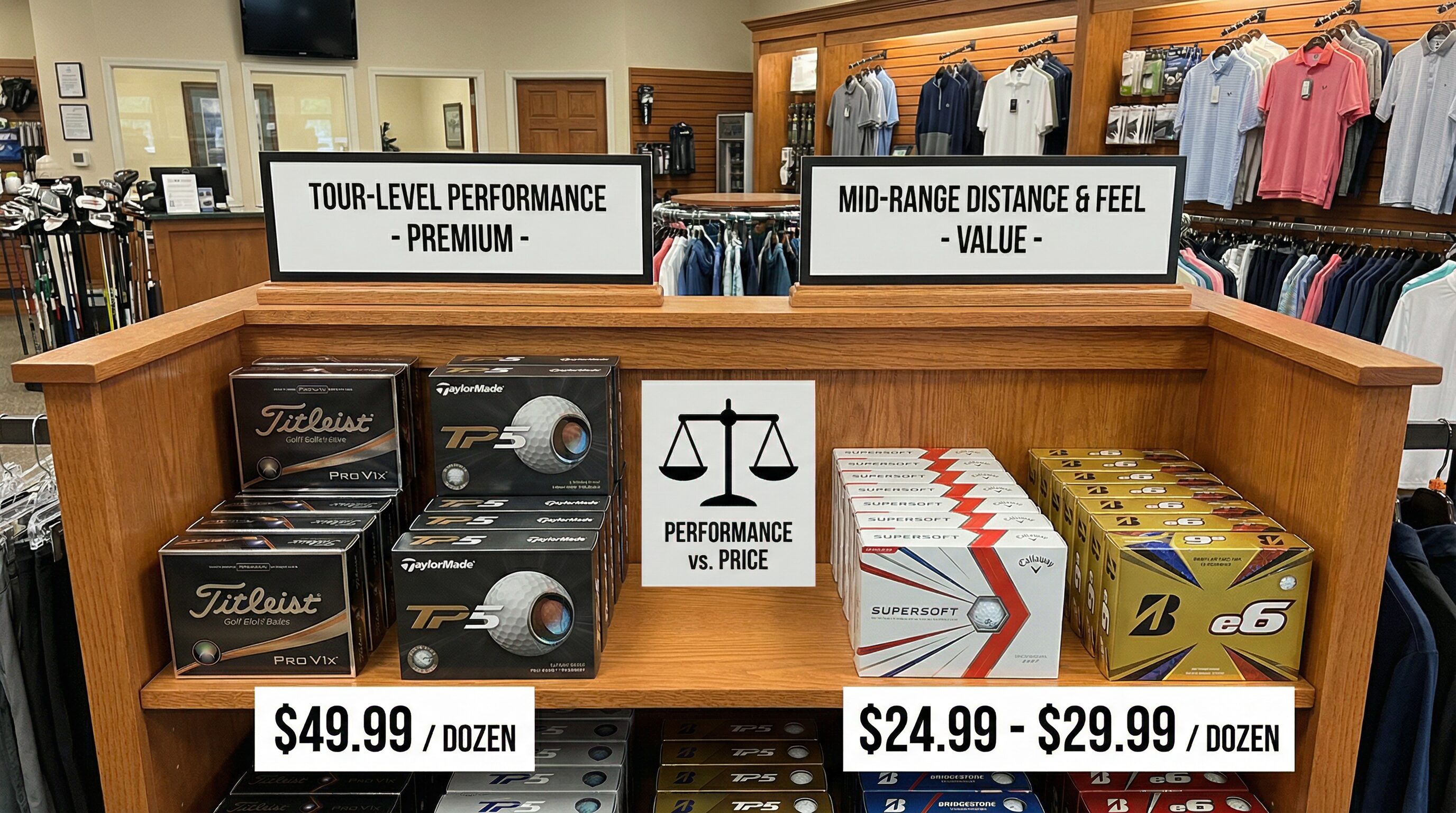
A comparison display showing expensive tour-level golf balls next to mid-range balls designed for average golfers, with price tags visible.

What Actually Matters: Compression, Spin, and Feel

Let’s break down the three factors that actually matter when choosing a golf ball: compression, spin characteristics, and feel. Compression is a measure of how much the ball deforms at impact. Lower compression balls (around seventy to eighty) are easier to compress and work better for slower swing speeds. Higher compression balls (ninety to one hundred plus) require more speed to compress properly. If you’re not sure what your swing speed is, a good rule of thumb is that most amateur golfers with a driver swing speed under ninety-five miles per hour should be playing a lower compression ball.

Spin is the next consideration, and this is where things get interesting. High spin balls give you more control around the greens, which sounds great until you realize that they also amplify your mistakes off the tee. If you slice or hook the ball, a high spin ball will make those curves more dramatic. For most average golfers, a mid-spin or low-spin ball is actually better because it reduces sidespin and keeps your drives straighter. Yes, you’ll sacrifice some greenside spin, but let’s be honest—if you’re a fifteen handicapper, you’re not spinning wedge shots back anyway. You’re better off with a ball that keeps your drives in play.

Feel is the most subjective factor, but it matters. Some golfers love the soft feel of a urethane-covered ball around the greens. Others prefer a firmer feel that gives them more feedback. The only way to know what you like is to try different balls. But here’s my advice: don’t obsess over feel until you’ve figured out compression and spin. Those two factors will have a much bigger impact on your scores than whether the ball feels slightly softer on chip shots.

Ball Recommendations by Swing Speed and Handicap

Now let’s get to the good stuff: specific recommendations. I’m going to break this down by swing speed and handicap because those are the two factors that matter most. These are balls that real golfers actually use and trust, not just whatever the tour pros are playing this week.

For Slower Swing Speeds (Under 85 MPH) and Higher Handicaps (20+):

If you’re in this category, you need a low compression ball that maximizes distance and minimizes spin. The Callaway Supersoft is the gold standard here. It has a compression rating of thirty-eight, which is incredibly soft, and it’s designed to help slower swingers get more distance. It’s also affordable, usually around twenty-five dollars a dozen. Another great option is the TaylorMade Soft Response, which has a similar compression and costs about the same. Both of these balls will give you straighter drives and more distance than any tour ball ever could.

For Moderate Swing Speeds (85-95 MPH) and Mid Handicaps (10-20):

ADVERTISEMENT

This is where most amateur golfers fall, and this is where you have the most options. The Titleist Tour Soft is my top recommendation for this group. It has a compression of around sixty-five, which is perfect for moderate swing speeds, and it offers a nice balance of distance and control. It costs about thirty-five dollars a dozen, which is reasonable for the performance you’re getting. Another excellent choice is the Srixon Q-Star Tour, which has similar specs and costs a bit less. If you want to save even more money, the Wilson Duo Soft+ is a solid budget option that performs surprisingly well for its price point.

For Faster Swing Speeds (95+ MPH) and Lower Handicaps (Under 10):

If you’re consistently swinging ninety-five miles per hour or faster and you’re a single-digit handicapper, then yes, you can start looking at tour-level balls. The Titleist Pro V1 is the industry standard for a reason—it offers exceptional control and consistency. But it’s not the only option. The TaylorMade TP5 and Callaway Chrome Soft are both excellent alternatives that some golfers prefer for their feel or spin characteristics. These balls cost around fifty dollars a dozen, but if you have the swing speed to compress them properly, they’re worth it. Just be honest with yourself about whether you’re really in this category. If you’re not breaking eighty regularly, you’re probably better off with a mid-range ball.
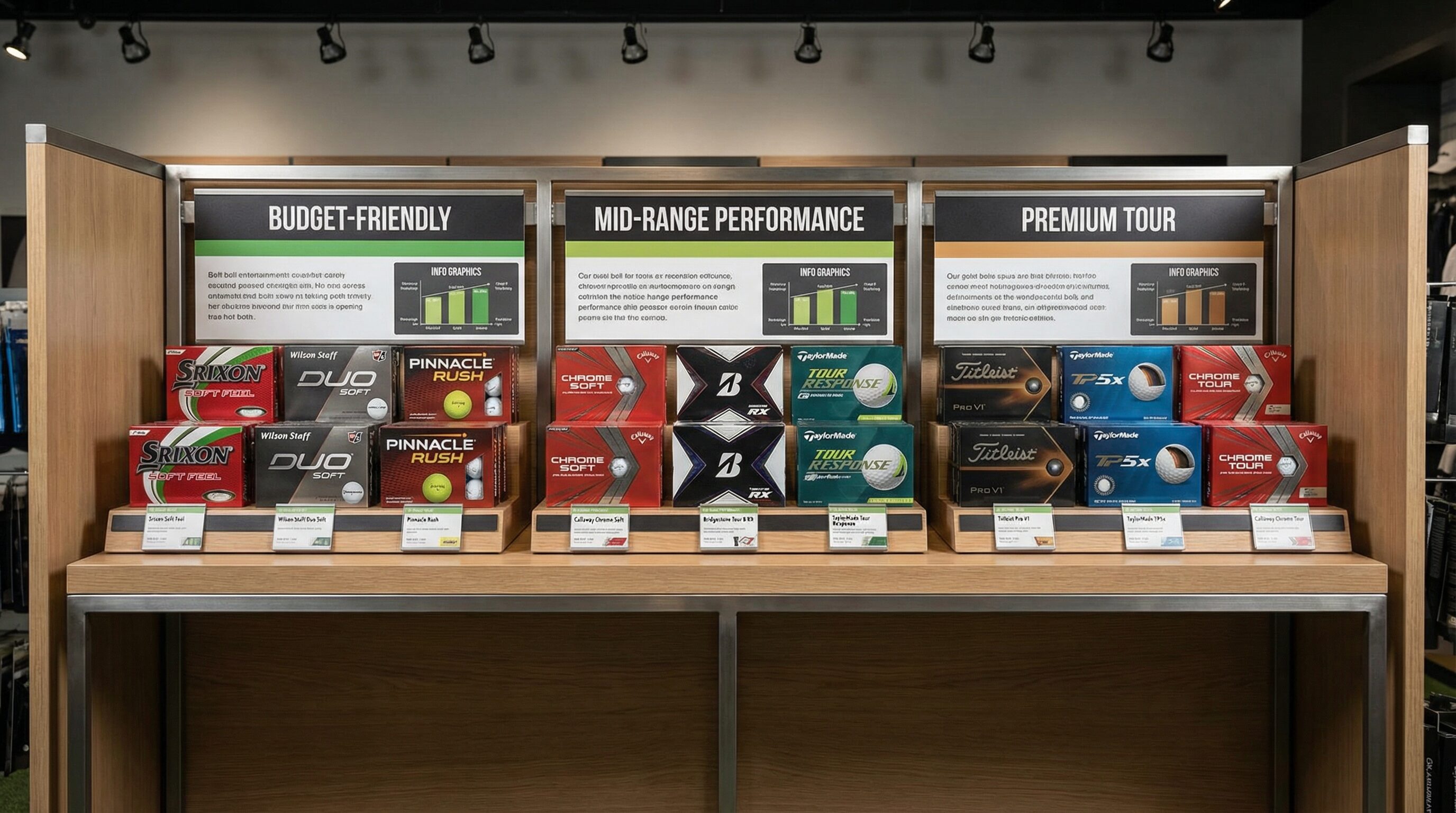
A selection of recommended golf balls arranged by category: budget-friendly, mid-range, and premium options.

Common Mistakes When Buying Golf Balls

Let’s talk about the mistakes I see golfers make when buying balls. The biggest one is buying based on what tour pros use. I can’t stress this enough: you are not Rory McIlroy. His swing speed is one hundred twenty miles per hour. Yours is probably eighty-five to ninety. What works for him will not work for you. Stop buying Pro V1s just because you see them on TV.

The second mistake is buying balls based on brand loyalty alone. Yes, Titleist makes great balls, but so do TaylorMade, Callaway, Srixon, and others. Don’t limit yourself to one brand just because that’s what you’ve always played. Try different options and see what works best for your game. You might be surprised.

The third mistake is not considering your budget realistically. If you lose three balls per round, you’re going through three dozen balls a month. At fifty dollars a dozen, that’s one hundred fifty dollars a month on golf balls. That’s insane. There’s no shame in playing a twenty-five dollar ball if it means you can afford to play more often. In fact, I’d argue that playing more often with cheaper balls will improve your game more than playing less often with expensive balls.

The fourth mistake is ignoring swing speed. I’ve said it before, but it bears repeating: if you don’t know your swing speed, you’re guessing. Most golf shops and driving ranges have launch monitors that can measure your swing speed in about five minutes. Get it measured. It’s free, it’s fast, and it will save you from wasting money on the wrong balls.

A Simple Decision Framework

Here’s a simple framework to help you choose the right ball. First, figure out your driver swing speed. If you don’t have access to a launch monitor, you can estimate based on how far you hit your driver: if you’re hitting it two hundred yards or less, you’re probably under eighty-five miles per hour. If you’re hitting it two hundred to two hundred thirty yards, you’re probably in the eighty-five to ninety-five range. If you’re hitting it over two hundred forty yards, you’re probably over ninety-five.

Second, consider your handicap and your biggest weakness. If you’re a higher handicapper who struggles with slicing or hooking, prioritize a low-spin ball that will keep your drives straighter. If you’re a lower handicapper who wants more control around the greens, you can afford to play a higher spin ball.

Third, set a realistic budget. Decide how much you’re willing to spend per dozen and stick to it. There are good balls at every price point, so don’t feel like you need to spend fifty dollars to get decent performance.

Finally, buy a sleeve or two of a few different balls and test them. Play a round with each one and see which one gives you the best results. Pay attention to distance off the tee, accuracy, and how the ball feels around the greens. The ball that performs best for you might not be the one you expected.
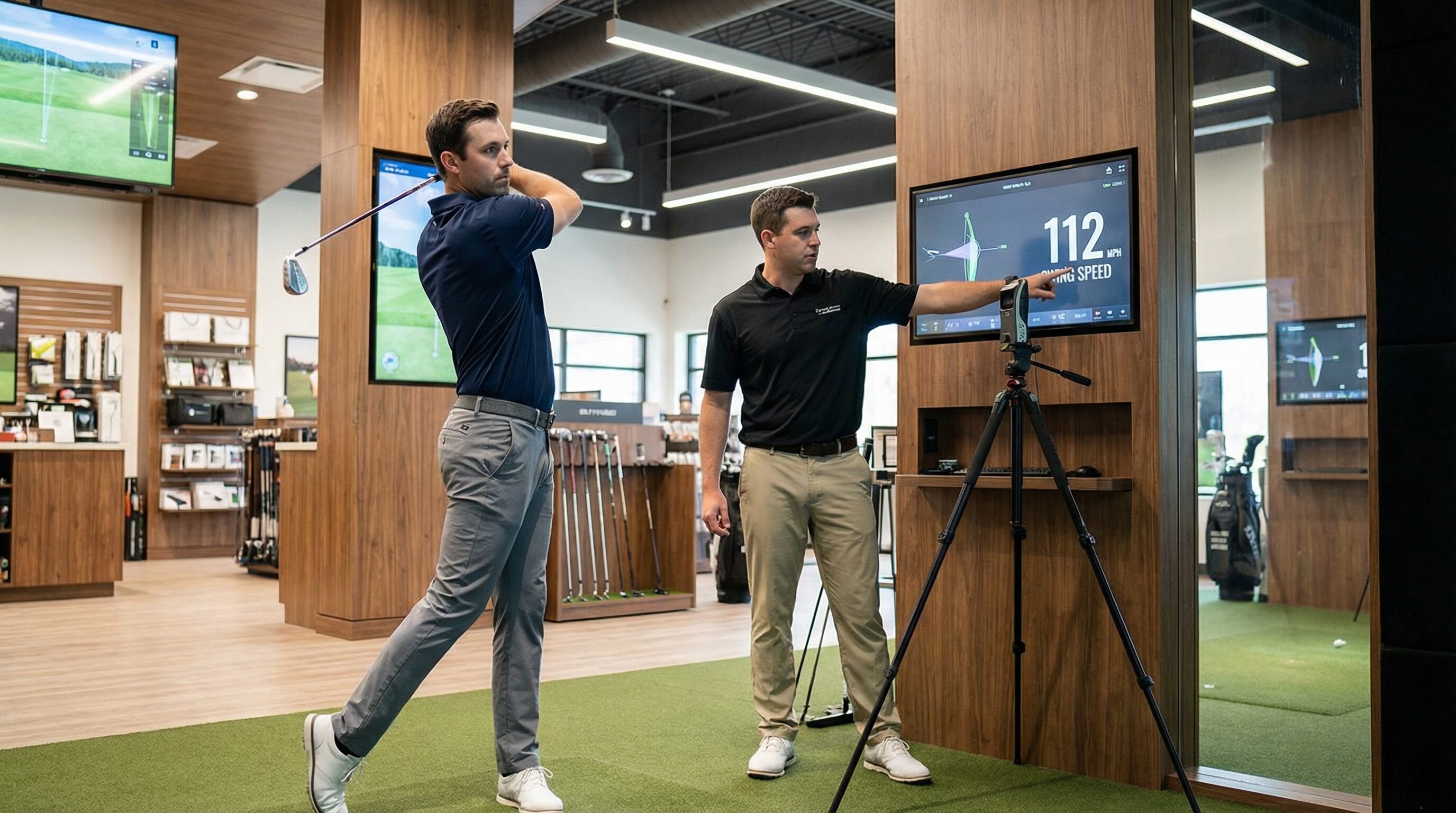
A golfer on a launch monitor at a golf shop, getting their swing speed measured by a professional.

The Truth About Premium Balls

Let me be blunt about premium balls: they’re amazing if you have the swing speed and skill to use them properly. But for most golfers, they’re overkill. It’s like buying a Ferrari to drive in city traffic. Sure, it’s a great car, but you’re never going to use its full capabilities. A Pro V1 is a phenomenal golf ball, but if you’re not compressing it properly, you’re wasting your money.

Here’s another truth: the difference between a thirty-five dollar ball and a fifty dollar ball is much smaller than the difference between a twenty-five dollar ball and a thirty-five dollar ball. In other words, you get diminishing returns as you move up in price. For most golfers, the sweet spot is in the twenty-five to thirty-five dollar range. That’s where you get the best performance for your money.

What About Used and Refurbished Balls?

This is a question I get all the time, and my answer is: it depends. If you’re buying used balls, make sure they’re in good condition. Look for balls graded as “mint” or “near mint” with no visible scuffs or cuts. A ball with a cut or deep scuff will not perform the same as a new ball, no matter how cheap it is.

Refurbished balls are a different story. These are balls that have been cleaned and sometimes repainted. The problem is that the refurbishing process can affect the ball’s performance, especially if the outer layer has been altered. I generally recommend avoiding refurbished balls unless you’re just practicing or playing a casual round where performance doesn’t matter as much.

If you want to save money, a better option is to buy last year’s model. Golf ball technology doesn’t change dramatically from year to year, and you can often find last year’s premium balls at mid-range prices. That’s a much better value than buying refurbished balls.

Stop Overthinking It

Here’s the bottom line: the golf ball matters, but it’s not going to fix your swing. If you’re slicing the ball thirty yards into the woods, switching from a Pro V1 to a Supersoft isn’t going to magically straighten out your drives. But it will help a little, and those little improvements add up.

The best ball for you is the one that matches your swing speed, fits your budget, and gives you confidence when you tee it up. It doesn’t have to be the most expensive ball on the market. It doesn’t have to be what the tour pros play. It just has to work for your game.

So stop buying balls based on marketing hype. Stop trying to play the same ball as Rory or Tiger. Figure out your swing speed, set a realistic budget, and choose a ball that’s designed for golfers like you. I guarantee you’ll see better results, and you’ll probably save money in the process.

Now get out there and play. And when you hit that drive down the middle of the fairway with a ball that actually fits your game, you’ll know exactly what I’m talking about.

Continue Reading
Advertisement
ADVERTISEMENT

Click to comment

Leave a Reply

Your email address will not be published. Required fields are marked *

Blog

The Ultimate Guide to Buying Used Golf Clubs

Save money and play better golf with our ultimate guide to buying used golf clubs. Learn where to find the best deals and what to look for to build a quality bag on a budget.

Avatar photo

Published

on

Let’s be honest, golf can be an expensive hobby. Between green fees, balls, and the latest and greatest gear, the costs can add up quickly. But what if I told you that you could build a high-performing bag without breaking the bank? The secret lies in the world of used golf clubs. In this guide, we’ll explore the ins and outs of buying used clubs, helping you find fantastic deals on quality equipment.

Why Buy Used? The Smart Golfer’s Advantage

Besides the obvious cost savings, buying used golf clubs has several other benefits. For one, you can often get clubs that are only a season or two old for a fraction of their original price. This means you can play with premium technology without the premium price tag. Additionally, buying used is a great way to experiment with different brands and models to find what truly works for your game without a major financial commitment.

Where to Find the Best Deals on Used Golf Clubs

Navigating the second-hand market can be tricky, but there are several reputable places to find great deals on used clubs.

Online Retailers

Websites like Callaway Pre-Owned, GlobalGolf, and 2nd Swing are fantastic resources. They offer a massive selection of clubs from all major brands, and they often provide detailed descriptions and condition ratings. Plus, they usually offer a trial period or return policy, which takes a lot of the risk out of buying online.

Local Golf Shops and Play It Again Sports

Don’t overlook your local golf shops. Many of them have a used club section, and the staff can often provide valuable insights and recommendations. Similarly, stores like Play It Again Sports can be a goldmine for used equipment, especially for beginner and intermediate players.

ADVERTISEMENT

eBay and Facebook Marketplace

For the truly adventurous bargain hunter, eBay and Facebook Marketplace can offer some of the best deals. However, be prepared to do your homework. Scrutinize the pictures, ask the seller questions, and be wary of deals that seem too good to be true. Always check the seller’s ratings and reviews before making a purchase.

A golfer inspecting a used driver in a golf shop, checking the grip and clubface for wear.

What to Look For When Buying Used Clubs

When you’re inspecting a potential purchase, here are a few key things to look for:

•Grips: Check for excessive wear, cracking, or slickness. Worn-out grips will need to be replaced, which can add to the overall cost.

•Shafts: Inspect the shafts for any dents, dings, or signs of rust. These can affect the club’s performance and durability.

•Clubfaces: Look for any major dings, deep scratches, or excessive wear on the grooves. Minor cosmetic blemishes are fine, but significant damage can impact how the ball comes off the face.

•Authenticity: Be cautious of counterfeit clubs, especially when buying from individual sellers. If a deal seems too good to be true, it probably is. Stick to reputable sellers and be wary of clubs with blurry logos or unusual paint fills.

The Hacker’s Playbook for Buying Used

•Know Your Specs: Before you start shopping, have a general idea of what you’re looking for in terms of shaft flex, loft, and club model.

•Be Patient: Don’t rush into a purchase. The used club market is constantly changing, so be patient and wait for the right deal to come along.

•Don’t Be Afraid to Haggle: Especially when buying from individual sellers, don’t be afraid to negotiate on the price.

Buying used golf clubs is a smart way to save money and build a bag that you love. With a little bit of research and a keen eye for detail, you can find some incredible deals on high-quality equipment. Have you had success buying used clubs? Share your best finds in the comments below!

Continue Reading

Blog

Fore! Reasons Your Golf Cart Needs a Glow-Up (and How to Do It)

Avatar photo

Published

on

CIG Image

Let’s be honest. We all love the game, the fresh air, the occasional well-struck shot that makes us feel like a temporary Rory McIlroy. But what about the unsung hero of our weekend rounds? The trusty, sometimes rusty, golf cart. For too long, these magnificent machines have been relegated to mere utility. A box on wheels to get us from the pro shop to the first tee and back again. Well, I say no more! It’s time to infuse some personality, some pizzazz, some… us into our golf cart experience. Because a golf cart isn’t just a ride; it’s an extension of our golfing soul.

Think about it. We obsess over driver lofts, putter grips, and the perfect golf fashion ensemble. We want to look good, feel good, and play good. Why should our golf cart be any different? It’s often the first and last impression we make on the course, a mobile clubhouse, and sometimes, let’s be real, a temporary confessional after a particularly brutal triple bogey. So, if you’re ready to ditch the drab and embrace the fab, here are four compelling reasons your golf cart needs a serious glow-up, along with some hacker-approved tips to get you started.

1. Stand Out from the Rough (Literally)

Golf courses are a sea of sameness when it comes to carts. White, beige, maybe a splash of green if you’re lucky. But what if your cart announced your arrival with a flourish? Imagine pulling up to the tee box in a cart that screams “I’m here to have fun and maybe even sink a few putts!” A personalized cart isn’t just about aesthetics; it’s about making a statement. It’s about showing off your golf passion even before you hit your first drive.

Hacker Hack: Start with a custom paint job or some snazzy vinyl wraps. Think bold stripes, a subtle argyle pattern, or even a replica of your favorite golf course’s logo. For the truly committed golf enthusiast, consider some underglow LED lights. Not only do they look cool, but they also make those twilight rounds a whole lot more exciting. Don’t forget custom golf cart wheels and tires; they can completely transform the look and feel of your golf cart.

ADVERTISEMENT

2. Boost Your On-Course Comfort (and Cool Factor)

Let’s face it, golf can be a long day. Hours spent traversing fairways, searching for wayward shots, and waiting for slow groups. Why not make those hours as comfortable as possible? A basic golf cart seat might suffice, but a souped-up one? That’s next-level golf life. We’re talking about enhancing your overall golf experience.

Hacker Hack: Invest in some premium, upholstered golf cart seats. Think marine-grade vinyl for durability and comfort. Add a custom steering wheel for better grip and a more luxurious feel. And for those scorching summer days, a golf cart fan is an absolute game-changer. You can even install a small cooler to keep your beverages chilled, making you the most popular person in your foursome. Consider a golf cart enclosure for those unexpected rain showers or chilly mornings, keeping you dry and warm.

3. Unleash Your Inner Technophile (and Score Better?)

Who says technology is just for your golf swing analyzer? Your golf cart can be a hub of innovation, making your rounds smoother, more enjoyable, and dare I say, potentially lowering your handicap. From GPS systems to rocking sound setups, there’s a world of golf cart tech waiting to be explored. We’re talking about smart golf accessories for your golf cart.

Hacker Hack: Integrate a golf GPS system directly into your dash. No more fumbling with your phone or rangefinder. Install a Bluetooth sound system so you can enjoy your favorite golf podcasts or pump up the jams between holes. And for the ultimate convenience, consider USB charging ports for your phone or other golf gadgets. Some golf carts even offer built-in ball washers and club cleaners, keeping your golf equipment pristine.

4. Express Your Golfing Personality (and Start Conversations)

Your golf cart is a canvas. It’s an opportunity to showcase your unique golf style and personality. Are you a traditionalist? A wild card? A minimalist? Your cart can reflect that. It’s a fantastic conversation starter and a way to connect with other golfers who appreciate a bit of flair. It’s all about golf cart customization and golf cart accessories that speak to you.

Hacker Hack: Personalize your golf cart with custom floor mats, a unique dash panel, or even a personalized license plate (check your local course rules first!). Add some fun decals or stickers that reflect your golfing sense of humor. A custom golf bag attachment can also add a touch of individuality. The possibilities for golf cart upgrades are endless, from practical additions like a sand bottle for divot repair to purely aesthetic touches.

So, next time you’re about to hop into that plain, run-of-the-mill golf cart, think about the potential. Think about the golf cart accessories, golf cart parts, and golf cart upgrades that can transform it into something truly special. Your golf cart isn’t just transportation; it’s an experience. It’s an extension of your golfing journey, and it deserves to shine as brightly as your best golf shot. Now go forth, hackers, and give your golf cart the glow-up it deserves!

Continue Reading

Blog

Why Proper Club Fitting Is the Real Game Changer

Avatar photo

Published

on

CIG Image

If you’ve ever walked off the 18th green thinking, “It’s not me, it’s the clubs,” well… you might be half right.

As a PGA Professional who’s watched thousands of swings—from scratch players to first-timers—I can tell you that one of the most overlooked keys to better golf is proper club fitting. Not just buying shiny new sticks off the rack, but taking the time to find clubs that are tailored to your swing.

You don’t need a Tour card to get Tour-level precision. Let’s talk about why club fitting matters, what it changes, and how it can truly transform your game from the tee box to the final putt.

The Myth of “Good Enough”

“I’m not good enough to be fit for clubs.”

That’s the most common thing I hear—and it’s completely backwards.

High-handicap golfers have even more to gain from club fitting than low-handicappers. Why? Because the equipment can help you fix ball flight, optimize distance, reduce mis-hits, and build confidence—all without having to reinvent your swing.

Off-the-rack clubs are designed to fit “average” specs. But no two golfers are the same. Length, lie angle, shaft flex, grip size—these all play a massive role in how the club interacts with your body and the ground.

What Happens in a Proper Club Fitting?

At its core, a fitting session is about matching the equipment to your natural swing—not forcing you to swing a certain way to fit the gear.

Here’s what a proper club fitting includes:

ADVERTISEMENT

1. Interview & Swing Assessment

A certified fitter (or PGA pro like myself) will ask about your current set, ball flight tendencies, common misses, and goals. Then we’ll watch you hit some shots to get a baseline.

2. Launch Monitor Data

Using tools like TrackMan or Foresight, we’ll capture numbers like:

  • Ball speed
  • Launch angle
  • Spin rate
  • Club path and face angle
  • Carry distance and dispersion

These numbers don’t lie—and they tell us what to tweak.

3. Testing Head & Shaft Combinations

You’ll hit several combinations of club heads and shafts to find what gives you the best performance. One degree of loft or a different shaft flex can make a huge difference.

4. Dialing In Lie Angle & Length

Lie angle affects directional control—too upright, and you might pull shots left; too flat, and you’ll miss right. Club length affects control, consistency, and strike location.

5. Grip Size & Feel

Don’t underestimate this. A grip that’s too thick or too thin can alter your grip pressure and release pattern.

Real Results—Backed by Data

One of my students recently went through a full iron fitting. He was using clubs he bought off the rack 10 years ago. His miss was a push-fade, and he struggled with distance control.

After 90 minutes, a combination of slightly shorter shafts, softer flex, and two degrees more upright lie changed everything. His dispersion tightened by 40%, and he gained an average of 12 yards per club. More importantly—his confidence skyrocketed.

And it wasn’t just him. Across the board, golfers who get fitted:

  • Gain more consistent contact
  • Reduce directional misses
  • Improve distance gapping
  • Hit more greens in regulation
  • Score better, without changing their swing

The Mental Game Boost

Here’s a secret: it’s not just about numbers. Fitted clubs give you confidence. When you know the tool in your hand is built for you, you swing freer, commit more fully, and stop second-guessing every shot.

Confidence leads to better swings. Better swings lead to better results. It’s a cycle—and it starts with the right equipment.

What About Cost?

Yes, a proper fitting might cost $75–$150 depending on where you go. And yes, custom-fit clubs may be slightly more than what you’d pay at a big box store.

But if you’re already spending time and money on golf, wouldn’t you want to get the most out of it?

A one-time investment in fitting can save you years of frustration—and possibly hundreds spent chasing fixes that won’t work with ill-fitting clubs.

Look—I’ve given thousands of lessons in my career, and nothing changes a golfer’s outlook faster than finally swinging clubs that work with them, not against them.

Whether you’re a 5 handicap trying to fine-tune yardages or a 25 handicap tired of slicing your driver, a proper club fitting can absolutely be a game changer.

You don’t need a new swing—you just need the right tools.

So before you spend another dollar on swing gadgets or tip videos, find your local PGA professional or certified fitter and book a session. Your game (and your sanity) will thank you.

Want more ways to play better without starting over?
Visit ClickItGolf.com every week for practical golf improvement tips, equipment reviews, betting insights, and advice from golfers who live the game every day.

Continue Reading

Trending

Click here to get all the latest golf news

Close