Blog
Golf and Grub at the Country Club
Pairing the Perfect Snacks with Your Swing
Greetings, gastronomic golfers! This week, we’re delving into the delicious world of golf and grub – because let’s face it, a well-fed golfer is a happy golfer. So grab your appetite and let’s explore the art of pairing the perfect snacks with your swing:
1. The Pre-Round Pick-Me-Up: Before you even step onto the first tee, it’s important to fuel up with a snack that’ll kickstart your engine and get you ready to conquer the course. Opt for something light and energizing, like a banana, a granola bar, or a handful of nuts. It’s the perfect way to fuel your body without weighing you down.
2. Mid-Round Munchies: As you make your way through the front nine, you may start to feel those hunger pangs creeping in. This is the perfect time to indulge in a mid-round snack that’ll keep you going strong. Think trail mix, fruit slices, or a protein-packed snack bar – something to refuel your energy levels and keep you focused on the task at hand.
3. The Turn Treat: Ah, the turn – that magical moment halfway through your round when you have the chance to refuel and recharge for the back nine. This is the perfect opportunity to indulge in a more substantial snack, like a turkey sandwich, a grilled chicken wrap, or a hearty salad. Just remember to pace yourself – you’ve still got nine more holes to conquer!
4. Post-Round Celebration: Congratulations, you’ve made it through another round of golf! Now it’s time to celebrate your victory – or drown your sorrows – with a well-deserved post-round snack. Whether you prefer a refreshing beverage from the clubhouse bar or a decadent dessert to satisfy your sweet tooth, treat yourself to something delicious and revel in your accomplishments on the course.
5. Hydration Station: Last but certainly not least, don’t forget to stay hydrated throughout your round. Water is your best friend on the golf course, so be sure to drink plenty of it before, during, and after your round to keep your body performing at its peak.
So there you have it, folks – the art of pairing the perfect snacks with your swing. Remember, golf is as much a mental game as it is a physical one, so fuel your body and nourish your soul with delicious snacks that’ll keep you feeling strong, focused, and ready to take on the world, one swing at a time. Until next time, may your snacks be satisfying, your swings be smooth, and your scores be low. Bon appétit, my friends!
Blog
A Field Guide to the 5 Types of Golfers You’ll Meet on a Public Course
Discover the 5 types of golfers you’ll meet on every public course in this humorous field guide. From the Speed Demon to the Social Butterfly, learn to appreciate the diversity of the game.
Golf is a beautiful game, man. It’s you, the course, and the universe all coming together in perfect harmony. Well, that’s the idea anyway. But if you’ve spent any time on a public course, you know that the reality is a bit more… colorful. Every round is like a safari through the wild kingdom of golf, where you’ll encounter a fascinating array of characters, each with their own unique approach to the game. Today, we’re going to explore the five most common species you’ll find on any public course. Consider this your field guide to the golf course ecosystem. No judgment here—just observations from a fellow traveler on this crazy journey we call golf.
The Speed Demon: “Ready Golf” Taken to the Extreme
You know this golfer the moment you see them. They’re practically jogging between shots, their golf cart in a perpetual state of motion, and they’ve already hit their approach shot before you’ve finished marking your ball on the green. The Speed Demon believes that golf should be played at the pace of a track meet, and they have zero patience for anyone who doesn’t share their urgency.
Here’s the thing about the Speed Demon: they’re not necessarily wrong. Slow play is a real problem, and their heart is in the right place. But somewhere along the way, they’ve confused efficiency with chaos. They’re hitting shots while still catching their breath, rarely taking time to read putts properly, and constantly looking over their shoulder to see if anyone is behind them. The irony is that all this rushing usually leads to more mistakes, which means more shots, which means… well, you get the idea.
How to coexist: If you’re paired with a Speed Demon, just let them play through if possible. They’ll be happier, you’ll be happier, and everyone can play at their own pace. If playing through isn’t an option, just do your best to keep up without sacrificing your own game. Remember, golf is supposed to be enjoyable, not a race.
The Analyst: Paralysis by Over-Analysis
On the opposite end of the spectrum, we have the Analyst. This golfer approaches every shot like they’re defending a doctoral thesis. They’ve got a rangefinder, a yardage book, a notebook, and possibly a weather station. They’re checking wind speed, calculating slope, considering barometric pressure, and consulting their swing thoughts checklist before every single shot. A simple eight-foot putt becomes a fifteen-minute expedition into the mysteries of green reading.
The Analyst is usually a genuinely nice person who loves the game deeply. They’ve read every instruction book, watched every YouTube video, and they’re absolutely convinced that the secret to great golf lies in perfect preparation. The problem is that all this analysis leads to paralysis. By the time they’ve finished calculating everything, they’re so wound up that the actual swing becomes an afterthought.
The lesson here: There’s a balance between preparation and overthinking. A little pre-shot routine is great, but at some point, you’ve got to trust your instincts and let it fly. As I like to say, be the ball. Don’t calculate the ball, don’t analyze the ball—just be the ball.
The Optimist: Hope Springs Eternal
The Optimist is perhaps my favorite character on the golf course. This is the golfer who pulls out the driver on every hole, regardless of the situation. Narrow fairway with water on both sides? Driver. Dogleg that requires a layup? Driver. Par three? Well, maybe not, but they’re thinking about it. The Optimist believes that this shot, right now, is going to be the one where everything clicks. Never mind that the last ten drives went sideways—this one is going to split the fairway.
What I love about the Optimist is their unshakeable belief in possibility. They’re not delusional; they’re hopeful. They know they’ve hit great shots before, and they believe they can hit them again. Sure, they might be in the trees more often than the fairway, but they’re having fun, and they never let a bad shot ruin their day. In a game that can be brutally humbling, there’s something admirable about maintaining that kind of positive attitude.
The wisdom: We could all learn something from the Optimist. Golf is hard enough without beating yourself up over every mistake. Embrace the challenge, believe in your ability, and remember that the next shot is always an opportunity for redemption.

The Technician: Equipment Is Everything
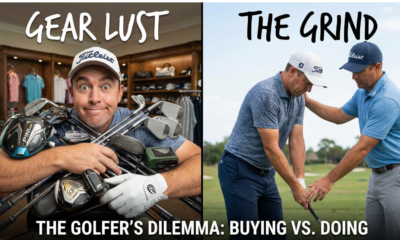
The Technician shows up to the course looking like they just walked out of a PGA Tour equipment truck. They’ve got the latest driver, a perfectly fitted set of irons, a putter that costs more than most people’s rent, and a golf bag that could double as a small apartment. They’re constantly tinkering with their setup, adjusting loft settings, changing shafts, and experimenting with different grips. If there’s a new piece of technology on the market, the Technician has already ordered it.
Now, don’t get me wrong—good equipment matters. But the Technician has fallen into the trap of believing that the right gear is the solution to all their problems. They’re convinced that if they can just find the perfect combination of clubs, their game will magically transform. The reality, of course, is that equipment can only do so much. At some point, you’ve got to actually hit the ball.
The reality check: Equipment is important, but it’s not everything. A great golfer can shoot a good score with a mediocre set of clubs, while a mediocre golfer will still struggle with the best equipment money can buy. Focus on fundamentals first, and let the equipment support your game rather than define it.
The Social Butterfly: Golf Is a Party
Finally, we have the Social Butterfly. For this golfer, the actual game of golf is almost secondary to the social experience. They’re here to hang out with friends, tell stories, share a few laughs, and maybe hit a golf ball occasionally. They’ve got snacks, beverages, and a Bluetooth speaker playing classic rock. They’re having the time of their life, and their scorecard is more of a suggestion than an actual record.
The Social Butterfly reminds us of an important truth: golf is supposed to be fun. Yes, it’s a competitive game, and yes, we all want to play well. But at the end of the day, it’s also about spending time outdoors with people you enjoy. The Social Butterfly has figured out how to keep the game in perspective, and there’s something beautiful about that.
The balance: You can be competitive and still have fun. You can care about your score and still enjoy the company of your playing partners. The best rounds are the ones where you play well and have a great time doing it. Don’t take yourself so seriously that you forget to enjoy the journey.

The Truth About Golf Course Characters
Here’s the beautiful thing about all these different types of golfers: they’re all valid. There’s no single “right” way to play golf. Some people love the competition, others love the social aspect, and some just love being outside on a beautiful day. The key is to find your own path and respect that others are on their own journey.
I’ve been all of these golfers at different times in my life. I’ve been the Speed Demon rushing through a round because I had somewhere to be. I’ve been the Analyst overthinking every shot. I’ve been the Optimist pulling driver when I should have hit an iron. And I’ve definitely been the Social Butterfly, more interested in the conversation than the scorecard. The game has room for all of us.
Embrace the Diversity
The next time you’re on the course and you encounter one of these characters, take a moment to appreciate them. They’re part of what makes golf such a rich and interesting game. Sure, the Speed Demon might be a little intense, and the Analyst might slow things down, but they’re all out there trying to figure out this impossible game, just like you.
Golf is a mirror. It reflects who we are, our strengths and weaknesses, our hopes and frustrations. These different types of golfers are really just different aspects of the human experience, all playing out on eighteen holes of grass. And that, my friends, is pretty cool.
So which type of golfer are you? Or maybe you’re a combination of several? Share your thoughts in the comments below, and let’s celebrate the beautiful chaos that is public course golf. After all, it’s just a game, and we’re all just trying to have a good time out there. Be the ball, people. Be the ball.
Blog
The Queens of the Links: How a 1920s Rivalry Forged the Modern Game
A New Look at the Match That Changed Everything.
In the annals of sport, certain rivalries transcend the simple tabulation of wins and losses to become something more—a cultural flashpoint, a testament to human potential, or, in the case of Stephen Proctor’s meticulously researched new book, Matchless, a quiet revolution played out on the windswept links of Britain and America. Proctor, who has previously chronicled the early days of the game, here turns his lens toward the 1920s, an era he frames as the “transformative age for women’s golf”.
At the heart of the narrative are two women who stood as “Empresses of Golf”: the British technician Joyce Wethered and the American competitor Glenna Collett. To read Proctor’s account is to realize that Wethered and Collett were to their era what Jones and Hagen were to theirs—perhaps even more, given the societal “patriarchal world” they were navigating while suffragettes fought for the right to vote just a year before their most famous duels.
Proctor is at his best when reconstructing the high-stakes drama of the 1929 British Ladies’ Championship at St. Andrews. He captures the “frenzied scene” where businesses declared half-day holidays so the Scottish public could witness the final 18 holes. The match itself was a masterpiece of fluctuation: Collett went out in a “scintillating 34,” a score Bernard Darwin—the dean of golf writers—called “overwhelming golf worthy of any male champion”. Yet, Wethered’s “imperturbable temperament” allowed her to claw back from five down to secure a victory that Darwin eventually found himself “at a loss for words” to describe.
What makes Matchless particularly relevant for the modern reader is Proctor’s insistence on the sheer quality of the play. He reminds us that in 1925, Troon was set at 6,415 yards—longer than the setup for the 2024 U.S. Women’s Open a century later. Playing from these “back tees,” Wethered and Collett repeatedly posted scores in the mid-70s, marks that were “unthinkably low for women” at the time and competitive with the men’s Open Championship records of the era.
The book also serves as a vital historical bridge. Proctor traces the lineage of the women’s game back to 1738, when “Charming Sally” won a match at Bruntsfield Links while her husband carried her clubs. He highlights the indispensable work of Issette Pearson, the “despotic” force who founded the Ladies’ Golf Union in 1893 to establish a uniform code of rules and handicapping long before the men’s game achieved similar cohesion.
Proctor’s prose is elegiac, particularly when discussing the “enduring legacy” of these two women who lived to great ages—Collett to 85 and Wethered to 96—but never outlived the legend they created on the Old Course. He concludes by noting that their performance remains, even a century later, “the greatest women’s golf match ever played”.
For the historian, Matchless is a rigorous addition to the library; for the enthusiast, it is a stirring reminder that the “manifest genius” of the game knows no gender. Proctor has not just written a sports book; he has recovered a lost chapter of excellence that, like a perfectly struck iron shot, rings true long after the follow-through.
Pick up your copy of Matchless today.
“Matchless” by Stephen Proctor is published by Arena Sport, an imprint of
Birlinn Limited.
Rating: ★★★★½ out of 5
Ms. Lexi the Golf Guru is a golf enthusiast, instructor, and advocate for inclusion in the game. When she’s not on the course, she can usually be found with her nose in a book, because great stories, like great golf shots, can change everything.
Blog
The Ultimate Guide to Buying Used Golf Clubs
Save money and play better golf with our ultimate guide to buying used golf clubs. Learn where to find the best deals and what to look for to build a quality bag on a budget.
Let’s be honest, golf can be an expensive hobby. Between green fees, balls, and the latest and greatest gear, the costs can add up quickly. But what if I told you that you could build a high-performing bag without breaking the bank? The secret lies in the world of used golf clubs. In this guide, we’ll explore the ins and outs of buying used clubs, helping you find fantastic deals on quality equipment.
Why Buy Used? The Smart Golfer’s Advantage
Besides the obvious cost savings, buying used golf clubs has several other benefits. For one, you can often get clubs that are only a season or two old for a fraction of their original price. This means you can play with premium technology without the premium price tag. Additionally, buying used is a great way to experiment with different brands and models to find what truly works for your game without a major financial commitment.
Where to Find the Best Deals on Used Golf Clubs
Navigating the second-hand market can be tricky, but there are several reputable places to find great deals on used clubs.
Online Retailers
Websites like Callaway Pre-Owned, GlobalGolf, and 2nd Swing are fantastic resources. They offer a massive selection of clubs from all major brands, and they often provide detailed descriptions and condition ratings. Plus, they usually offer a trial period or return policy, which takes a lot of the risk out of buying online.
Local Golf Shops and Play It Again Sports
Don’t overlook your local golf shops. Many of them have a used club section, and the staff can often provide valuable insights and recommendations. Similarly, stores like Play It Again Sports can be a goldmine for used equipment, especially for beginner and intermediate players.
eBay and Facebook Marketplace
For the truly adventurous bargain hunter, eBay and Facebook Marketplace can offer some of the best deals. However, be prepared to do your homework. Scrutinize the pictures, ask the seller questions, and be wary of deals that seem too good to be true. Always check the seller’s ratings and reviews before making a purchase.

What to Look For When Buying Used Clubs
When you’re inspecting a potential purchase, here are a few key things to look for:
•Grips: Check for excessive wear, cracking, or slickness. Worn-out grips will need to be replaced, which can add to the overall cost.
•Shafts: Inspect the shafts for any dents, dings, or signs of rust. These can affect the club’s performance and durability.
•Clubfaces: Look for any major dings, deep scratches, or excessive wear on the grooves. Minor cosmetic blemishes are fine, but significant damage can impact how the ball comes off the face.
•Authenticity: Be cautious of counterfeit clubs, especially when buying from individual sellers. If a deal seems too good to be true, it probably is. Stick to reputable sellers and be wary of clubs with blurry logos or unusual paint fills.
The Hacker’s Playbook for Buying Used
•Know Your Specs: Before you start shopping, have a general idea of what you’re looking for in terms of shaft flex, loft, and club model.
•Be Patient: Don’t rush into a purchase. The used club market is constantly changing, so be patient and wait for the right deal to come along.
•Don’t Be Afraid to Haggle: Especially when buying from individual sellers, don’t be afraid to negotiate on the price.
Buying used golf clubs is a smart way to save money and build a bag that you love. With a little bit of research and a keen eye for detail, you can find some incredible deals on high-quality equipment. Have you had success buying used clubs? Share your best finds in the comments below!
-
Product Review6 years agoThe Perfect Practice Putting Mat Review by Jason Tenzer
-
Blog5 years agoLoophole Rule Offers PGA Tour Pros a Mulligan
-
Blog5 years ago2021 Buyer’s Guide: The Top 10 Value Golf Balls For Distance & Feel
-
Blog5 years agoGolf Marriage Counselor
-
Blog6 years ago9 Biggest Chokes Of The Past Decade
-
Product Review6 years agoTHE ADJUSTABLE IRONS: WALKING STICKS GOLF CLUBS
-
Blog5 years agoWhat Your Golf Clubs Say About You
-
News1 month agoThe latest news in golf