Connect with us

Drills

Golf Fitness for the Off-Season: Build Strength, Flexibility, and Power Before Spring

Now is the time to get in shape before the season starts. Start your routine now so you can be ready.

Avatar photo

Published

on

As the days grow shorter and the golf courses are covered in a blanket of frost or snow, it’s easy to let your clubs gather dust in the garage. But what if this winter off-season wasn’t an end, but a beginning? What if you could use these next few months to build a stronger, more flexible, and more powerful body, emerging in the spring not just rust-free, but fundamentally better than you were last season?

Welcome to your off-season game plan. This isn’t about grueling, two-hour gym sessions. This is a smart, targeted approach to golf fitness that will increase your clubhead speed, improve your consistency, and dramatically reduce your risk of injury. By focusing on the three pillars of athletic performance—Mobility, Strength, and Power—you can transform your game without ever hitting a ball.

Why Off-Season Fitness is a Game-Changer

During the golf season, our focus is on playing. It’s difficult to make significant physical gains when your body is also trying to recover from rounds and practice sessions. The off-season, however, presents a golden opportunity. It’s a dedicated block of time where you can push your body, build a solid foundation, and make improvements that are simply not possible mid-season .

Furthermore, the physical qualities required for a powerful and resilient golf swing are the exact same qualities essential for long-term health and vitality. As we age, we naturally lose muscle mass, strength, and power—a process that is catastrophic for both our golf game and our quality of life. The good news? All of these factors are incredibly trainable at any age. Research on adults aged 60 to 83 years found that just 8-16 weeks of resistance training improved maximal strength by approximately 18% and rate of force development by 27% . The workout that adds 15 yards to your drive is the same one that helps you carry groceries with ease and stay independent for decades to come.

The Three Pillars of a Powerful Golf Swing

A successful golf fitness program doesn’t need to be complicated. It should be built on a consistent and progressive approach focused on three key areas.
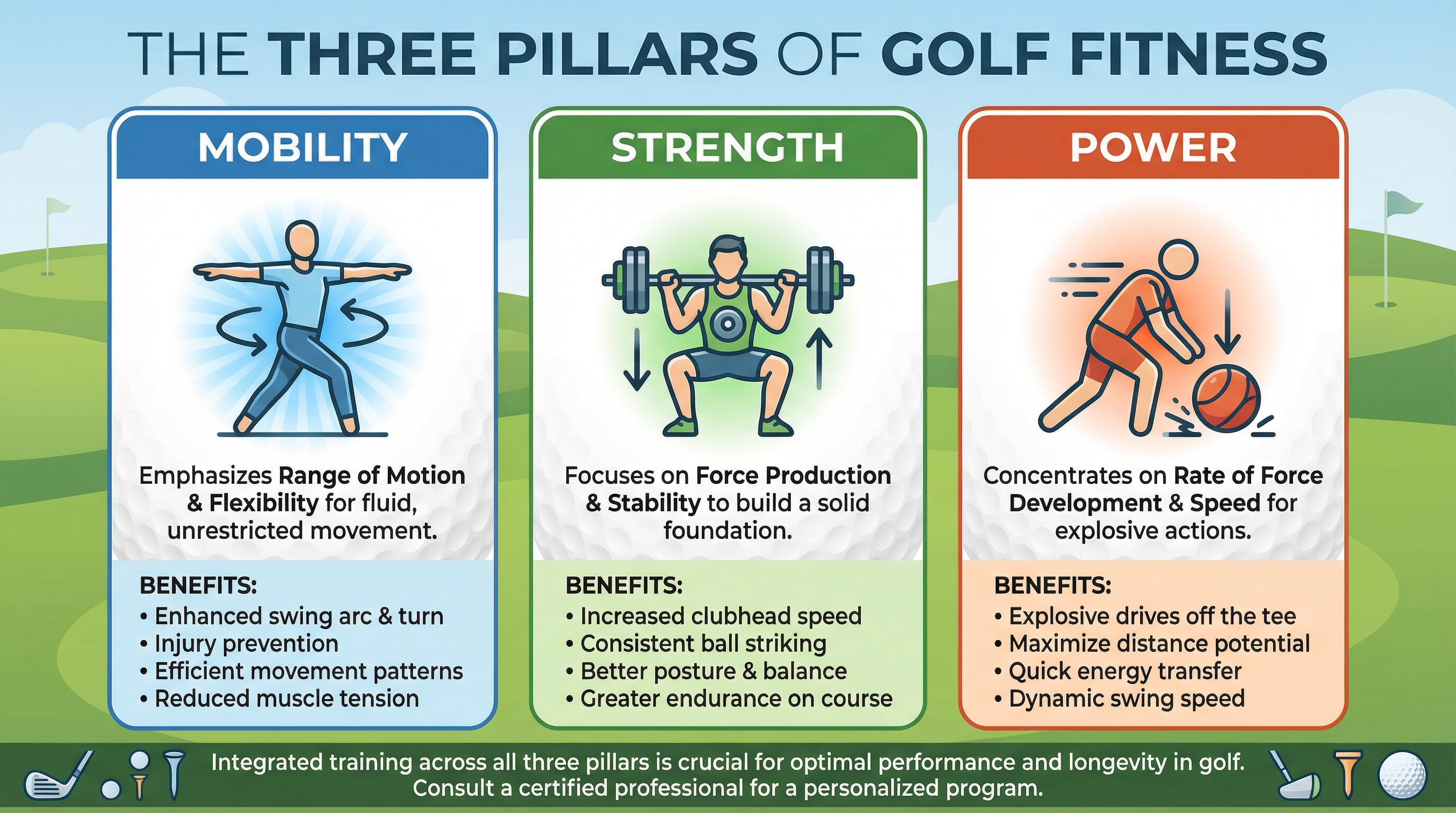
The three pillars of golf fitness

Pillar 1: Mobility – The Foundation of a Fluid Swing

Mobility is the ability to move a joint through its full range of motion with control. For golfers, this is non-negotiable. Without adequate mobility in your hips, thoracic spine (upper back), and shoulders, your body will be forced to find that rotation from other, less stable areas, like your lower back—a leading cause of golf-related pain and injury.

Why it Matters: A bigger turn in your backswing creates a longer arc, which directly translates to more clubhead speed. How much you turn your pelvis and torso, and how far your hands travel around the clock in the backswing, play a very important role in your club head speed . Improved mobility allows you to generate this rotation safely and efficiently.

The Focus: Hips, Thoracic Spine, Shoulders. The beauty of mobility training is that it doesn’t require any equipment, is not very taxing, and the gains are immediate. It doesn’t even require much training time.
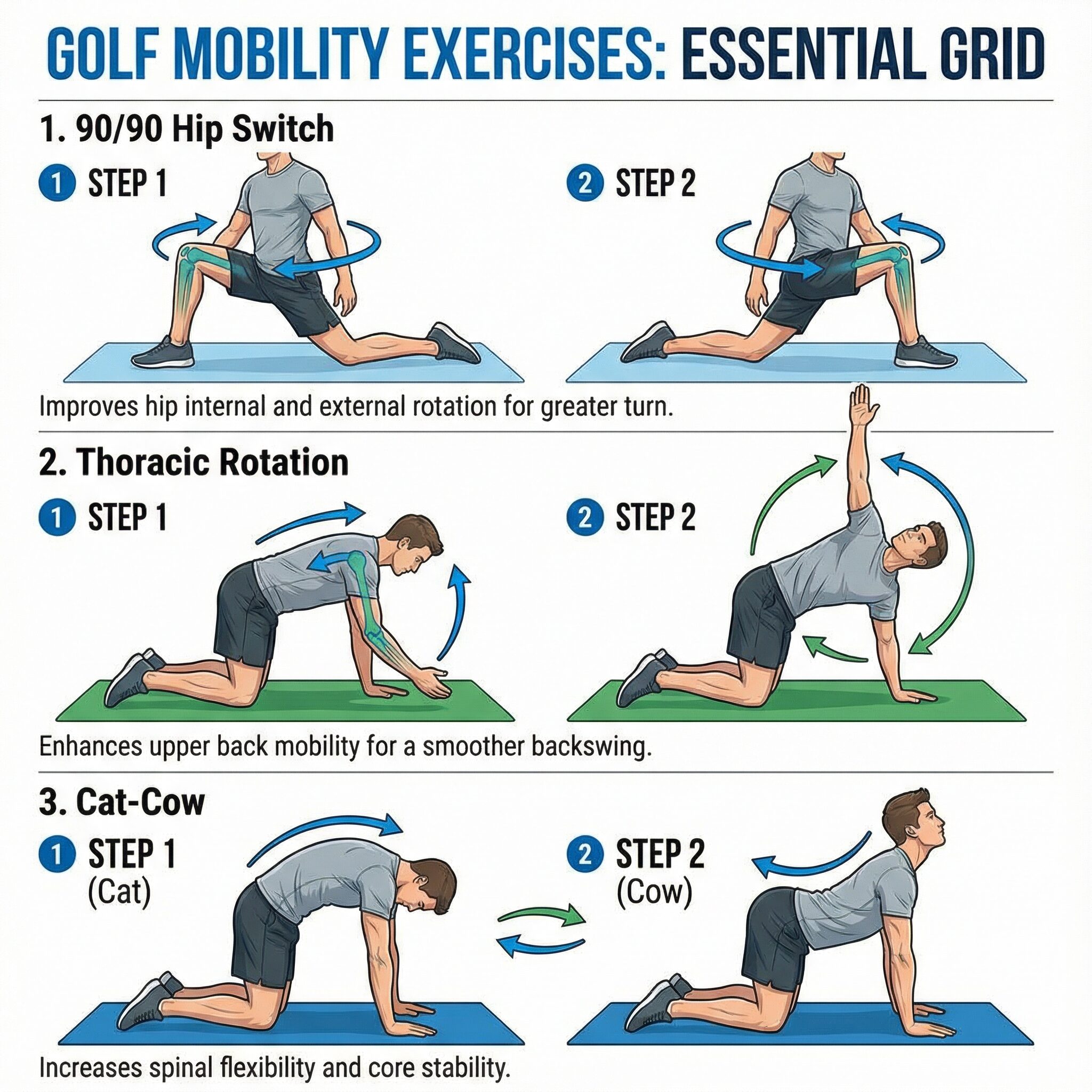
Key golf mobility exercises demonstration

Pillar 2: Strength – The Engine of Your Swing

Strength is the ability to produce force. It’s the engine that powers your golf swing. A stronger body is a more stable body, allowing you to maintain your posture and balance from address to follow-through. It’s also the foundation upon which you build power.

Why it Matters: Strength is essential for creating speed, controlling the club, and preventing the breakdown of swing mechanics due to fatigue over 18 holes. It is arguably the most underappreciated physical quality in the general population, and it requires specific training to maintain . Everyday tasks or just being active is not sufficient to preserve muscle strength as we age.


ADVERTISEMENT

The Focus: Full-body, compound movements like squats, hinges (deadlifts), presses, and rows. These exercises engage multiple muscle groups simultaneously, building functional strength that translates directly to the golf course.

Pillar 3: Power – Unleashing Your Speed

If strength is the size of your engine, power is how quickly you can rev it. In golf, this is known as Rate of Force Development (RFD)—how rapidly you can generate force. The golf swing is an explosive, athletic movement that happens in the blink of an eye. You don’t have time to gradually ramp up to maximum force; you need to be able to summon it instantly.

Why it Matters: RFD is the physical quality most closely correlated with clubhead speed. It declines more rapidly with age than strength or muscle mass, which is why explosive training is a critical, yet often overlooked, component of golf fitness . A minuscule percentage of adults train explosively, but those who do see dramatic improvements in their ability to generate speed.

The Focus: Explosive movements like medicine ball throws, jumps, and kettlebell swings. These exercises train your nervous system to recruit muscle fibers rapidly, creating the explosive power needed for a fast, powerful swing.

Your At-Home Off-Season Workout Plan

You don’t need a fancy gym membership to build a golf-ready body. This simple and effective workout can be done at home with minimal equipment (a few dumbbells or kettlebells and resistance bands are helpful).

Frequency: Perform this full-body workout 2-3 times per week on non-consecutive days.

Exercise CategoryExercise ExampleSets & RepsWhy It Helps Your Golf Game
1. Dynamic Warm-Up90/90 Hip Switches2 sets of 10 reps/sideImproves hip internal and external rotation, crucial for a powerful backswing and follow-through.
(Mobility)Cat-Cow2 sets of 10 repsMobilizes the spine, warming up the muscles of the back and core.
Thoracic Rotations (Quadruped)2 sets of 8 reps/sideIncreases rotation in the upper back, allowing for a bigger, safer turn away from the ball.
2. PowerMedicine Ball Rotational Slams3 sets of 5 reps/sideDevelops explosive power in the transverse (rotational) plane, mimicking the golf swing.
Box Jumps (or Broad Jumps)3 sets of 5 repsTrains lower body explosiveness and improves your ability to use the ground for power.
3. StrengthGoblet Squats3 sets of 8-10 repsBuilds lower body and core strength, essential for stability and power generation.
Dumbbell Bent-Over Rows3 sets of 8-10 repsStrengthens the back and shoulders, helping to maintain posture throughout the swing.
Glute Bridges3 sets of 12-15 repsActivates and strengthens the glutes, the most powerful muscles in your body and key for a stable swing.
4. CorePallof Press3 sets of 10 reps/sideAn anti-rotation exercise that builds incredible core stability to resist unwanted movement during the swing.
Dead Bug3 sets of 10 reps/sideImproves coordination and strengthens the deep core muscles that protect your lower back.

Progression: Start at an appropriate level for your current fitness, and slowly and gradually increase the demand of the training as you improve. This principle of progressive overload is the key to long-term gains.

Injury Prevention: Play Smarter, Not Harder

The repetitive nature of the golf swing can take a toll on the body. The most common injuries are not acute, sudden events, but chronic overuse issues that build up over time . The lower back, wrists, and elbows are particularly vulnerable.

“People often think swinging a golf club is just about the arms and shoulders, but it’s really a total body workout,” explains Dr. Daniel Komlos, an orthopedic surgeon at Houston Methodist. “Building strength is also critical for injury prevention, since the repetitive motions and prolonged gripping that come with playing golf can take a toll on your muscles and joints.”
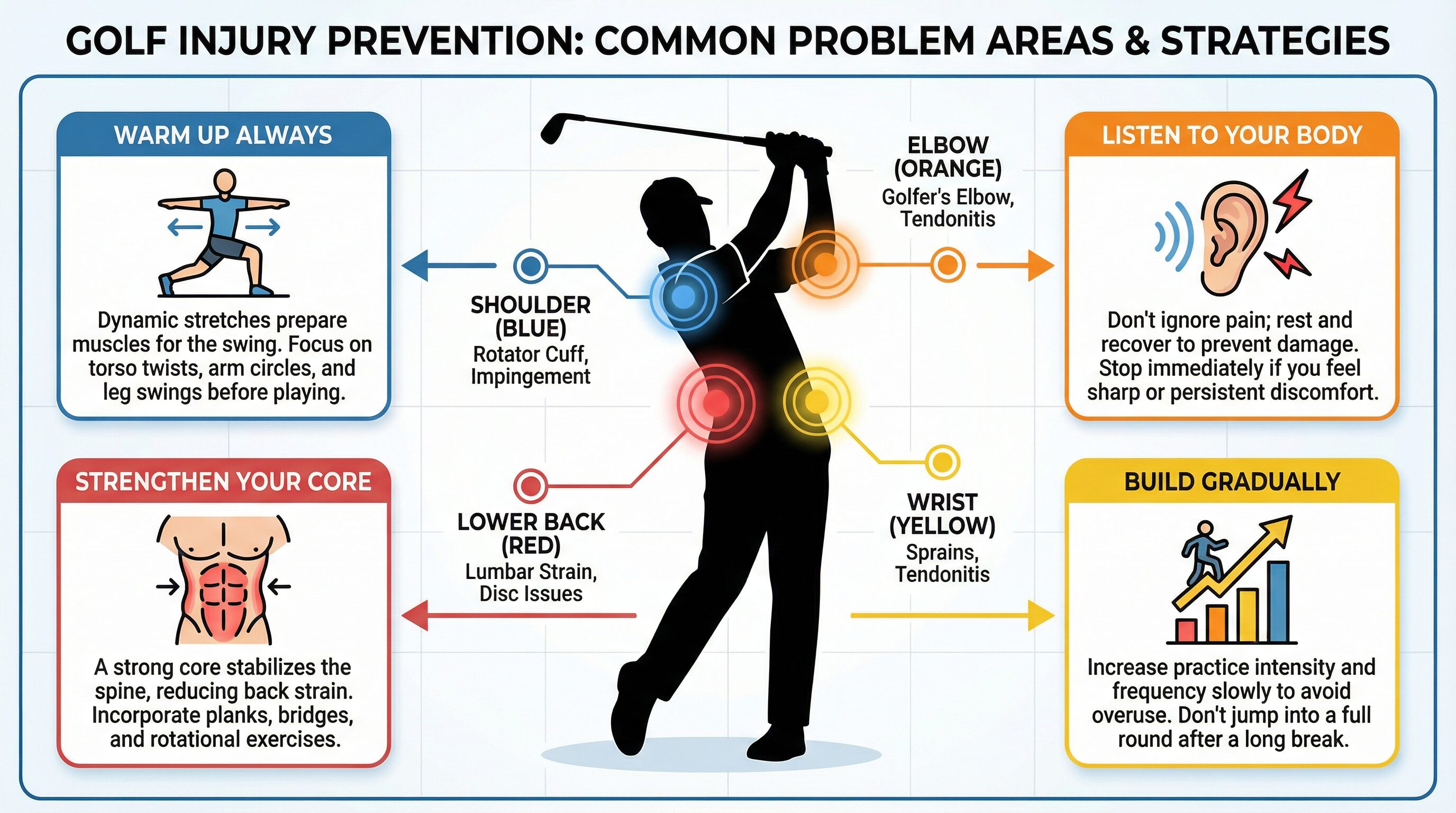
Golf injury prevention guide

Interestingly, while golfer’s elbow (medial epicondylitis) gets its name from the sport, lateral epicondylitis—more commonly known as tennis elbow—is actually the more prevalent elbow injury among golfers . This happens because of the prolonged grip and positioning of the wrist while gripping a golf club. Other potential injuries include triceps tendonitis, rotator cuff injuries, and lower back sprains and strains.

Here are the most important strategies to stay injury-free:

Always Warm Up: Never step onto the first tee cold. A 5-10 minute dynamic warm-up (like the one in the workout plan) increases blood flow to your muscles and prepares your joints for the rotational demands of the swing. Stretch frequently, using slow, controlled movements that work through your full range of motion. Pay particular attention to the mobility of your shoulders, neck, wrists, and lower back, since flexibility is key for a smooth swing .

Listen to Your Body: This is the golden rule. Pain is your body’s signal that something is wrong. The “no pain, no gain” mantra does not apply to joint pain in golf. If you feel a sharp or unusual pain, it’s time to rest. After about two weeks, you should be pain-free and can return to playing. But if you notice the pain comes back, you should stop and see a doctor . Pushing through pain is the fastest way to turn a minor issue into a major setback.

Strengthen Your Core: A strong and stable core is your best defense against lower back pain. It acts as a corset, protecting your spine from excessive rotational forces. Incorporate exercises like planks, bridges, and rotational core work into your routine.

Build Gradually: If you haven’t played in a while, don’t jump into a full round or multiple rounds in quick succession. Increase practice intensity and frequency slowly to avoid overuse. This is especially important as we age, when muscles and joints are more prone to overuse injuries.

Conclusion: The Time to Start is Now

The winter off-season is a gift. It’s an opportunity to invest in your most important piece of golf equipment: your body. By dedicating just a few hours a week to a structured fitness program, you can build a foundation of mobility, strength, and power that will pay massive dividends when the season begins.

Don’t wait for spring to start thinking about your golf game. Start today. Begin with the mobility exercises, gradually incorporate the strength and core work, and then add in the power movements as you feel comfortable. Track your progress, stay consistent, and trust the process. When you step onto the first tee next season, you won’t just feel ready—you’ll be objectively, measurably better. Your swing will be faster, your body will be more resilient, and your scores will reflect the work you put in during the cold months.


References

[1] Carroll, M. (2025, October 8). Off Season Golf Workouts: Build Speed, Strength, and Mobility. Fit For Golf.

[2] Houston Methodist. (2025, February 24). A Golfer’s Guide to Strength, Mobility, and Injury Prevention.

Continue Reading
Advertisement
Click to comment

Leave a Reply

Your email address will not be published. Required fields are marked *

Blog

The Mental Game of Golf: Mastering the Psychology Behind Lower Scores

Avatar photo

Published

on

It’s a scenario every golfer knows intimately: you’ve just striped a perfect drive down the middle of the fairway, only to follow it up with a chunked iron shot that barely advances the ball. Frustration mounts, your focus shatters, and the rest of the hole—and perhaps the round—unravels. While we often blame our swing mechanics for these inconsistencies, the true culprit frequently lies between our ears. Research consistently shows that the mental game accounts for a staggering 70-90% of performance in golf . Yet, despite its monumental importance, studies reveal that only about 14% of golfers regularly practice their mental skills .

This article is designed to change that. We will explore the critical role of psychology in golf, break down the most common mental errors that sabotage your scores, and provide you with professional-grade techniques and practical drills to build an unshakeable mental game. By the end, you will have a clear roadmap to not only lower your handicap but also to find more joy and resilience on the course.

Why the Mental Game is Your Most Important Club

In golf, a quiet mind is a powerful asset. Your mental and emotional state directly influences your physical capabilities. When you are calm, focused, and confident, your body is relaxed, and your swing can flow freely and naturally. Conversely, when you are anxious, angry, or distracted, your muscles tighten, your coordination suffers, and your swing mechanics break down. This isn’t just a feeling; it’s a physiological reality. Negative emotions trigger a fight-or-flight response, which is fundamentally at odds with the fine motor control required for a successful golf shot .

A 2025 systematic review on mental fatigue in golf further highlights this connection. The research found that prolonged mental exertion during a round directly leads to a decline in performance, affecting everything from driving distance and iron accuracy to, most significantly, putting . Every decision, every calculation, and every moment of frustration depletes your cognitive resources, making it harder to execute shots as the round progresses. Mastering the mental game is therefore not just about thinking positively; it’s about efficiently managing your mental energy.

Mental strength vs mental weakness comparison

The 5 Mental Mistakes Costing You Strokes (and How to Fix Them)

Based on extensive analysis of amateur golfers, sports psychologists have identified several recurring mental errors. Here are five of the most common, along with strategies to overcome them, adapted from the work of mental game coach David MacKenzie .

Mental MistakeDescriptionThe Fix
1. Analyzing Your SwingConstantly dissecting your mechanics on the course, trying to “fix” your swing mid-round.Trust the swing you brought. The course is for playing, the range is for practicing. Focus on your target and let your body execute. If you need a swing thought, use a simple rhythm cue like “one-two-three.”
2. Obsessing Over ScoreTying your emotional state to your score on every hole, leading to a rollercoaster of feelings.Focus on the process, not the outcome. Your goal for each shot should be to execute your routine flawlessly. The score will take care of itself.
3. Negative Self-TalkBerating yourself after a bad shot, which lowers confidence and increases tension.Become your own best caddy. After a poor shot, offer yourself the same encouragement you would a friend. Develop a post-shot routine that involves acknowledging the feeling, taking a deep breath, and moving on.
4. Vague TargetingAiming for a general area like “the fairway” or “the green” instead of a specific point.Pick the smallest possible target. Top professionals aim at incredibly precise spots, like a specific tree branch or a single blade of grass. This sharpens focus and improves accuracy.
5. Neglecting Your RoutineLacking a consistent pre-shot and post-shot routine, leading to inconsistent mental preparation and reaction.Make your routine your primary goal. A well-defined routine is your mental armor against pressure. It ensures you are committed to every shot and can handle any outcome.

Building an Unshakeable Mental Game: Pro-Level Techniques

Top professional golfers are masters of the mental game. They employ specific techniques to stay focused, confident, and resilient under immense pressure. Here are a few you can incorporate into your own game.

The Power of a “Pre-Shot Creation”

Instead of a rigid, robotic pre-shot routine, think of it as a “pre-shot creation.” This concept, inspired by the approach of players like Tiger Woods, reframes the process as an artistic and imaginative one . Rather than just going through the motions, you should feel the shot, engage your senses, and become genuinely interested in the unique puzzle each shot presents. This fosters a state of deep presence and curiosity, quieting the analytical mind.

Tiger Woods worked extensively with navy psychologist Dr. Jay Brunza early in his career, developing what he called “game training.” Woods emphasized the importance of bringing attention to “THIS SHOT in THIS moment” and described feeling the shot in his fingers rather than relying solely on visualization. At his best, Woods found a way to be immensely interested in each shot, playing from a position of curiosity rather than anxiety .

The golfer's pre-shot routine in 4 steps

Mastering Your Mind: Awareness Over Control

One of the biggest paradoxes in golf psychology is that trying to control your thoughts often backfires. Telling yourself “don’t hit it in the water” only makes the water a more prominent feature in your mind . The key is not to suppress negative thoughts but to change your relationship with them through mindfulness and awareness. Acknowledge the thought without judgment, and then gently guide your focus back to your target and your breathing. The best players don’t have fewer negative thoughts; they are simply more skilled at not letting them take over.

Research shows that the average person has approximately 70,000 thoughts per day, with more than two-thirds being negative . The difference between elite golfers and amateurs is not the quantity of negative thoughts but how they respond to them. Elite players have developed the skill of awareness—noticing thoughts without becoming entangled in them—allowing the thoughts to pass like clouds in the sky.

Breathe Like a Champion

Breathing is one of the most powerful and simple tools for managing your physiological state. When you feel pressure mounting, your breathing becomes shallow and rapid. By consciously slowing it down, you can signal to your nervous system that it’s time to calm down. A popular and effective technique is Box Breathing:

1.Inhale slowly for a count of four.

2.Hold your breath for a count of four.

3.Exhale slowly for a count of four.

ADVERTISEMENT

4.Hold your breath for a count of four.

Repeating this cycle just a few times can significantly lower your heart rate and reduce muscle tension, allowing you to approach the shot from a state of calm focus .

Box breathing technique diagram for golfers

The Science Behind Mental Training

Recent research validates what professional golfers have known intuitively for decades. A brain training study conducted with UCLA Golf demonstrated remarkable results: participants increased their greens in regulation by 12% and decreased three-putts per round by 9.7%. Perhaps most impressively, these improvements were sustained eight weeks after the training concluded . This demonstrates that mental skills, like physical skills, can be trained and improved with consistent practice.

A 2024 neuroscience study revealed that expert golfers exhibit distinct brain activity patterns during successful putts compared to unsuccessful ones. The research emphasized that mental preparation—not just physical technique—is the key differentiator between making and missing putts . This finding underscores the importance of developing a consistent mental routine before every shot.

Putting It Into Practice: Drills for a Stronger Mind

Improving your mental game requires consistent practice, just like your swing. Here are a few drills you can incorporate into your routine:

Pressure Putting Drill: Place three balls at 3, 6, and 9 feet from the hole. You must make all three in a row to complete the drill. If you miss, you start over. This simulates pressure and forces you to focus on your routine for each putt. As you improve, increase the difficulty by adding more balls or extending the distances.

Mindfulness on the Range: During your practice sessions, take a few moments between shots to simply be present. Feel the grip in your hands, notice the breeze, and listen to the sounds around you. This trains your ability to stay in the present moment, which is essential for peak performance on the course.

Post-Round Journaling: After each round, take five minutes to write down one thing you did well mentally and one mental challenge you faced. This builds self-awareness and helps you identify patterns in your mental game. Over time, you will notice recurring themes that you can address in your practice.

Target Practice with Consequences: On the range, pick a specific target for every shot—not just a general area. If you miss your target, perform a small penalty like five push-ups or hitting the next shot with your opposite hand. This adds consequences to your practice, making it more similar to on-course conditions where every shot matters.

Key Takeaways for Your Next Round

As you prepare for your next round, keep these fundamental principles in mind:

Trust over control. The more you try to consciously control your swing, the more tension you create. Trust the swing you have practiced and let your body execute naturally.

Process over outcome. Make your pre-shot routine your primary goal for every shot. When you focus on executing your process flawlessly, good scores follow naturally.

Awareness over suppression. You cannot eliminate negative thoughts, but you can change your relationship with them. Notice them, acknowledge them, and gently return your focus to the present moment.

Precision over generality. Always pick the smallest possible target. This sharpens your focus and gives your subconscious mind a clear objective.

Compassion over criticism. Treat yourself with the same kindness and encouragement you would offer a playing partner. Negative self-talk only compounds mistakes and drains your confidence.

Conclusion

The journey to mastering the mental game of golf is ongoing, but it is one of the most rewarding pursuits in the sport. By understanding the profound impact of your mind on your performance, recognizing common mental errors, and consistently practicing proven psychological techniques, you can unlock a new level of consistency, resilience, and enjoyment on the golf course. Remember, the next time you step onto the tee, your most powerful tool isn’t in your bag—it’s in your head. The difference between a good round and a great round often comes down to how well you manage the six inches between your ears.

Start small. Pick one technique from this article—perhaps developing a consistent pre-shot routine or practicing Box Breathing before important shots—and commit to it for your next three rounds. Track your progress, notice the changes, and gradually incorporate additional mental skills into your game. The mental game is not a quick fix, but a lifelong practice that will serve you well both on and off the course.

References

[1] NeuroTrackerX. (2023, December 1). Why Golf Performance is 90% Mental.

[2] McCarthy, P. (2025, November 8). The Mental Game of Golf: Pro Secrets You Haven’t Heard Before.

[3] Colorado Senior Golfers’ Association. The Brain Game – Spring Edition.

[4] McCarthy, P. (2025, November 8). The Mental Game of Golf: Pro Secrets You Haven’t Heard Before.

[5] Pan, X., et al. (2025). Mental fatigue in golf: A systematic review. PLOS ONE.

[6] MacKenzie, D. (n.d.). 5 Mental Mistakes You Should Never Make on the Golf Course. Practical Golf.

[7] Mind Caddie. (2025, November 9). Tiger Woods’ Mental Strategies.

[8] Whitehead, A. (2025, July 20). How to Stay Calm Under Pressure – Breathing Techniques for Clutch Shots.

[9] MyTPI. Mental Game: Brain Training Study With UCLA Golf.

[10] PsyPost. (2024, August 15). Golf: New neuroscience study reveals the secrets of better putting.

Continue Reading

Blog

Stop Wasting Strokes: 5 Simple Drills to Kill the Dreaded 3-Putt

Tired of ruining a great hole with the dreaded 3-putt? These 5 simple drills fix your speed, conquer pressure, and turn three putts into two.

Avatar photo

Published

on

There is no feeling in golf quite as demoralizing as the 3-putt.

You smash a perfect drive. You hit a pure iron shot that lands safely on the green. You’re feeling like a pro, walking up to your ball with a birdie on your mind.

Then, disaster strikes. You blaze the first putt eight feet past the hole. Your comebacker for par is a nervous, jabby stroke that lips out. You tap in for a bogey, walking off the green with that all-too-familiar feeling of frustration, your good shots completely wasted.

The 3-putt is the great scorecard killer. It’s the difference between breaking 90 and shooting 95. The good news? It’s almost always the easiest problem to fix. It’s not about buying a $500 putter; it’s about controlling your speed and handling pressure.

Here are 5 simple, time-tested drills to kill the 3-putt and make you a confident force on the greens.

ADVERTISEMENT

Why You 3-Putt (It’s Not What You Think)

Most amateurs 3-putt for two simple reasons, and neither has to do with a “bad stroke”:

  1. Poor Lag Putting: You leave your first putt so far from the hole that the second putt is still a challenge.
  2. Missed “Knee-Knockers”: You can’t consistently sink putts inside 3-5 feet.

These five drills are designed to fix both of those problems, starting today.

5 Drills to Become a 2-Putt Machine

Find a practice green and spend 20 minutes on these. You’ll see results in your very next round.

1. The Ladder Drill (For Lag Control)

This is the ultimate drill for dialing in your speed control.

  • How to do it: Place three balls at 20, 30, and 40 feet from a hole (or use tees if you’re just practicing speed).
  • The Goal: Hit the 20-foot putt, then the 30-foot, then the 40-foot. Your only goal is to get all three putts to stop within a 3-foot radius of the hole (imagine a hula-hoop around the cup).
  • Why it works: It trains your brain to instinctively understand how hard to hit a putt based on distance. You’ll stop blazing putts 10 feet by or leaving them 10 feet short.

2. The Clock Drill (For Short Putt Pressure)

You must be automatic from three feet. This drill adds the pressure you feel on the course.

  • How to do it: Place 12 balls in a 3-foot circle around the hole (like the numbers on a clock).
  • The Goal: Go around the clock and make all 12 putts in a row. If you miss one, you must start over from the beginning.
  • Why it works: It’s not just about mechanics; it’s about focus. When you get to ball #10, you will feel the pressure. This simulates the feeling of having to make a putt for par.

3. The Gate Drill (For a Pure Roll)

Missed short putts are often caused by a poor starting line. This drill gives you instant feedback.

  • How to do it: Find a straight, 5-foot putt. Place two tees on the ground just wide enough for your putter head to pass through. About a foot in front of your ball, place two more tees just slightly wider than the ball itself.
  • The Goal: Stroke the putter through the first “gate” and roll the ball through the second “gate.”
  • Why it works: If you hit the ball off-center or have a wobbly stroke, the ball will hit the second gate. It forces you to hit the sweet spot and start the ball exactly where you’re aiming.

4. The 100-Footer (The “No 3-Putt” Zone)

This drill is simple: go to one end of the practice green and putt to a hole on the opposite end. Your goal is not to make it, but to get it inside that imaginary 3-foot circle. Do this 10 times. This makes 30 and 40-footers on the course feel like tap-ins by comparison.

5. The “Read, Roll, and React” Drill

Stop agonizing over every putt. This drill teaches you to trust your first instinct.

  • How to do it: Take three balls to a 25-foot breaking putt.
  • The Goal: You have 20 seconds total. In that time, you must read the green, take one practice stroke, and hit all three putts.
  • Why it works: It stops “paralysis by analysis.” It trains you to pick a line, trust your speed, and accept the result. You’ll be amazed at how much better your instincts are than your over-analytical brain.

It’s About Process, Not Perfection

You’re still going to 3-putt occasionally. Even the pros do. But by practicing these drills, you’ll be building confidence and skill. You’ll stop fearing long putts and start knowing you can get them close. That confidence is the real secret to finally killing the 3-putt for good.

Continue Reading

Blog

The Mental Game: How to Stay Calm Under Pressure on the Golf Course

Master the mental side of golf with proven strategies to stay calm under pressure and play your best when it matters most.

Avatar photo

Published

on

Golf is often called a mental game, and for good reason. While physical technique is important, the difference between a good round and a great round often comes down to what happens between your ears. I’ve seen golfers with beautiful swings fall apart under pressure, and I’ve watched players with less-than-perfect technique shoot amazing scores because they had their mental game dialed in.

The mental challenges in golf are unique. Unlike other sports where you react instinctively to changing situations, golf gives you time to think – sometimes too much time. Standing over a shot with water on the left and bunkers on the right, you have plenty of opportunity to imagine all the things that could go wrong. Learning to manage these thoughts and emotions is crucial for consistent performance.

Understanding Golf Pressure

Pressure in golf comes in many forms. There’s the pressure of playing well in front of others, the pressure of a tight match, the pressure of trying to break your personal best score, or simply the pressure of hitting a good shot after several poor ones. The key is recognizing that pressure is normal and learning to work with it rather than against it.

Physical symptoms of pressure include increased heart rate, sweaty palms, tight muscles, and shallow breathing. These are natural responses, but they can interfere with your golf swing if not managed properly. The first step in handling pressure is acknowledging these feelings rather than trying to ignore them.

Developing a Pre-Shot Routine

A consistent pre-shot routine is your best defense against pressure and negative thoughts. This routine should be the same for every shot, whether you’re hitting a driver on the first tee or a crucial putt to win a match. Your routine creates a familiar pattern that helps calm your mind and prepare your body for the shot ahead.

Your pre-shot routine should include both physical and mental elements. Physically, you might take a practice swing, check your alignment, and take a deep breath. Mentally, you should visualize the shot you want to hit and commit fully to that image. The key is making this routine automatic so it works even when you’re nervous.

Visualization is a powerful tool that many golfers underutilize. Before each shot, create a clear mental picture of the ball flying toward your target and landing exactly where you want it. See the trajectory, feel the solid contact, and imagine the positive result. This positive imagery helps crowd out negative thoughts and gives your subconscious mind a clear target to work toward.

ADVERTISEMENT

Course Management Psychology

Smart course management is as much about psychology as it is about strategy. Playing within your abilities and making conservative choices when appropriate can actually boost your confidence and lead to better scores. There’s no shame in laying up short of a water hazard or aiming for the center of the green instead of attacking a tight pin position.

The key is honest self-assessment. Know your strengths and limitations, and plan your shots accordingly. If you’re not comfortable hitting a 3-iron, don’t try to hit one under pressure. If you struggle with draws, don’t attempt one when a fade will work just as well. Playing to your strengths builds confidence and reduces the likelihood of big mistakes.

Risk versus reward decisions should be made with your head, not your ego. Before attempting any risky shot, ask yourself: “What’s the best possible outcome, what’s the worst possible outcome, and what’s most likely to happen?” If the potential downside significantly outweighs the potential benefit, choose the safer option.

Dealing with Bad Shots and Bad Rounds

Every golfer hits bad shots and has bad rounds – it’s part of the game. The difference between good players and great players is often how quickly they recover from mistakes. Dwelling on a bad shot or getting angry about a poor result only makes it more likely that you’ll hit more bad shots.

Develop a short memory for bad shots. Allow yourself to feel disappointed for a few seconds, then let it go and focus on the next shot. Some golfers find it helpful to have a physical routine for releasing frustration, such as taking a deep breath and exhaling slowly, or making a practice swing to reset their feel.

Learn from mistakes without dwelling on them. If you hit a shot into the water, quickly analyze what went wrong (poor club selection, bad swing, mental error), make a mental note for future reference, then move on. The lesson is valuable, but continuing to think about it will only hurt your performance on subsequent shots.

Building Confidence

Confidence in golf is built through preparation and positive experiences. The more you practice and the more you understand your capabilities, the more confident you’ll feel on the course. Keep a record of your good shots and good rounds to remind yourself of your abilities when doubt creeps in.

Set realistic, achievable goals for each round. Instead of trying to shoot your career best every time out, focus on process goals like hitting a certain number of fairways or avoiding three-putts. These goals are more within your control and help build confidence through achievement.

Positive self-talk is crucial for maintaining confidence. Replace negative thoughts like “Don’t hit it in the water” with positive ones like “Hit it to the center of the green.” Your subconscious mind responds better to positive instructions than negative warnings.

Staying Present and Focused

One of the biggest mental challenges in golf is staying in the present moment. It’s easy to get ahead of yourself, thinking about what score you might shoot or worrying about difficult holes coming up. It’s equally easy to get stuck in the past, replaying bad shots or dwelling on missed opportunities.

The solution is to focus on one shot at a time. This isn’t just a cliché – it’s a practical mental strategy that keeps you grounded in the present moment. Before each shot, remind yourself that this shot is the only one that matters right now. The shots you’ve already hit are history, and the shots you haven’t hit yet don’t exist.

Breathing exercises can help you stay calm and focused. Before important shots, take a slow, deep breath in through your nose and exhale slowly through your mouth. This activates your parasympathetic nervous system, which helps calm your mind and relax your body.

Conclusion: Developing Mental Toughness

Mental toughness in golf isn’t about being emotionless or never feeling pressure. It’s about acknowledging these feelings and having strategies to deal with them effectively. Like physical skills, mental skills improve with practice and attention.

Start incorporating mental training into your practice routine. Spend time visualizing successful shots, practice your pre-shot routine, and work on staying positive even when things don’t go as planned. The mental game might not be as visible as your swing mechanics, but it’s just as important for shooting lower scores and enjoying golf more.

Remember that even the best players in the world struggle with the mental side of golf sometimes. The difference is that they have developed tools and strategies to help them work through these challenges. With practice and patience, you can develop these same mental skills and take your game to the next level.

Continue Reading

Trending

Click here to get all the latest golf news

Close