Blog
Playing Par 5s: How to Own Them


Here’s the deal, golf lessons can be great. If you take them from a reputable club pro, you may learn a lot about swing mechanics, the plane of your swing, tempo, swing speed and even impact position. However, lessons don’t tell you how to look at a golf hole and assess the risk vs. reward. Simply put, lessons do not get into hole strategy.
So, when you are standing on the tee box on hole 16, a 487-yard par 5 with a 245-yard forced carry AND you are playing the round of your life…what do you do? Your golf buddies are saying things like “You didn’t come this far to lay up“ or “Don’t over think it, just rip driver”. They may be right, but without a plan you are basically throwing darts blind. Nothing hurts more than carding a snowman on a birdie hole and nothing will jack up your score as well as your mental game faster than indecision.
We all hate the dreaded “Big Number” and that’s why we are here for you. So, the next time you are in that spot, remember these 5 tips:
Five keys to owning par 5s:
– Don’t just automatically grab driver – Choose the right club off the tee
– Look at your lie – Assess what shot best suits your approach
– Take an extra club on your approach – 70% of approach shots come up short
– Know where to miss – Do not always go flag hunting
– Have a number in mind to lay up to in case you can’t go after it in two
Many weekend golfers hate par 5s because they are long and can seem daunting. The task: you are basically trying to get a 1 ½ inch ball into a 4-inch hole from 5 football fields away! But they also provide great opportunity if played properly. They are a golden goose for birdies and can turn an 81 into a 79 like that.
1. Select the Right Club on a Par 5

I know you heard me before, but this is a huge mistake I see all the time. You don’t always have to hit driver off the tee. You can hit a fairway wood or a hybrid. Shoot If I know I can not get home in two, I hit my 3 iron all day off the box and more times than not am sitting pretty for my approach while my buddies are ball hunting in the woods. Let’s be honest, it’s probably going to take three shots to reach the green any way unless you can bomb it 300+. So, use the club that gives you the best chance of finding the fairway.

2. Look at Your Lie and Assess The Shot

This is the golden ticket to scoring on Par 5’s. Little known fact: The second shot is often the key to beating par 5s. You need to play a smart shot that puts you in the best position to card a 4. Start by looking at your lie; is it in the fairway or first cut, is it a flier lie or sitting down a little bit, is it side hill above or below your feet? All of these will 100% determine what club you can and should hit. Hitting a 3-wood off a downhill side hill lie in the intermediate rough is hard to do. I suggest you take your medicine and lay up to a good number, so you hit the GIR and have a look at bird.
3. Take an Extra Club
This one is huge. Most approach shots come up short. The average handicap for men is about a 15. The average swing speed is 93 mph and produces a 220 yard drive. Ask around, everyone thinks they hit the ball farther than they actually do. Here are some trackman averages for reference. Take an extra wrench and thank me later. You will hit more greens, score better and find yourself shooting lower scores.
4. Know Where to Miss

Now you hit your drive, you looked at your lie, you have the right club for your approach, time to go flag hunting, right? WRONG. You want to look at the green complex and pin placement. You want to see where the greenside bunkers are. Does the green slope down and away or is there a false front? Start taking note of the danger areas and take them out of play. These determinations will help you pick out a landing area for this shot. For the love of the game, do yourself a favor and stay away from trouble at all costs. Play smart and aim center green. Nobody hit it dead straight every time, well maybe the guys on tour, but even they miss a handful of times per round. This strategy of knowing where not to be, allows you to better understand where to be! It gives you the greatest chance of hitting the green even on a slight miss.
5. Know Your Ideal Lay Up Number

There is no shame in laying up on a par 5. More times than not, smart money says it’s the right move. That’s especially true if the flag is protected by water or a massive pot bunker. Sometimes golfers try to pull off a miracle shot on their second from 237 out in the rough under a tree. They end up in the drink and dropping hitting 4 and will likely post a double bogie when its all said and done. Had they just taken the 5 iron out and laid back to 120 in they would have stuck a 9 iron to 15 feet and a look at 4!
Now I am no PGA tour pro golfer. I am a 5.5 handicap and like the Alice in Wonderland quote “I give myself very good advice, but very seldom follow it” I will tell you, however, that on occasion I stumble onto a pearl and feel the need to pass it on. Use this simple five-step approach above when playing par 5s. It’s a practical golf lesson that can help you own par 5s no matter their length or difficulty. That, in turn, will cut strokes from your scores, lower your handicap and have you collecting the $$$ at the end of the round.
BONUS SCORING DRILL:

Here is Today’s Tip… Your Wedges.
Very few weekend warriors practice hitting wedges at less than full distances. Ironically, however, we face these shots all the time on the course. I know I do. The closer your approach shots the better your chance of draining putts. It’s funny, I always told myself that I was not a great putter. I started doing this drill below and low and behold my distance to the pin was tighter and I started making more putts. Turns out, I was not a bad putter at all, I just was hitting my approach shots to 40 feet. Here’s how I fixed it:
Pick three awkward distances — say 25, 50 and 75 yards… then hit five balls at each target. Now, don’t just grab the 60 for all these shots, actually select the club you would use in a round. Give yourself a point for each ball that lands within what you consider an acceptable distance — I use a 15-foot circle. Max score for this drill is 15 points. Whatever you score, try to beat that number the next day, with the perfect score of 15.
I guarantee if you do this a couple of days in a row, or even for just 15 minutes before your round, you will be stunned at the results on the course. Once you score 15, tighten up that proximity the next time. Pretty soon you will be sending those pitch shots inside a 5-foot circle and have you golf buddies jealous as your ex at your wedding.


Blog
Confessions of a Weekend Golfer: The Shots We All Lie About
Every golfer lies to themselves on the course. From “that was my practice swing” to “I usually make that putt,” Ty Webb confesses the universal lies we all tell—and why it’s perfectly okay.


We need to talk. Not about swing mechanics or course management or the latest driver technology. We need to talk about something more fundamental, more universal, more deeply human: the lies we tell ourselves on the golf course. And I’m not talking about the big lies—”I could go pro if I had more time” or “I’m definitely a ten handicap.” I’m talking about the small, everyday lies. The ones we tell ourselves on every single round. The ones that make golf bearable, and occasionally, magical.
I’m guilty of all of them. You are too. Your buddy who claims he shoots in the seventies? He’s lying about at least three things per round, minimum. And that’s okay. Because golf is hard, and life is short, and sometimes a little self-deception is what keeps us coming back. So consider this my confession. A truth-telling about all the lies. A public admission of the creative accounting, selective memory, and optimistic scorekeeping that make this beautiful, frustrating game possible.
Let’s get into it.
The Lie: “That Was My Practice Swing”
You know the one. You step up to the ball, full of confidence. You take a swing. The ball dribbles fifteen yards into the rough. There’s a brief moment of silence. Then, without missing a beat, you say, “That was my practice swing.” You tee up another ball and hit it two hundred yards down the middle.
We’ve all done it. And here’s the thing: nobody believes you. Your playing partners know it wasn’t a practice swing. You know it wasn’t a practice swing. The golf gods know it wasn’t a practice swing. But we all go along with it, because tomorrow, it might be us. Golf karma is real, and we’re all in this together.
The best version of this lie is when you don’t even say it out loud. You just shake your head, tee up another ball, and hit it like nothing happened. The silent practice swing. A masterclass in denial.
The Lie: “I Never Play That Well on the Range”
This is the lie we tell after a terrible round. You shot a hundred and three. You lost six balls. You four-putted twice. And as you’re walking off the eighteenth green, someone asks how it went, and you say, “Eh, I was hitting it great on the range this morning. Just couldn’t figure it out on the course.”
The truth? You were hitting it exactly the same on the range. Maybe worse. But admitting that would mean admitting that your range session was pointless, and we can’t have that. So we create this alternate reality where we were striping it on the range, and something mysterious happened between the range and the first tee that caused everything to fall apart.
It’s a comforting lie. It suggests that your real game—the good one—is still in there somewhere, just waiting to come out. And who knows? Maybe it is.

The Lie: “The Wind Really Got That One”
Ah yes, the wind. Golf’s most convenient scapegoat. You pull your drive forty yards into the trees, and before anyone can say anything, you’re shaking your head and muttering, “Wind really got that one.”
Never mind that it’s a calm day. Never mind that the flag on the green isn’t moving. Never mind that your ball started left and stayed left. The wind got it. End of story.
The beauty of the wind lie is that it’s impossible to disprove. Sure, it doesn’t feel windy right now, but maybe there was a gust. Maybe it was a micro-burst. Maybe it was a localized weather phenomenon that only affected your ball. Who’s to say? Not your playing partners, that’s for sure. They’re too busy preparing their own wind-related excuses.
The Lie: “I’m Just Playing for Fun Today”
This is the lie we tell on the first tee when we’re trying to manage expectations. “I’m just out here for fun today. Not worried about my score.” Translation: I’m about to play terribly, and I’m getting ahead of it.
The problem with this lie is that nobody who says it actually means it. You say you’re playing for fun, but by the third hole, you’re grinding over a five-footer like it’s for the Masters. You say you don’t care about your score, but you’re definitely counting every stroke and doing the math in your head after every hole.
Golf has a way of making liars out of all of us. We tell ourselves we’re playing for fun, and then we spend four hours being deeply, personally offended by a small white ball.
The Lie: “I Usually Make That Putt”
You’re standing over a six-footer. It’s a straight putt, slightly uphill. You hit it. It misses. And immediately, without thinking, you say, “I usually make that.”
Do you, though? Do you really? Because if you usually made six-footers, you’d be a scratch golfer. The stats say that even tour pros only make about sixty-five percent of putts from six feet. So unless you’re secretly Scottie Scheffler, you probably don’t “usually” make that putt.
But we say it anyway. Because in our minds, we’re better putters than we actually are. We remember the putts we make and forget the ones we miss. It’s selective memory, and it’s what keeps us believing that we’re one good putting day away from shooting our best round ever.

The Lie: “I Didn’t See Where It Went”
You hit your ball into the woods. Deep into the woods. You know exactly where it went. You watched it the whole way. But when your playing partner asks, “Did you see where it went?” you say, “Nope. Lost it.”
Why? Because if you admit you saw it, you have to go look for it. And nobody wants to spend ten minutes searching through poison ivy and thorns for a ball that cost you three dollars. So you take the stroke-and-distance penalty, drop a new ball, and move on with your life.
The “I didn’t see where it went” lie is an act of self-preservation. It’s not about cheating—it’s about maintaining your sanity and keeping pace of play. The golf gods understand.
The Lie: “That’s Good”
This is the lie we tell our playing partners, and they tell us. You’re three feet from the hole. Your buddy says, “That’s good.” You pick up your ball without putting it. Everyone’s happy.
Except here’s the thing: that putt wasn’t good. Not really. You might have made it. You also might have missed it. We’ll never know, because we didn’t putt it out. But we all agree to pretend it was a gimme, because nobody wants to watch you line up a three-footer for five minutes.
The “that’s good” lie is the social contract that makes recreational golf possible. Without it, rounds would take six hours, and we’d all hate each other. So we give each other putts, we accept them graciously, and we pretend we would have made them anyway.
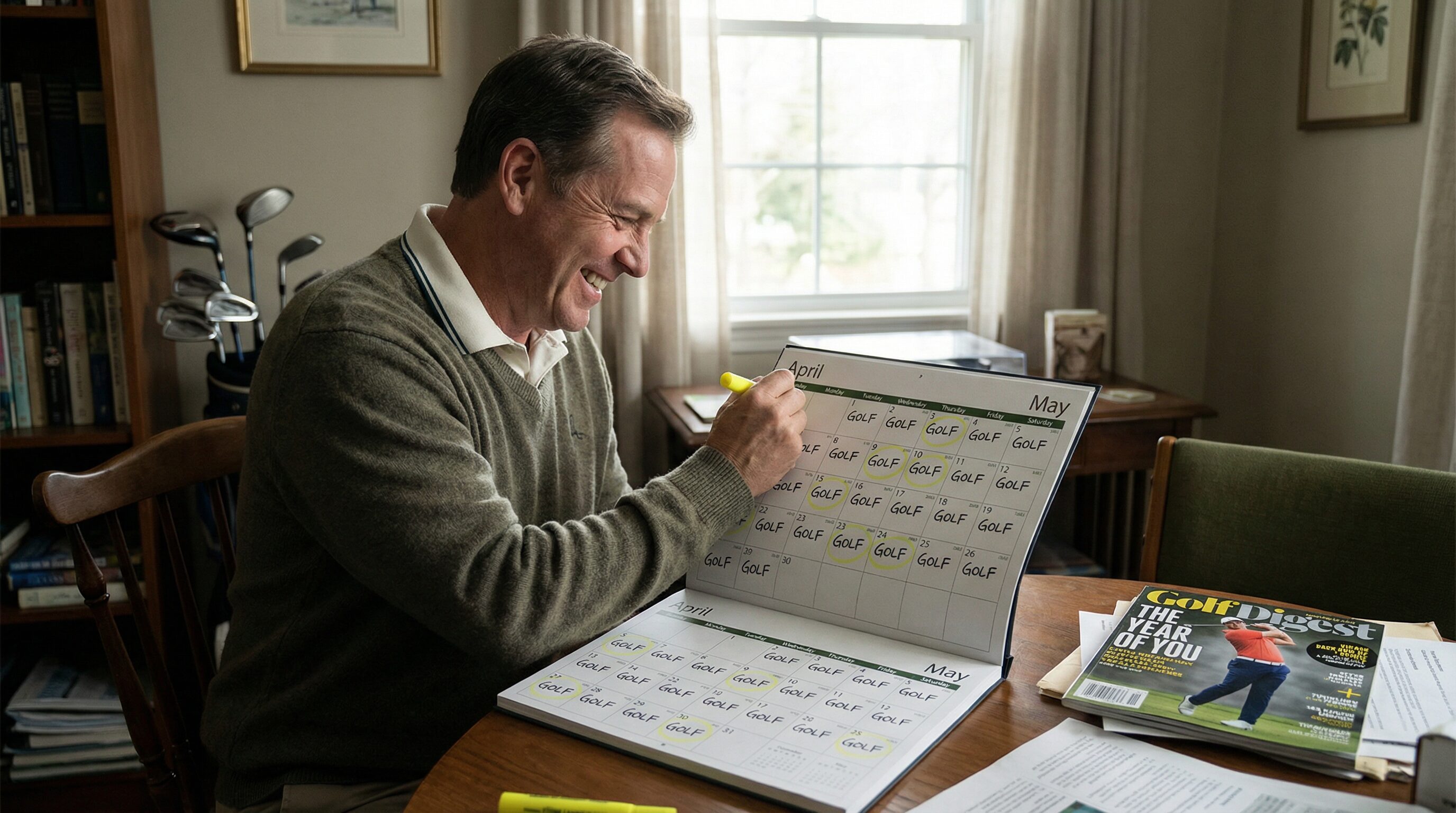
The Lie: “I’m Going to Play More This Year”
This is the lie we tell ourselves in January. “This is the year. I’m going to play twice a week. I’m going to practice. I’m going to get my handicap down to single digits.”
And then life happens. Work gets busy. The weather doesn’t cooperate. Your back starts hurting. By June, you’ve played six times, and you’re already revising your goals. “Okay, maybe not twice a week. But definitely once a week.” By September, you’re down to once a month, and you’re telling yourself, “Next year. Next year I’ll play more.”
We all do this. We all have grand plans for our golf game that reality refuses to accommodate. And yet, every January, we make the same promise. Because hope springs eternal, and golf is nothing if not a game of hope.
The Lie: “I Just Need to Figure Out One Thing”
This is the lie that keeps golf instructors in business. “I’m so close. I just need to figure out one thing, and it’s all going to click.” Maybe it’s your grip. Maybe it’s your takeaway. Maybe it’s your weight shift. Whatever it is, you’re convinced that once you figure it out, you’ll unlock your true potential.
The truth? There is no “one thing.” Golf is a thousand things, all working together in a complex, fragile system that falls apart the moment you think about it too hard. But we can’t accept that, because it’s too overwhelming. So we tell ourselves it’s just one thing. One fix away. One lesson away. One range session away.
And you know what? Sometimes it works. Not because there really was one thing, but because believing there was one thing gave us the confidence to play better. Golf is weird like that.
The Lie: “I’m Going to Lay Up”
You’re two hundred and twenty yards from the green. There’s water in front. Trees on the right. Bunkers on the left. Your playing partner says, “What are you hitting?” You say, “I’m going to lay up. Play it safe.”
And then you pull out your three-wood.
We all know how this ends. You go for it. You don’t make it. The ball finds the water, or the trees, or the bunkers. And as you’re walking up to take your drop, you’re already explaining to yourself why going for it was actually the smart play. “I hit it pretty good. Just came up a little short.” Or, “I had the distance. Just pulled it a bit.”
The “I’m going to lay up” lie is aspirational. It’s the golfer we want to be—smart, strategic, disciplined. But it’s not the golfer we are. We’re the golfer who goes for it, because going for it is fun, and golf is supposed to be fun. Even when it’s not.
The Lie: “I Don’t Care About My Handicap”
Sure you don’t. That’s why you update it after every round. That’s why you get excited when it goes down and defensive when it goes up. That’s why you’re constantly checking the GHIN app to see where you stand.
Look, it’s okay to care about your handicap. It’s a measure of progress. It’s a way to compete with your friends. It’s a number that represents all the hours you’ve spent working on your game. Caring about it doesn’t make you shallow or obsessed. It makes you human.
But we pretend we don’t care, because caring too much feels vulnerable. What if we try really hard and don’t improve? What if we’re stuck at this level forever? So we act casual. “Oh, my handicap? I don’t really pay attention to that.” Meanwhile, we’re checking it three times a day.

Why We Do It
So why do we lie to ourselves? Why do we engage in this elaborate theater of self-deception every time we step onto a golf course?
Because golf is hard. Really hard. And if we were completely honest with ourselves about how hard it is, and how little control we have, and how much luck is involved, we’d probably quit. So we lie. We tell ourselves we’re better than we are. We blame external factors. We give ourselves the benefit of the doubt. We create a version of our golf game that’s just slightly better than reality.
And here’s the thing: it works. Those little lies keep us motivated. They keep us hopeful. They keep us coming back. Because if we truly accepted that we’re a twenty handicap who’s going to stay a twenty handicap no matter how much we practice, what would be the point? But if we believe we’re one swing thought away from being a fifteen, or one lesson away from being a ten, then we have a reason to keep playing.
The lies aren’t about cheating. They’re about hope. They’re about maintaining the belief that improvement is possible, that the next round will be better, that we’re capable of more than we’ve shown. And in a game as humbling as golf, hope is everything.
Why It’s Okay
Here’s what I’ve learned after years of lying to myself on the golf course: it’s not just okay to do this. It’s necessary. Golf is a game that will break you if you let it. It will expose every flaw, every weakness, every limitation. It will make you question your intelligence, your coordination, and your life choices. If you approach it with complete, brutal honesty, you’ll be miserable.
So we lie. We soften the edges. We give ourselves grace. We remember the good shots and forget the bad ones. We tell stories that make us sound better than we are. And in doing so, we make golf bearable. We make it fun. We make it something we want to keep doing.
The best golfers I know aren’t the ones who are hardest on themselves. They’re the ones who can laugh at their mistakes, shrug off bad shots, and find joy in the process. They’re the ones who understand that golf is supposed to be fun, and sometimes fun requires a little creative interpretation of reality.
So if you need to call that a practice swing, go ahead. If you need to blame the wind, be my guest. If you need to believe you usually make that putt, I’m not going to argue with you. We’re all just trying to enjoy this ridiculous game, and if a few harmless lies help us do that, then who’s really getting hurt?
The Truth About the Lies
I’ll leave you with this: the lies we tell ourselves on the golf course aren’t really about golf. They’re about life. They’re about how we cope with failure, how we maintain hope, how we keep trying even when the odds are against us. Golf just happens to be the arena where these lies play out most obviously.
In life, we tell ourselves we’re going to start eating better, exercising more, being more patient with our kids. We tell ourselves we’re going to finish that project, learn that skill, make that change. And most of the time, we don’t. But we keep telling ourselves we will, because the alternative—accepting that we’re not going to change—is too depressing to consider.
Golf is the same. We tell ourselves we’re going to practice more, play smarter, stay calm. We tell ourselves we’re better than our last round, that we’re improving, that we’re capable of greatness. And sometimes we are. But most of the time, we’re just out there, doing our best, lying to ourselves just enough to keep it interesting.
And you know what? That’s beautiful. That’s human. That’s why I love this game.
So the next time you’re on the course, and you hit a terrible shot, and you hear yourself saying, “That was my practice swing,” or “The wind got it,” or “I usually make that,” just smile. Because you’re part of a long tradition of golfers who’ve been lying to themselves since the game was invented. You’re in good company. And you’re doing exactly what you need to do to keep loving this maddening, magnificent game.
Now if you’ll excuse me, I have a tee time. And I’m definitely going to break eighty this time. I can feel it.
Blog
What Your Handicap Really Says About Your Game
What does your golf handicap really say about your game? A thoughtful, non-judgmental exploration of handicap ranges, strengths, weaknesses, and how to use your handicap productively.


Your handicap is just a number. But somehow, it’s also so much more than that. It’s a badge of honor, a source of frustration, a conversation starter, and sometimes, a point of embarrassment. We compare our handicaps to our friends, to strangers on the first tee, to the golfers we see on social media. We obsess over lowering it, celebrate when it drops, and feel discouraged when it creeps back up. But here’s something worth considering: most of us don’t really understand what our handicap actually says about our game.
I’ve been playing golf for more than twenty years, and I’ve had just about every handicap you can imagine. I’ve been a thirty, a twenty, a fifteen, a ten, and everywhere in between. And through all those years and all those numbers, I’ve learned that a handicap is less about how “good” you are and more about where you are on your golf journey. It’s a snapshot, not a judgment. A tool, not a trophy. And once you understand what your handicap really represents, you can use it to improve your game instead of just worrying about what other people think of it.
Misconceptions About Handicap
Let’s start by clearing up some common misconceptions, because there’s a lot of confusion out there about what a handicap actually means.
Misconception #1: Your Handicap Defines Your Worth as a Golfer
This is the big one. Somewhere along the way, we started treating handicaps like grades in school. A five handicap is an A. A fifteen is a C. A twenty-five is failing. But that’s not how it works. Your handicap doesn’t measure your worth as a golfer—it measures your current scoring potential relative to par. That’s it. It doesn’t account for how much you love the game, how much fun you have playing, how good of a playing partner you are, or how much you’ve improved over the years. It’s just a number that helps level the playing field in competition.
Misconception #2: Lower Is Always Better
Yes, a lower handicap generally means you shoot lower scores. But “better” is subjective. I know scratch golfers who are miserable on the course because they put so much pressure on themselves. I also know twenty handicappers who have more fun playing golf than anyone I’ve ever met. If your goal is to compete at a high level, then yes, lowering your handicap matters. But if your goal is to enjoy the game, spend time with friends, and challenge yourself in a healthy way, then your handicap is just one small piece of the puzzle.
Misconception #3: Your Handicap Is Fixed
Your handicap is a moving target. It goes up and down based on your recent scores, and it’s designed to reflect your current ability, not your best ability or your worst ability. Some golfers get discouraged when their handicap goes up, but that’s just part of the game. Life gets busy. You don’t play as much. Your swing gets rusty. Your handicap adjusts. That’s what it’s supposed to do. It’s not a failure—it’s a reflection of where you are right now.
Misconception #4: Handicap Is About Consistency
Here’s a subtle one: many golfers think a handicap measures how consistently you play. But that’s not quite right. Your handicap is based on your best scores, not your average scores. The USGA handicap system takes your best eight scores out of your last twenty rounds, which means it’s designed to reflect your potential, not your typical performance. This is important because it means your handicap might be lower than what you usually shoot. And that’s okay. It’s supposed to be.

What Different Handicap Ranges Typically Indicate
Now that we’ve cleared up some misconceptions, let’s talk about what different handicap ranges actually tell us about a golfer’s game. Remember, these are generalizations. Every golfer is different, and there are always exceptions. But if you’re trying to understand what your handicap says about your strengths and weaknesses, this is a good place to start.
30+ Handicap: The Beginner or Casual Golfer
If you’re a thirty handicap or higher, you’re likely either new to the game or you play very casually. And that’s perfectly fine. At this stage, you’re still learning the basics—how to make solid contact, how to control direction, how to get the ball airborne consistently. You probably have a few clubs in your bag that you feel comfortable with, and a few that you avoid at all costs. Your scores are inconsistent, and you have a lot of big numbers on your scorecard.
What this means for your game: focus on fundamentals. Work on your grip, your setup, and your swing basics. Don’t worry about advanced techniques or course management strategies yet. Just try to make consistent contact and keep the ball in play. And most importantly, have fun. This is the stage where you’re falling in love with the game, so enjoy it.
20-29 Handicap: The Developing Golfer
In this range, you’ve moved past the beginner stage. You can make solid contact most of the time, and you have a general sense of where the ball is going. But you still struggle with consistency. You might hit a great drive followed by a terrible approach shot. You might make par on a tough hole and then triple-bogey an easy one. Your short game is probably your biggest weakness, and you lose a lot of strokes around the green.
What this means for your game: it’s time to focus on your short game. Chipping, pitching, and putting are where you’ll see the fastest improvement. Also, start thinking about course management. You don’t need to hit driver on every hole. Sometimes laying up or playing safe is the smarter play. The goal at this stage is to eliminate the big numbers and start shooting more consistent scores.
10-19 Handicap: The Solid Recreational Golfer
This is where a lot of golfers settle in, and it’s a great place to be. You’re a legitimate golfer. You can break ninety consistently, and on a good day, you might break eighty. You have a reliable swing, a decent short game, and a good understanding of course management. You’re not going to wow anyone with your distance or your shot-making, but you’re steady. You don’t make a lot of big mistakes, and you capitalize on your good shots.
What this means for your game: you’re at a crossroads. If you want to keep improving, you’ll need to identify your specific weaknesses and work on them deliberately. Maybe it’s driving accuracy. Maybe it’s approach shots from a hundred and fifty yards. Maybe it’s lag putting. Whatever it is, you need to be honest with yourself about where you’re losing strokes and commit to fixing it. If you’re happy where you are, that’s great too. This is a handicap range where you can enjoy competitive golf with friends and still have fun.
5-9 Handicap: The Advanced Amateur
If you’re a single-digit handicap, you’re in rare company. Only about twenty percent of golfers ever reach this level. You have a repeatable swing, a solid short game, and good course management skills. You can shoot in the seventies on a regular basis, and you rarely have blow-up holes. You’re the kind of golfer that other golfers look up to.
What this means for your game: at this level, improvement is about refinement, not overhaul. You’re working on small details—shaving a stroke here, tightening up your dispersion there. You’re also dealing with the mental side of the game more than ever. Pressure, expectations, and the desire to get even better can be both motivating and frustrating. The key is to stay patient and keep working on the fundamentals.
0-4 Handicap: The Elite Amateur
Scratch golfers and plus handicappers are in the top one percent of all golfers. You can shoot par or better on a regular basis, and you have the skills to compete at a high level. Your swing is efficient, your short game is sharp, and your mental game is strong. You rarely make mistakes, and when you do, you recover quickly.
What this means for your game: you’re playing a different game than most golfers. At this level, it’s all about consistency, mental toughness, and maximizing your strengths. You’re also probably thinking about whether you want to pursue competitive golf more seriously. If not, enjoy being one of the best players at your course. You’ve earned it.

Strengths vs. Weaknesses: What Your Handicap Doesn’t Tell You
Here’s the thing about handicaps: they tell you how well you score, but they don’t tell you why you score that way. Two golfers with the same handicap can have completely different games. One might be a long hitter with a shaky short game. The other might be short off the tee but deadly with a wedge. Your handicap is the result, but it doesn’t explain the process.
This is why it’s so important to understand your own strengths and weaknesses. If you’re a fifteen handicap who drives the ball great but can’t putt, your path to improvement is different than a fifteen handicap who struggles off the tee but has a great short game. You need to know where you’re gaining strokes and where you’re losing them.
The best way to do this is to track your stats. Not obsessively, but consistently. Keep track of your fairways hit, greens in regulation, putts per round, and up-and-downs. After ten or twenty rounds, patterns will emerge. You’ll see where you’re strong and where you need work. And that information is far more valuable than your handicap alone.
For example, let’s say you’re a twelve handicap. You look at your stats and realize you’re only hitting six greens in regulation per round, but you’re getting up and down fifty percent of the time. That tells you that your short game is actually a strength, and your ball-striking is the weakness. So instead of spending all your practice time chipping and putting, you should focus on your iron play. Your handicap didn’t tell you that—your stats did.
How to Use Your Handicap Productively
So now that we understand what a handicap is and what it isn’t, let’s talk about how to use it productively. Because a handicap can be a powerful tool for improvement if you approach it the right way.
1. Use It as a Benchmark, Not a Judgment
Your handicap is a starting point. It tells you where you are right now. Use it to set realistic goals. If you’re a twenty handicap, aiming to be a five handicap by next year probably isn’t realistic. But aiming to be an eighteen or a sixteen? That’s doable. Set incremental goals, celebrate when you hit them, and don’t beat yourself up if progress is slow.
2. Track Trends, Not Individual Rounds
One bad round doesn’t define your game, and one great round doesn’t mean you’ve figured it all out. Look at trends over time. Is your handicap gradually coming down? Great. Is it stuck in the same range for months? That’s a sign you need to change your approach. Are you seeing more volatility than usual? Maybe it’s time to focus on consistency.
3. Use It to Find the Right Competition
One of the best things about a handicap is that it allows golfers of different skill levels to compete fairly. If you’re a fifteen handicap, you can play a match against a five handicap and have a legitimate chance to win. Use your handicap to find competitive opportunities that are fun and challenging. Join a league. Play in a club championship. Set up matches with friends. Golf is more fun when there’s something on the line.
4. Don’t Let It Define You
This is the most important one. Your handicap is a tool, not an identity. You’re not “just a twenty handicap” or “only a fifteen.” You’re a golfer who’s working on your game, enjoying the challenge, and spending time doing something you love. Some days you’ll play great. Some days you’ll play terrible. Your handicap will go up and down. That’s golf. Don’t let a number determine how you feel about yourself or the game.

The Real Measure of a Golfer
I want to share something I’ve learned over the years: the best golfers I know aren’t necessarily the ones with the lowest handicaps. They’re the ones who love the game, respect their playing partners, handle adversity with grace, and keep coming back no matter how frustrating it gets. They’re the ones who celebrate their friends’ good shots, offer encouragement after bad ones, and never take themselves too seriously.
I’ve played with scratch golfers who were miserable to be around. I’ve also played with thirty handicappers who made every round a joy. The difference wasn’t their skill level—it was their attitude.
So yes, work on your game. Try to lower your handicap. Set goals and track your progress. But don’t forget why you started playing golf in the first place. It wasn’t to impress people with a number. It was because you love the challenge, the competition, the camaraderie, and the simple pleasure of being outside on a beautiful day, trying to hit a little white ball into a hole.
Your handicap is part of your golf story, but it’s not the whole story. It’s a chapter, not the book. And the best part? You’re still writing it.
Moving Forward: Rethinking How You Judge Your Game
If you take one thing away from this article, let it be this: your handicap is a tool for understanding and improving your game, not a measure of your worth as a golfer. Use it to set goals, track progress, and find competitive opportunities. But don’t let it define you, stress you out, or take the fun out of the game.
The next time you step onto the first tee, don’t worry about what your handicap says about you. Instead, focus on playing your game, enjoying the challenge, and appreciating the opportunity to be out on the course. Because at the end of the day, golf is about so much more than a number. It’s about the journey, the friendships, the moments of triumph and frustration, and the endless pursuit of improvement.
Your handicap will go up and down. Your game will have peaks and valleys. But if you approach it with the right mindset—using your handicap as a tool, not a judgment—you’ll not only play better golf, you’ll enjoy it more. And isn’t that the whole point?
So go ahead. Rethink how you judge your game. Focus on your strengths, work on your weaknesses, and remember that every golfer, from the thirty handicap to the scratch player, is on their own unique journey. Yours is just as valid as anyone else’s. Play your game, enjoy the process, and let the handicap take care of itself.
Blog
The 5 Most Overrated Golf Tips (And What to Do Instead)
Stop following bad golf advice! The Golf Hacker debunks 5 overrated tips (keep your head down, swing easy, aim left) and shares what actually works for mid-handicappers.

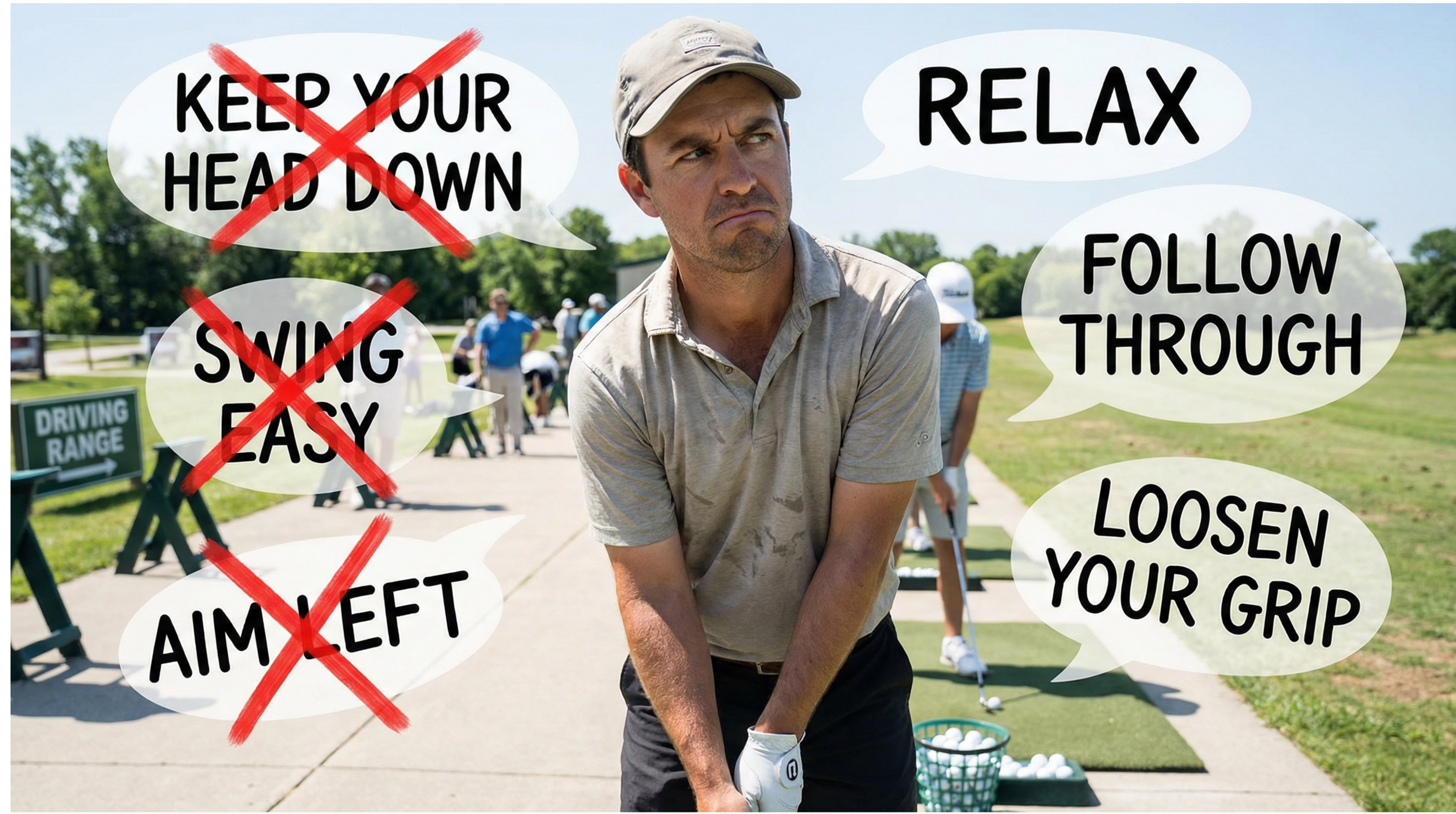
Let’s talk about bad golf advice. The golf world is drowning in it. Every magazine, every YouTube video, every well-meaning buddy at the range has a tip that’s supposed to transform your game. “Keep your head down.” “Swing easy.” “Grip it and rip it.” Most of it is garbage. Not because the people giving the advice are trying to mislead you, but because generic tips don’t work for specific problems. What helps a tour pro with a hundred-twenty-mile-per-hour swing speed might wreck a weekend warrior who barely breaks ninety. What fixes a hook won’t help a slice. And yet, we keep repeating the same tired advice like it’s gospel.
I’ve spent years trying every tip, drill, and swing thought imaginable. Some helped. Most didn’t. And a few actually made my game worse. So I’m here to save you some time and frustration by calling out the five most overrated golf tips I’ve encountered—and more importantly, telling you what to do instead. These aren’t just my opinions. These are lessons learned through trial, error, and way too many balls hit into the woods. Let’s get into it.
Why Generic Advice Fails Golfers
Before we dive into the specific tips, let’s talk about why so much golf advice falls flat. The problem is that golf instruction has become one-size-fits-all. Instructors, magazines, and influencers dish out tips without knowing anything about your swing, your tendencies, or your skill level. They’re throwing spaghetti at the wall and hoping something sticks.
But here’s the thing: golf swings are individual. Your body type, flexibility, strength, and coordination are different from mine. Your miss pattern is different. Your goals are different. So when someone tells you to “keep your left arm straight” or “turn your hips faster,” they’re making assumptions about your swing that might not be true. And if the advice doesn’t match your actual problem, it’s not just unhelpful—it can make things worse.
The best golf instruction is diagnostic. It identifies your specific issue and addresses it with a tailored solution. Generic tips skip the diagnosis and jump straight to the prescription. That’s why they fail. So as we go through these overrated tips, remember: the goal isn’t to bash people who give advice. The goal is to help you think more critically about what advice actually applies to you.
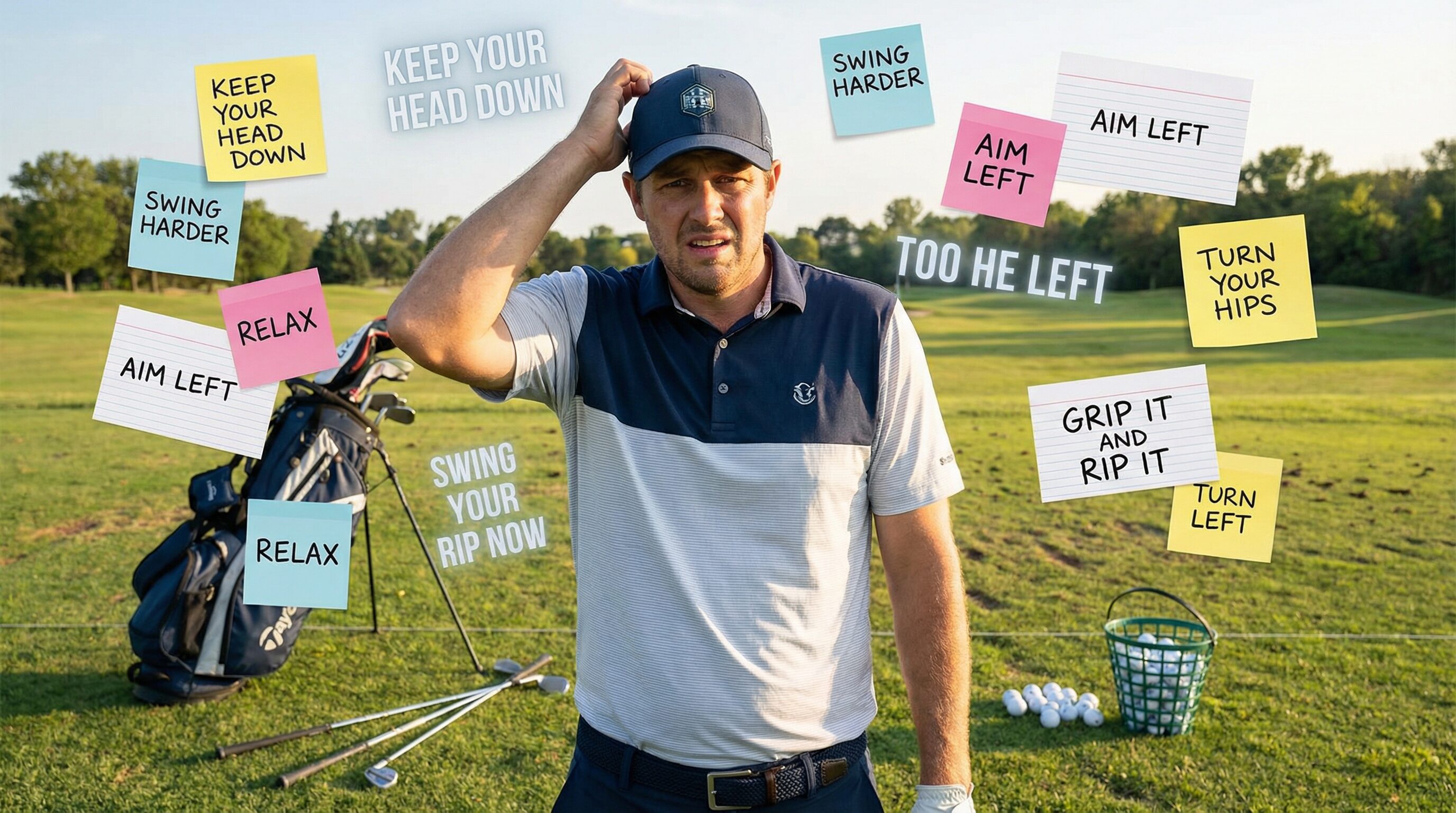
Overrated Golf Tip #1: “Keep Your Head Down” Ruins Your Swing (Do This Instead)
This is probably the most common piece of golf advice ever given, and it’s also one of the most damaging. How many times have you hit a bad shot and had someone say, “You looked up”? It’s become a reflex. Bad shot? Must have lifted your head. But here’s the truth: keeping your head rigidly down through impact doesn’t help most golfers. In fact, it often hurts.
When you focus on keeping your head down, you restrict your body’s natural rotation. Your shoulders can’t turn fully. Your hips get stuck. Your weight stays on your back foot. You end up with a cramped, restricted swing that produces weak, inconsistent contact. And ironically, trying to keep your head down often causes you to lift it anyway, because your body is fighting against an unnatural position.
Watch any tour pro in slow motion. Their head moves. Not wildly, but it moves. It rotates slightly during the backswing and follows the ball through impact. That’s natural. That’s efficient. The head isn’t an anchor—it’s part of a dynamic athletic motion.
What to Do Instead:
Focus on keeping your eyes on the ball, not your head down. There’s a difference. Your eyes can track the ball while your head rotates naturally with your body. This allows for a full, unrestricted turn and proper weight transfer. Practice making swings where you let your head rotate naturally. You’ll feel less restricted, generate more power, and make better contact. If you’re really worried about looking up too early, try this drill: after you hit the ball, keep your eyes on the spot where the ball was for a count of one before looking up. This trains you to stay down through impact without restricting your rotation.
Overrated Golf Tip #2: “Swing Easy” (Why This Advice Backfires)
“Swing easy” sounds like great advice. It’s calming. It’s zen. The problem is that it’s vague and often counterproductive. When most golfers try to “swing easy,” they decelerate through the ball. They get tentative. They lose rhythm and tempo. The result? Weak contact, inconsistent ball flight, and frustration.
The advice usually comes from a good place. Someone sees you swinging out of your shoes, losing your balance, and spraying balls all over the range. So they tell you to swing easy. But “easy” isn’t the same as “smooth” or “controlled.” Easy implies less effort, and less effort in golf usually means less speed, less compression, and worse results.
Tour pros don’t swing easy. They swing smooth. They swing with tempo. They swing with control. But they’re still generating tremendous speed through the ball. The difference is that their speed is efficient and well-timed, not wild and uncontrolled.
What to Do Instead:
Focus on tempo and balance, not effort level. A good tempo is the key to consistency. Try this: count “one” on your backswing and “two” on your downswing. The ratio should be about three-to-one—your backswing takes three times as long as your downswing. This creates a smooth, rhythmic motion that generates speed without feeling rushed or out of control.
As for balance, make it a rule: you should be able to hold your finish position for three seconds after every swing. If you can’t, you’re swinging too hard or too out of control. Work on finishing in balance, and your swing will naturally find the right amount of effort. You’ll generate plenty of speed, but it will be controlled speed—the kind that produces consistent, solid contact.

Overrated Golf Tip #3: “Grip It and Rip It” (The Truth About Power)
If you slice the ball, you’ve probably been told to aim left (for right-handed golfers) to compensate. This is terrible advice. It doesn’t fix your slice—it just accommodates it. And worse, it often makes your slice worse.
Here’s why: when you aim left, your brain knows the ball is going to curve right, so you subconsciously swing even more across the ball to get it started left. This creates an even steeper, more out-to-in swing path, which produces more sidespin and a bigger slice. You’re not fixing the problem; you’re reinforcing it. And now you’re also dealing with alignment issues that make it harder to hit straight shots even if you do fix your swing.
Aiming left to compensate for a slice is like putting a bucket under a leaky roof. Sure, it catches the water, but it doesn’t fix the leak. And eventually, the leak gets worse.
What to Do Instead:
Fix the root cause of your slice: an open clubface at impact relative to your swing path. The most common reason for an open clubface is a weak grip. Check your grip. When you look down at your hands, you should see two to three knuckles on your left hand (for right-handed golfers). If you only see one knuckle or none, your grip is too weak, and you’re going to struggle to square the clubface.
Strengthen your grip by rotating both hands slightly to the right on the club. This will help you close the clubface through impact and reduce your slice. Pair this with a focus on swinging more from the inside (imagine swinging out toward right field instead of pulling across your body), and you’ll start hitting straighter shots. It takes practice, but it’s a real fix, not a band-aid.
Overrated Tip #4: “Hit Down on the Ball”
“Hit down on the ball” is advice you’ll hear constantly, especially with irons. And to be fair, it’s not entirely wrong—you do want to make contact with the ball before the ground. But the way this tip is usually interpreted causes more problems than it solves.
When most golfers hear “hit down on the ball,” they think they need to chop at it. They get steep. They drive their hands down aggressively. They try to pound the ball into the turf. The result? Fat shots, thin shots, and a lot of frustration. They’re working harder, not smarter.
The reality is that good ball-first contact comes from proper swing mechanics, not from consciously trying to hit down. If your weight is shifting correctly and your swing path is on plane, you’ll naturally hit the ball first and then the ground. The divot happens as a byproduct of a good swing, not as the goal.
What to Do Instead:
Focus on weight transfer and low point control. Your low point—the lowest point of your swing arc—should be a few inches in front of the ball. This happens naturally when you shift your weight properly from your back foot to your front foot during the downswing.
Here’s a simple drill: place a tee in the ground a few inches in front of your ball. Your goal is to brush the ground where the tee is, not where the ball is. This trains you to move your low point forward, which creates the ball-first contact you’re looking for. You don’t have to think about hitting down. Just shift your weight, let your swing bottom out in front of the ball, and the contact will take care of itself.

Overrated Tip #5: “Keep Your Left Arm Straight”
The left arm straight tip (for right-handed golfers) is a classic. It’s been around forever, and it’s based on the idea that a straight left arm creates width and power in the swing. And again, there’s some truth to it. But the way it’s taught and practiced often creates more problems than it solves.
When golfers obsess over keeping their left arm perfectly straight, they create tension. Tension is the enemy of a good golf swing. A tense left arm restricts your shoulder turn, limits your backswing, and makes it harder to release the club through impact. You end up with a rigid, mechanical swing that lacks fluidity and speed.
Look at tour pros. Yes, their left arms are relatively straight at address and through most of the backswing. But they’re not locked. There’s a slight bend, and more importantly, there’s no tension. The arm is extended, not rigid. That’s a huge difference.
What to Do Instead:
Focus on extension, not rigidity. Your left arm should be comfortably extended, not locked straight. Think of it like reaching for something on a high shelf—your arm is extended, but there’s no tension. You’re not forcing it.
Here’s a good checkpoint: at the top of your backswing, your left arm should feel extended but relaxed. If you feel tension in your shoulder or elbow, you’re overdoing it. Let your arm bend slightly if that’s what feels natural. The goal is width and control, not a perfectly straight line. A relaxed, extended left arm will give you better rotation, more speed, and more consistent contact than a rigid, locked arm ever will.
How to Filter Golf Advice Going Forward
Now that we’ve debunked five overrated tips, let’s talk about how to evaluate golf advice in general. Because the truth is, there will always be more tips, more drills, and more “secrets” to better golf. How do you know what’s worth trying and what’s a waste of time?
1. Consider the Source
Who’s giving the advice? Is it a qualified instructor who’s seen your swing, or is it a random guy at the range who shoots a hundred and five? Context matters. The best advice is personalized. If someone is giving you a tip without knowing your swing, your tendencies, or your goals, take it with a grain of salt.
2. Ask: Does This Address My Specific Problem?
Generic advice rarely works. Before you try a new tip, ask yourself: does this address a problem I actually have? If you don’t slice the ball, advice about fixing a slice isn’t relevant. If you already have good tempo, being told to “slow down” won’t help. Focus on tips that target your specific weaknesses.
3. Test It, But Give It Time
Golf changes take time. If you try a new grip or a new swing thought, don’t expect immediate results. Give it a few range sessions. But also, don’t stick with something that clearly isn’t working. If a tip makes your ball flight worse after a fair trial, move on. Trust your results, not your hopes.
4. Prioritize Fundamentals Over Quick Fixes
The most valuable advice is usually the least sexy. Grip, stance, posture, alignment—these fundamentals matter more than any swing thought or magic drill. If your fundamentals are solid, everything else gets easier. If they’re not, no amount of tips will save you.
5. Record Your Swing
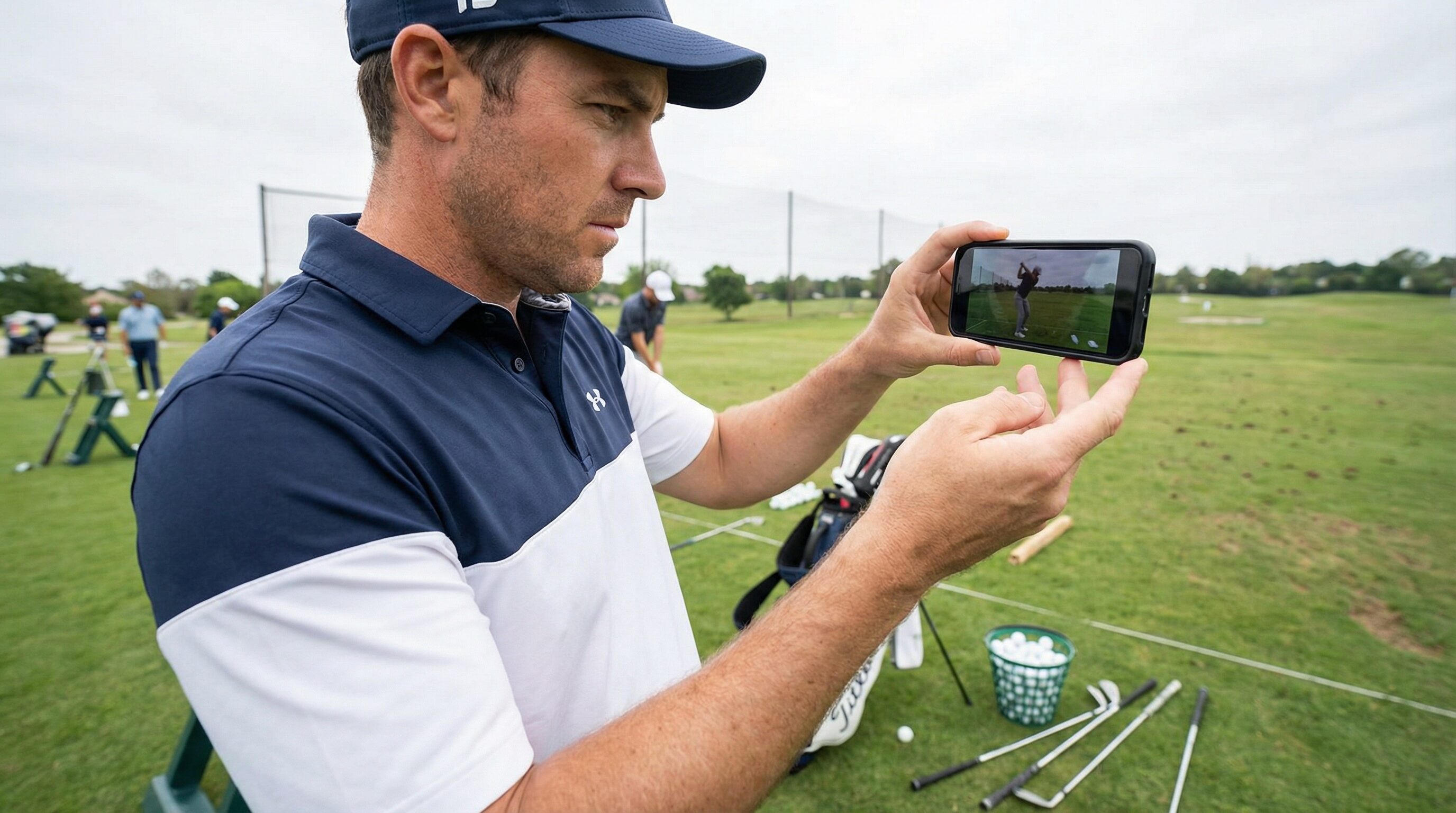
One of the best ways to filter advice is to see your swing for yourself. Record your swing on your phone. Watch it in slow motion. Compare it to what good swings look like. This gives you objective data. You’ll know if your head is actually moving too much, if your left arm is bending excessively, or if you’re really swinging out of control. Video doesn’t lie.
The Bottom Line: Think Critically, Swing Better
Golf instruction is full of well-meaning advice that doesn’t actually help most golfers. “Keep your head down,” “swing easy,” “aim left to fix your slice”—these tips sound good, but they’re either too vague, too generic, or just plain wrong for most players. The key to improving your game isn’t collecting more tips. It’s learning to think critically about the advice you receive and focusing on solutions that address your specific problems.
So the next time someone offers you a tip, ask yourself: does this make sense for my swing? Does it address a problem I actually have? Is it based on sound mechanics, or is it just conventional wisdom that’s been repeated so many times it sounds true? If the answer to any of those questions is no, feel free to ignore it. Your golf game will thank you.
And remember: the best tips are the ones that work for you. Not for tour pros. Not for your buddy who plays twice a year. For you. So stop wasting range time on overrated advice, start focusing on what actually matters, and go play better golf.

Best Golf Balls for 95–105 MPH Swing Speed (2026)

How to Build a Practice Routine for Real On-Course Scoring

Stop Doing This: The Most Overrated Swing Tips and Better Drills




-
 Product Review6 years ago
The Perfect Practice Putting Mat Review by Jason Tenzer
-
 Blog5 years ago
Loophole Rule Offers PGA Tour Pros a Mulligan
-
Blog5 years ago
2021 Buyer’s Guide: The Top 10 Value Golf Balls For Distance & Feel
-
Blog5 years ago
Golf Marriage Counselor
-
 Product Review7 years ago
THE ADJUSTABLE IRONS: WALKING STICKS GOLF CLUBS
-
 Blog7 years ago
9 Biggest Chokes Of The Past Decade
-
Blog5 years ago
What Your Golf Clubs Say About You
-

 Golf News3 months ago
The latest news in golf