Performance Lab
How to Break 90 in Golf: The 9-Week Game Plan That Actually Works
Finally break 90 with our Resident PGA Pro’s 9-week game plan. Drills, stats targets, and mental strategies for every part of your game.


Disclosure: This article contains affiliate links. If you buy through these links, Clickit Golf may earn a commission at no additional cost to you.
Nearly half of all golfers who pick up a club will never learn how to break 90 in golf. They spend years hovering around 95, buying new drivers and watching late-night YouTube tips, hoping for a magical breakthrough. The truth is, breaking 90 is not about hitting perfect shots. It is about eliminating catastrophic mistakes. If you can eliminate the blow-up holes, you are already halfway there.
To break 90 on a standard par-72 course, you do not need to play like a tour pro. You simply need to play bogey golf and mix in three pars. That equates to a score of 89. This 9-week game plan strips away the noise and focuses entirely on the measurable skills required to achieve that exact mathematical target.

Alt text: Golfer celebrating on a sunlit fairway after learning how to break 90 in golf
The Scorecard Math: What Breaking 90 Actually Requires
Before diving into the drills, you must understand the objective. Shooting an 89 on a par-72 layout means you have 17 strokes to give back to the course.
If you average a bogey on 15 holes and manage to scrape together just three pars, you shoot 89. You do not need a single birdie. You can even survive a double bogey if you offset it with an extra par. The entire strategy hinges on keeping the ball in play, avoiding penalty strokes, and getting the ball in the hole from 30 yards in without wasting shots.
Score Target Bogeys Pars Doubles Allowed 90 18 0 0 89 15 3 0 89 (with recovery) 13 3 1 85 13 5 0
The 9-Week Plan to Break 90 in Golf
Week 1: Tee Shot Accuracy
Goal: Keep the ball in play off the tee.
Measurable Target: Hit 70% of fairways (or safe rough).
Time Required: Two 45-minute practice sessions.
The quickest way to ruin a scorecard is by hitting tee shots out of bounds or into unplayable lies. This week, your only focus is finding a reliable club off the tee. If your driver is wildly inconsistent, leave it in the bag and hit a 3-wood or a hybrid.
The Drill: Go to the range and create a fairway using two alignment sticks or targets in the distance. Hit 10 consecutive tee shots with your driver. If you cannot keep 7 out of 10 between the targets, drop down to your 3-wood and repeat the process. Find the longest club in your bag that you can confidently keep in play 70% of the time. Write that club down. That is your Week 1 tee club.
Week 2: Iron Distance Gapping
Goal: Know exactly how far you hit every iron.
Measurable Target: Document your true carry distances for every club.
Time Required: One 60-minute practice session.
Most mid-handicap golfers vastly overestimate how far they hit their irons. They remember the one time they flushed a 7-iron 165 yards and assume that is their standard distance, ignoring the fact that their average strike only carries 150 yards. Playing the wrong club is one of the most common causes of double bogeys.
The Drill: Use a launch monitor to record the carry distance of five solid strikes with every iron in your bag. Throw out the longest and shortest shots, and average the remaining three. Write these numbers down and tape them to your bag. For automatic tracking on the course, the Arccos Smart Sensors (Gen 4) are the most efficient way to build a real-world distance database — they log every shot automatically, so after five rounds you will have statistically reliable carry numbers for every club. For dedicated range sessions, the Voice Caddie SC300i Launch Monitor provides instant ball speed, carry distance, and launch angle data.
Week 3: Chipping From 30 Yards and In
Goal: Get the ball on the green safely.
Measurable Target: Leave every chip shot inside 15 feet.
Time Required: Three 30-minute practice sessions.
When you miss a green in regulation, your primary objective is to get the ball onto the putting surface safely. Do not try to hit a high-spinning flop shot. Play a low-running chip that gets the ball rolling like a putt as quickly as possible. This is the shot that separates golfers who break 90 from those who do not.
The Drill: Take your 8-iron, pitching wedge, and sand wedge to the practice green. Place a towel 15 feet from the hole. Practice chipping with each club, focusing on landing the ball on a specific spot and letting it roll out. Setting up a Callaway Chip-Shot Golf Chipping Net in your backyard allows you to groove this motion daily without needing to visit the course.
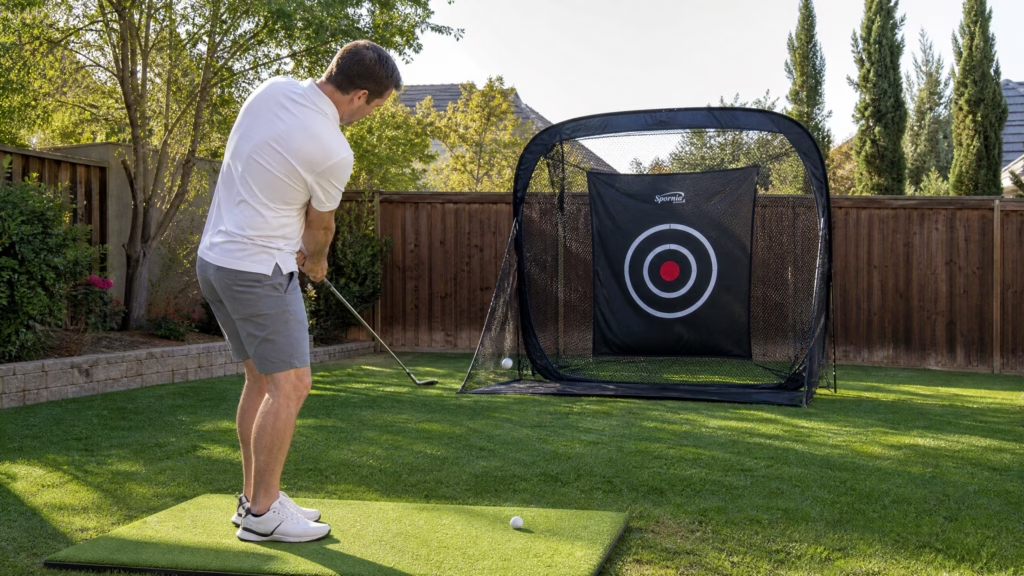
Golfer practicing chip shots in backyard with a practice net — how to break 90 in golf
Week 4: Putting — Eliminate All 3-Putts
Goal: Two-putt consistently from inside 20 feet.
















Measurable Target: Zero 3-putts from 20 feet during practice.
Time Required: Three 30-minute practice sessions.
Three-putts are the silent killers of a scorecard. If you can eliminate them, your scores will plummet. The key to avoiding 3-putts is exceptional distance control on your first putt, ensuring your second putt is nothing more than a tap-in.
The Drill: Place tees at 10, 15, and 20 feet from a hole on the practice green. Hit three putts from each distance, focusing entirely on speed. Your goal is to leave every ball within a three-foot circle around the hole. Do not leave the green until you have successfully lagged nine consecutive putts into the safe zone. This drill is uncomfortable at first, but it builds the speed control that eliminates 3-putts under pressure.
Week 5: Sand Saves — Get Out in One
Goal: Escape greenside bunkers on the first attempt.
Measurable Target: Successfully exit the sand 8 out of 10 times.
Time Required: Two 45-minute practice sessions.
Bunkers terrify high-handicap golfers, often resulting in multiple wasted strokes. You do not need to hit it close from the sand. You just need to get it out. One stroke in the bunker followed by a two-putt bogey is a perfectly acceptable outcome.
The Drill: Draw a line in the sand two inches behind the golf ball. Focus on hitting the line, not the ball. Open the face of your sand wedge slightly, take a wide stance, and splash the sand onto the green. The sand lifts the ball out. Practice this motion until you can consistently exit the bunker in one attempt before worrying about proximity to the hole.
Week 6: Course Management — Play Away From Trouble
Goal: Make strategic decisions that eliminate penalty strokes.
Measurable Target: Hit 5 greens in regulation during your next round.
Time Required: Mental preparation before each round.
Stop aiming at pins tucked behind bunkers or near water hazards. Your target should always be the center of the green, regardless of where the flag is located. This conservative approach dramatically reduces the likelihood of double bogeys and worse.
The Strategy: Before every approach shot, identify where the worst trouble is located and aim away from it. If the pin is on the right side of the green near a pond, aim for the left edge. A two-putt bogey is perfectly acceptable. A ball in the water is a scorecard disaster. To further optimize your equipment decisions on the course, review our guide on the best golf ball by swing speed — playing the right ball for your swing speed is a simple upgrade that costs nothing extra.
Week 7: The Mental Game — The 10-Second Reset
Goal: Recover quickly from bad shots.
Measurable Target: Implement a 10-second reset routine after every poor shot.
Time Required: Ongoing implementation during every round.
You will hit bad shots. Every golfer does, including tour professionals. How you respond to them dictates whether you shoot an 89 or a 99. Anger and frustration lead to tension, which leads to more bad shots. The mental game is not optional when you are learning how to break 90 in golf.
The Drill: Develop a 10-second reset routine. After a poor shot, allow yourself 10 seconds to be frustrated. Once that time is up, take a deep breath, undo the velcro on your glove, and mentally move on to the next shot. The previous stroke is history. Your only concern is executing the next one properly. Practice this routine on the range so it becomes automatic on the course.
Week 8: On-Course Practice Round With Scorecard Tracker
Goal: Apply all skills in a low-pressure environment.
Measurable Target: Track fairways hit, greens in regulation, and total putts.
Time Required: One 18-hole round.
Head to the course for a practice round. Do not keep a cumulative score. Instead, use your scorecard to track your specific targets: fairways hit, greens in regulation, and total putts. This data-gathering approach removes the emotional weight of the score and helps you identify exactly which areas of your game are holding up and which need more work before the final test.
The Focus: If you find your driver is still causing issues, rely on the club you identified in Week 1. If your putting is leaking strokes, spend an extra session on the Week 4 lag putting drill before proceeding to Week 9.
Week 9: Full Simulation Round — Pressure Situations
Goal: Break 90 under real playing conditions.
Measurable Target: Shoot 89 or better.
Time Required: One 18-hole round.
This is the culmination of your work. Play a standard 18-hole round, adhering strictly to the strategies you have developed. Play conservative golf, aim for the center of the greens, and rely on your short game to save strokes when you miss.
The Mindset: Remember the math — bogey golf plus three pars. Do not panic if you start with a double bogey. There is plenty of time to recover. Stick to the plan, trust your practice, and watch your scores drop. If you are playing the right golf ball for your swing speed, check our recommendations for best golf balls for 95-105 mph swing speed to ensure your equipment is not working against you.
How to Break 90 in Golf: What the Stats Say
Featured Snippet Target: To break 90 in golf, you need to average a bogey on 15 holes and make three pars on a par-72 course. The most important skills are tee shot accuracy (keeping the ball in play), eliminating 3-putts, and avoiding penalty strokes. You do not need a single birdie to shoot 89.
The National Golf Foundation reports that the average male amateur golfer shoots around 97. The gap between a 97 and an 89 is not talent — it is strategy and targeted practice. Research consistently shows that the short game (chipping and putting) accounts for roughly 60% of all strokes taken by golfers who score between 90 and 100. Improving your iron distance gapping and tee shot accuracy accounts for the remaining margin.
WSG Sidebar
Ready to compete? The World Series of Golf Satellite Series runs September 1-2 at Topgolf. Enter at wsg.golf.
Frequently Asked Questions
How long does it realistically take to break 90 in golf?
While this game plan is structured over 9 weeks, the actual timeline depends on your starting point and practice consistency. Dedicated golfers who focus on the right metrics — tee shot accuracy, distance gapping, and putting — can achieve this milestone within a single season. Sporadic practice without measurable targets rarely produces lasting improvement.
Do I need to hit the ball further to break 90?
No. Distance is helpful, but accuracy and course management are far more critical. Keeping the ball in play and avoiding penalty strokes will lower your scores faster than adding 10 yards to your drives. If you swing between 95-105 mph, ensure you are playing the right equipment by checking our recommendations for best golf balls for 95-105 mph swing speed.
What is the single most important skill for breaking 90?
Eliminating three-putts and avoiding penalty strokes off the tee are the two most vital skills. Mastering distance control on the greens and finding a reliable tee shot will drastically reduce your scores more than any other improvement.
Should I use a driver if I struggle with a slice?
If your driver consistently puts you in penalty areas or unplayable lies, leave it in the bag. Use a 3-wood or hybrid off the tee until you can correct the slice on the practice range. A fairway wood in the fairway is always better than a driver in the trees.
How many pars do I need to break 90?
On a standard par-72 course, playing bogey golf on every hole results in a 90. To shoot 89, you only need to make three pars while maintaining bogeys on the remaining 15 holes. You can even afford one double bogey if you replace it with an extra par.
Can I break 90 without fixing my swing?
Yes. Course management, short game improvement, and mental discipline can lower your score by 5-10 strokes without changing your swing mechanics at all. Fixing your swing is a long-term project; these strategies produce results within weeks.
What handicap is a golfer who shoots 90?
A golfer who consistently shoots 90 on a par-72 course typically carries a handicap index of approximately 17-18, depending on the course rating and slope. Breaking 90 consistently usually corresponds to a handicap between 15 and 17.
Is the Arccos Smart Sensor system worth it for a golfer trying to break 90?
Absolutely. The Arccos system automatically tracks every shot, giving you real carry distances, miss patterns, and strokes gained data after just a few rounds. For a golfer trying to break 90, understanding your true club distances and identifying your worst holes is invaluable information that accelerates improvement.
Want more golf tips every Friday? Join over 400,000 golfers — subscribe to The 19th Hole Newsletter → clickitgolf.com/newsletter
Follow Clickit Golf: